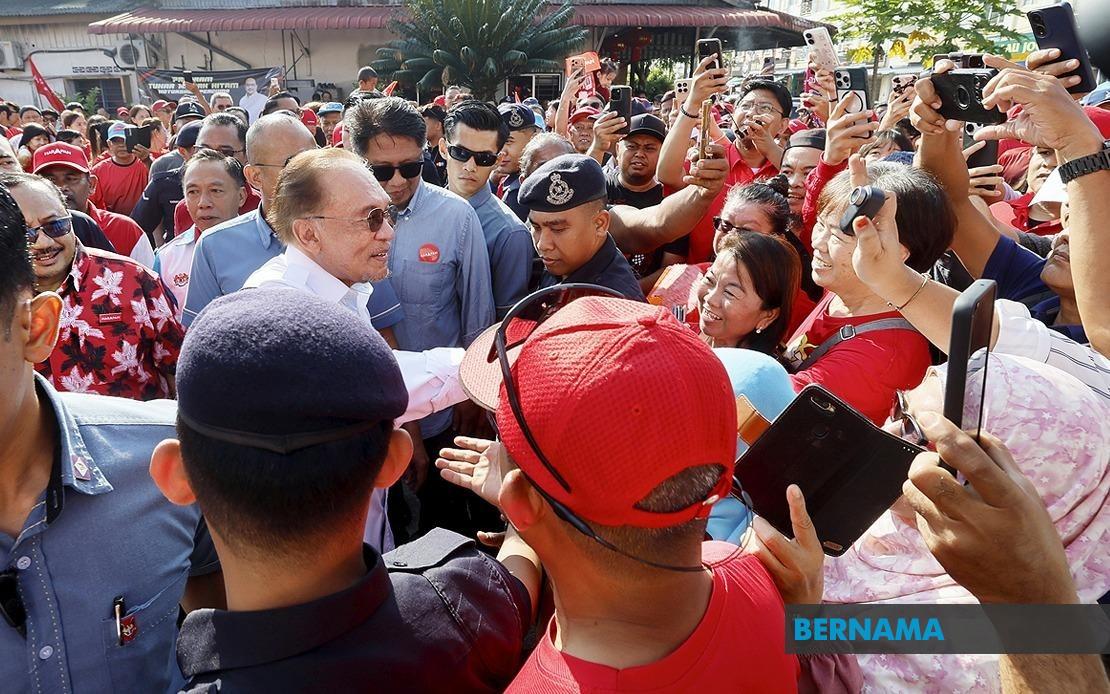
Prime Minister Datuk Seri Anwar Ibrahim has defended his administration's approach to state funding and development, insisting that the Federal Government makes investment decisions based solely on need and merit rather than the political complexion of state governments. Speaking at a campaign event in Batu Pahat during the lead-up to the 16th Johor state election, Anwar stressed that his government's track record demonstrates a commitment to supporting communities and advancing infrastructure across the country without regard to whether states are governed by his coalition partners or political opponents.
The Prime Minister's remarks were intended to counter perceptions that the federal centre might favour states controlled by Pakatan Harapan (PH), the ruling coalition he chairs, over those governed by other political formations. Anwar pointed to concrete examples of federal investment spanning multiple states with different political alignments, suggesting that electoral considerations play no role in determining where development funding flows. His statement carries particular weight as the country prepares for state-level elections and as questions about resource distribution between federal and state governments remain a recurring point of political friction.
Among the flagship projects Anwar highlighted was the Johor-Singapore Special Economic Zone (JS-SEZ), a major transnational economic initiative aimed at boosting regional competitiveness and attracting foreign investment. The project represents the type of large-scale, strategically important development that symbolises federal commitment to economic advancement in specific states. Beyond this, the Prime Minister referenced substantial federal allocations approved for flood mitigation infrastructure in the Johor districts of Segamat and Muar, addressing a pressing public welfare issue that has periodically affected these communities.
The inclusion of Kelantan and Kedah in Anwar's enumeration of states receiving federal support is particularly significant given their political complexion. Both states have historically been governed by opposition parties or coalitions, yet Anwar's assertion that they have received federal development assistance suggests a deliberate effort to demonstrate evenhandedness across the political spectrum. This framing is designed to appeal to voters in all states by signalling that federal resources follow need rather than partisan loyalty, a distinction that matters greatly in Malaysian electoral politics where regional interests frequently intersect with national political calculations.
Anwar's emphasis on not limiting assistance to pre-election campaign periods addresses a common criticism levelled at Malaysian politics: that promises of development and financial support often concentrate during election campaigns, only to dissipate afterwards. By contrasting this approach with his administration's record of sustained, year-round project implementation, he attempted to position his government as fundamentally different from previous administrations. The distinction matters because Malaysian voters have grown cynical about empty electoral promises, making tangible evidence of follow-through a valuable political asset.
The Johor campaign event itself served as a platform for this message, bringing together various federal and state-level PH figures to reinforce the coalition's narrative ahead of the state election. Present alongside Anwar were Communications Minister and PH communications director Datuk Fahmi Fadzil, as well as coalition candidates for three state constituencies: Onn Abu Bakar (Senggarang), Mohd Khuzzan Abu Bakar (Semerah), and Felicia Poh Rui Ling (Penggaram). The structured presence of multiple party figures underscored an attempt to present a unified federal and coalition front.
The timing of such statements is crucial in Malaysian politics. As state elections approach, voters become acutely focused on what each level of government can deliver to their constituencies. A Prime Minister's assertion that development is allocated fairly carries weight that extends beyond mere rhetoric, as voters can assess whether federal infrastructure and funding actually materialise in their communities. In Johor's case, the JS-SEZ represents a bilateral initiative with Singapore that promises substantial economic benefits, while flood mitigation spending addresses immediate quality-of-life concerns for residents in flood-prone areas.
For regional Southeast Asian observers, Anwar's positioning on equitable federal resource distribution also reflects broader tensions in federalist systems across the region. Malaysia's structure divides power between federal and state authorities, creating inherent competition for resources and influence. The degree to which the federal centre allocates funds based on objective criteria versus political affiliation affects not only electoral outcomes but also the overall efficiency and equity of public resource management. Anwar's emphasis on meritocratic distribution, whether entirely accurate or aspirational, sets a standard against which his administration's actual conduct can be measured.
The specific projects cited—the JS-SEZ and flood mitigation funding—represent different categories of federal investment that serve different political purposes. The economic zone appeals to voters concerned with long-term prosperity and job creation, suggesting forward-thinking federal leadership. The flood mitigation spending addresses immediate, tangible public needs, demonstrating responsiveness to community welfare. Together, they construct a narrative of comprehensive federal engagement spanning both future economic development and present-day problem-solving.
Critically, Anwar's statement also implicitly challenges opposition parties to match federal commitment to development in states they govern. By asserting that the Federal Government distributes resources equitably regardless of state-level political affiliation, he frames any development shortfalls in opposition-governed states as potentially attributable to state-level governance rather than federal neglect. This rhetorical positioning shifts responsibility while simultaneously claiming the moral high ground of federal fairness and impartiality.
The broader context for these remarks includes ongoing debates within Malaysian politics about federalism, resource allocation, and the relationship between electoral politics and public investment. Anwar's framing—that development follows need rather than political colour—represents a normative claim about how government should function, even if the reality remains more complicated. For Malaysian voters evaluating the federal government's performance ahead of state elections, such statements serve as benchmarks against which they can assess whether actual federal spending patterns align with stated principles of even-handed resource distribution.

