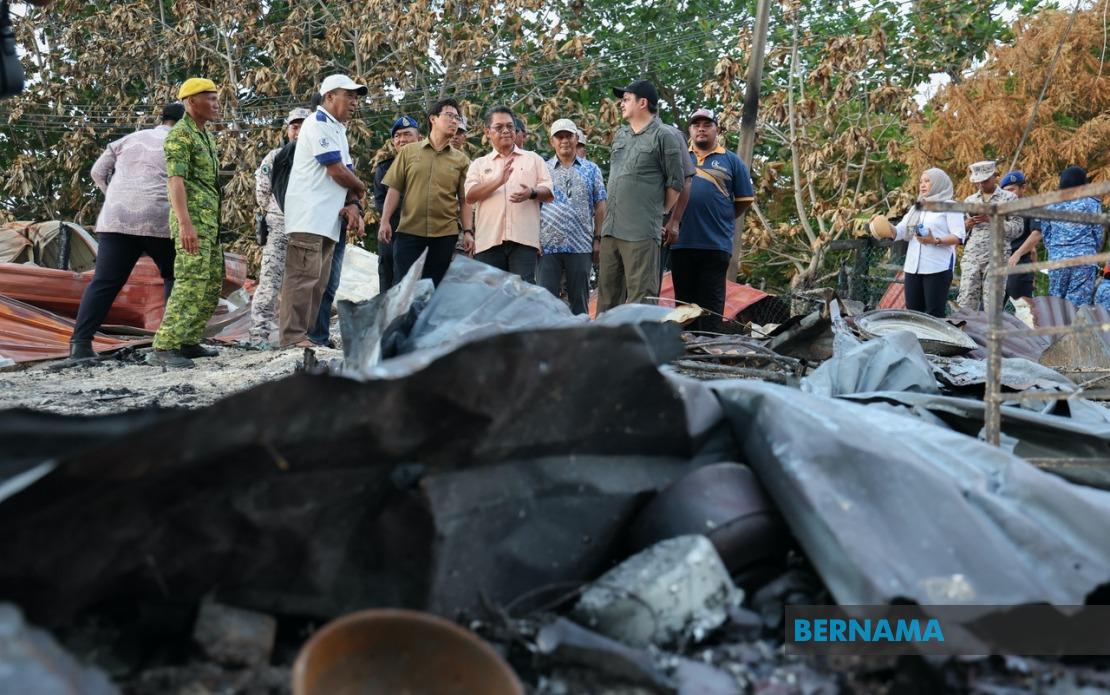
The Federal Government has swiftly responded to a major fire disaster in Sandakan by channelling immediate assistance through the Prime Minister's Department to 29 household heads affected by the blaze at Pulau Nunuyan Laut. The coordinated response demonstrates the government's commitment to supporting vulnerable communities in East Malaysia during emergencies, with officials visiting the affected area to assess needs and map out recovery strategies.
The Implementation Coordination Unit, operating under the Prime Minister's Department, has already begun distributing relief, including mobility aids for elderly residents requiring immediate care. This initial intervention reflects a broader strategy to alleviate hardship while longer-term solutions are being developed. Datuk Mustapha Sakmud, who oversees the department's operations in Sabah and Sarawak, underscored the government's determination to restore normalcy swiftly, noting that authorities have instructed local agencies to conduct comprehensive needs assessments across the disaster zone.
A critical concern for officials has been protecting children's access to education following the tragedy. Infrastructure damage, particularly to the jetty that serves as the primary route for schoolchildren commuting to and from their educational institutions, poses a significant risk to continuity of learning. The government has prioritised repairs to this essential facility, requesting the Sandakan Municipal Council to expedite reconstruction work through the Implementation Coordination Unit. This focus on maintaining educational services reflects understanding of how disasters can compound disadvantages for vulnerable youth populations.
The fire, which erupted around 3 am at Kampung Nunuyan Laut, devastated the settlement with remarkable speed and intensity. The blaze consumed 28 residential structures, rendering more than 100 people homeless in a single night and creating an immediate humanitarian challenge requiring multi-agency coordination. The scale of destruction placed significant strain on local resources and highlighted the vulnerability of waterfront communities in Sabah, many of which lack modern fire prevention infrastructure and emergency response systems.
Relocation planning has emerged as a central element of the recovery strategy, though complications exist given the land tenure situation on the island. The Rural Development Department will lead efforts to identify suitable resettlement areas, with discussions already underway regarding village reserve land and arrangements with two private landowners whose properties have been occupied by displaced residents. This dual approach—respecting existing land rights while facilitating community reconstruction—reflects the complexity of disaster recovery in areas with mixed land ownership patterns.
The proposed resettlement package extends beyond merely providing shelter, encompassing infrastructure development that addresses long-standing service deficits. Plans include installing electrical systems, establishing reliable water supply networks, and reconstructing the jetty to restore transport connectivity. These improvements, if implemented comprehensively, could enhance living standards beyond pre-fire conditions and reduce isolation that has historically characterised island communities in the Sandakan region.
Sandakan's experience with this disaster carries implications for other waterfront settlements across Southeast Asia where similar vulnerabilities exist. Many Malaysian coastal and island communities face analogous risks, including inadequate building codes, limited emergency response capacity, and dependence on informal land arrangements. The coordinated response from federal and municipal authorities in this instance may establish a template for addressing such emergencies elsewhere in the country.
The involvement of multiple agencies—from the Prime Minister's Department to municipal councils and rural development bodies—underscores recognition that fire disasters demand holistic responses addressing immediate survival needs, medium-term reconstruction, and long-term community resilience. Successful recovery will depend on sustained commitment beyond the initial emergency phase, particularly in supporting traumatised residents and ensuring that relocated communities maintain social cohesion and economic viability.
For Sabah's East Coast region, the Pulau Nunuyan fire incident has reinforced awareness of disaster preparedness gaps in smaller settlements that often lack resources for fire prevention or rapid evacuation. State and federal authorities will likely face pressure to enhance building safety standards, establish early warning systems, and ensure adequate emergency response capacity in vulnerable communities. The willingness demonstrated by the Prime Minister's Department to mobilise resources may encourage similar proactive engagement in other at-risk areas.
The broader context of this disaster response relates to Malaysia's ongoing development of mechanisms for supporting vulnerable populations during crises. The Implementation Coordination Unit's deployment suggests maturing institutional capacity for crisis management, though implementation effectiveness will ultimately determine whether displaced families successfully rebuild their lives. Success will require not only financial assistance and infrastructure investment but also psychological support and economic opportunities enabling former residents to achieve self-sufficiency.

