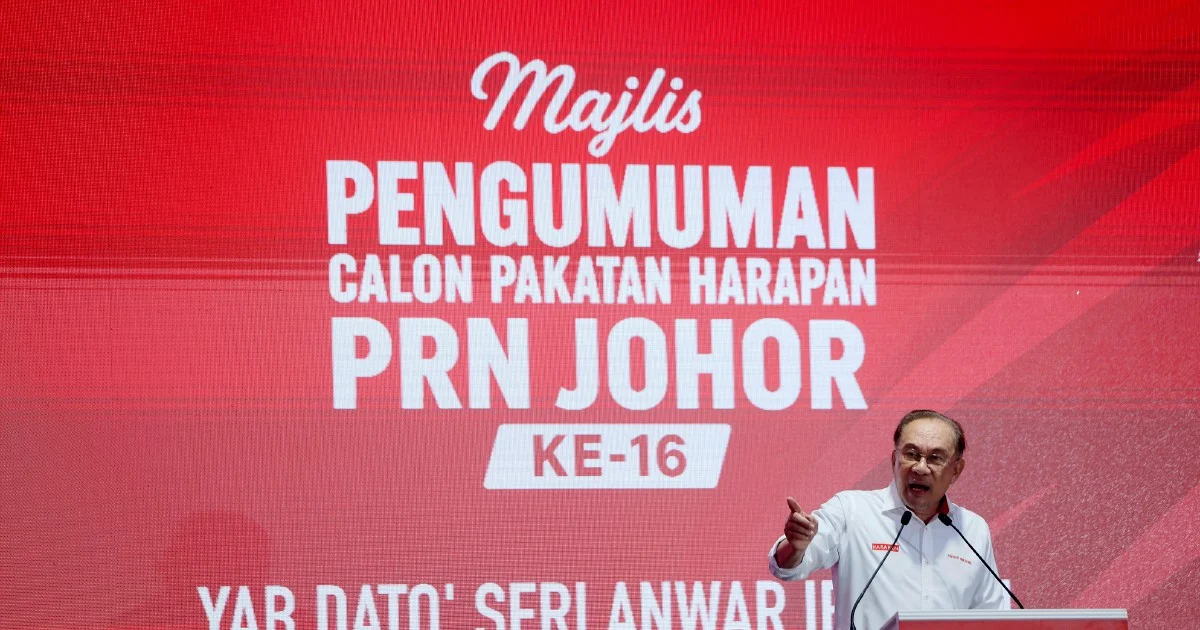
Prime Minister Datuk Seri Anwar Ibrahim unveiled figures in Tangkak that underline the federal government's commitment to directing greater resources toward Johor than the state itself contributes through taxation and other revenue channels. Speaking during an official visit, the Prime Minister disclosed that over a three-year period, Kuala Lumpur has channelled RM16 billion to the southern state, whereas Johor's contribution to federal coffers totalled RM14 billion. The RM2 billion differential illustrates how federal fiscal policy continues to favour regional development outside the capital area, a pattern that reflects the government's broader mandate to distribute wealth across Malaysia's diverse economy.
This disclosure carries particular significance for Johor, which has long occupied a crucial position in Malaysia's economic and political landscape. As the southernmost state on Peninsular Malaysia and home to the strategically vital Port Klang region—as well as serving as a gateway to Singapore—Johor's prosperity directly affects broader regional stability and growth. The allocation figures suggest that despite the state's substantial economic output, the federal machinery recognises the necessity of continued investment in infrastructure, social services, and developmental projects that transcend what state revenues alone can sustain.
Anwar's announcement arrives against a backdrop of intensifying focus on how federal funds are distributed across Malaysia's thirteen states. The difference between contribution and allocation has become a touchstone issue in Malaysian political discourse, particularly as states governed by different political coalitions seek evidence of equitable treatment. By publicly highlighting that Johor receives more than it remits to the centre, the Prime Minister addresses longstanding perceptions that federal resources flow unevenly or that certain states endure fiscal disadvantage.
The three-year timeframe referenced by Anwar—though the exact years were not specified in the Prime Minister's comments—likely encompasses the period following the 2022 general election and subsequent formation of the unity government. This window has seen considerable debate about how the federal budget ought to be structured, with various state administrations arguing their cases for increased allocations. Johor, under the Barisan Nasional government, has maintained cooperative ties with the federal administration, and the financial figures presented by Anwar may reflect both the state's economic needs and the political calculus of ensuring that a major state remains satisfied with the distribution of resources.
From a developmental perspective, the RM16 billion figure distributed to Johor likely encompasses funding for major infrastructure projects, including road networks, port facilities, education institutions, and healthcare infrastructure. The state's role as an industrial powerhouse and its proximity to Singapore mean that federal investment in Johor carries implications beyond the state's boundaries, affecting supply chains and regional competitiveness across Southeast Asia. Projects funded through federal allocation often target cross-border connectivity and economic corridors that benefit the broader region.
The revelation also touches on broader fiscal federalism questions that remain pertinent for Malaysia's economic management. How the federal government allocates resources among states reflects political priorities, economic logic, and constitutional obligations. The federal structure allows Kuala Lumpur to redistribute wealth from wealthy jurisdictions to those with greater needs, though this mechanism frequently generates political tension. By transparently sharing these figures, Anwar appears keen to counter narratives that certain states receive unfair treatment—a rhetorical strategy aimed at building consensus around federal spending decisions.
For Malaysian business communities operating in or investing in Johor, the federal government's demonstrated willingness to channel RM2 billion more to the state than it receives in return signals confidence in the region's development potential. This resource commitment can translate into improved public services, better infrastructure, and an enabling environment for private enterprise. Companies planning expansion or relocation strategies may view such fiscal commitments as indicators of government confidence in state-level growth prospects.
The announcement also arrives as Malaysia navigates broader economic uncertainties, including inflationary pressures and fluctuating global demand for manufactured goods—sectors in which Johor maintains substantial exposure. Federal transfers of this magnitude can provide counter-cyclical support during economic downturns, helping state governments maintain spending on welfare and development even when their own revenues contract. This cushioning effect has proven valuable for states during periods of economic stress.
The figures presented by Anwar invite scrutiny into how Johor deploys federal resources. State-level governance and project execution determine whether federal allocations translate into tangible improvements in residents' living standards and business conditions. Effective utilisation of these funds depends on transparent procurement, competent project management, and alignment between state and federal developmental priorities. The Prime Minister's emphasis on the numbers suggests confidence that Johor's administration deploys resources productively, though this remains subject to ongoing evaluation and public accountability.
Looking forward, the announcement contextualises ongoing discussions about Malaysia's fiscal architecture and regional equity. As the nation pursues its economic transformation agenda—encompassing digitalisation, sustainability, and high-value manufacturing—how federal resources flow to states will shape which regions capture investment opportunities and develop the capabilities to support emerging industries. Johor's continued significance in Malaysia's economic future appears underscored by the magnitude of federal commitment that Anwar's figures represent, positioning the state as a priority destination for resources essential to driving national competitiveness and inclusive growth across the federation.