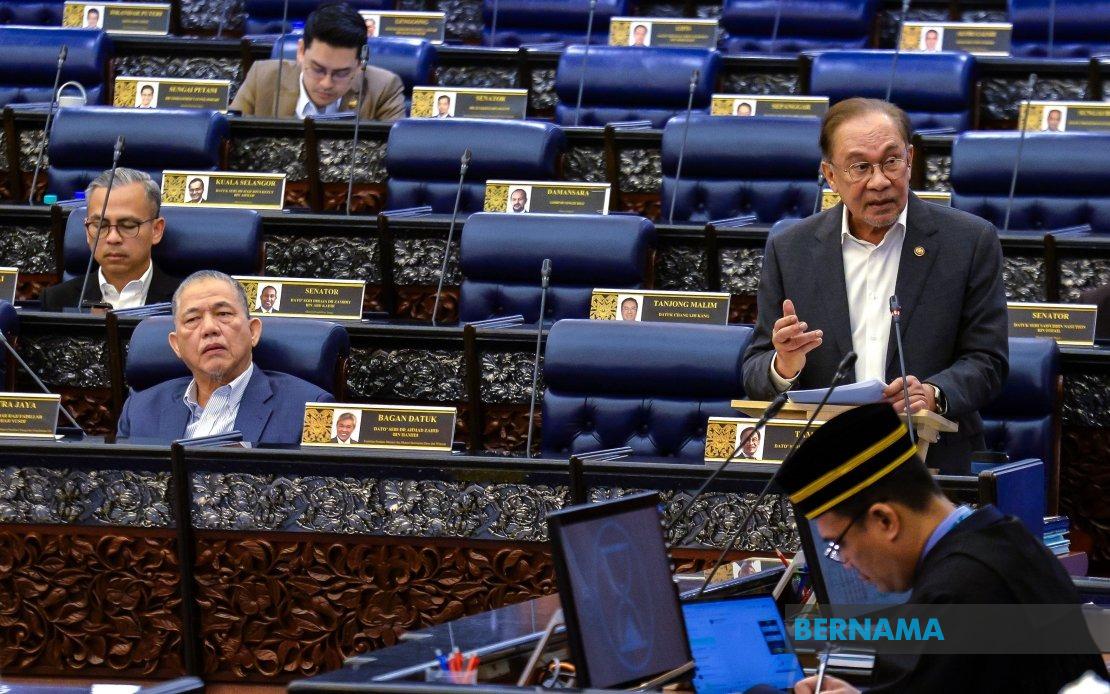
Prime Minister Datuk Seri Anwar Ibrahim has clarified the government's approach to distributing federal funds across Malaysia's states, emphasising that the allocation formula prioritises local development needs over each state's tax contribution capacity. Speaking during Ministerial Question Time in the Dewan Rakyat on June 30, Anwar outlined a framework where nearly every state receives substantially higher federal funding than the tax revenue it generates, with only Selangor and Penang operating as net contributors to the federal purse.
The Prime Minister's remarks directly addressed concerns about equitable treatment in state funding, rejecting assertions that any state has been deliberately sidelined or denied resources. Instead, Anwar framed federal allocations as a deliberate policy instrument designed to narrow development disparities and improve living standards across all regions. This stance reflects a broader philosophy within the MADANI Government that federal resources should function as a redistributive mechanism to support less-developed areas and address localised challenges that require significant capital investment.
Breaking down the rationale behind allocation decisions, Anwar identified several priority areas guiding the distribution process. Flood mitigation remains a critical consideration, particularly given Malaysia's vulnerability to seasonal flooding and the devastating costs of natural disasters. The government has also committed substantial resources to upgrading the Pan Borneo highway, a megaproject spanning Sabah and Sarawak that promises to enhance connectivity and economic opportunities in East Malaysia. Complementing these major infrastructure initiatives are investments in water drainage systems, poverty reduction programmes, and educational facilities, all of which require tailored funding based on each state's specific circumstances and requirements.
The allocation framework reveals how contemporary Malaysian governance interprets federalism not as strict proportional funding tied to revenue generation, but as a commitment to national cohesion through targeted investment. States like Kedah, Terengganu and Kelantan, which have historically struggled with economic development and infrastructure deficits, receive disproportionately higher allocations relative to their tax contributions. This redistribution strategy acknowledges that fiscal capacity does not necessarily correlate with development needs, and that poorer states require greater federal support to achieve comparable standards of public service delivery.
Anwar's statement during parliamentary questioning came in response to a query from Datuk Seri Doris Sophia Brodi (GPS-Sri Aman), reflecting ongoing parliamentary scrutiny of federal-state financial relationships. The question itself encapsulated common criticisms levelled against government spending patterns: whether allocations genuinely reflect the revenue states generate, and whether distribution mechanisms have improved under the current administration. These concerns resonate particularly in states where opposition parties hold sway, as federal allocation decisions invariably become intertwined with partisan political dynamics.
The Prime Minister seized the opportunity to contrast the MADANI Government's allocation record with its predecessor, claiming that Kedah, Terengganu and Kelantan have received unprecedented levels of federal funding under the current administration. This comparative assertion carries political weight, as it allows the government to position itself as more responsive to the needs of less-developed regions than previous coalitions. Such claims require scrutiny, but they demonstrate how the government frames its resource distribution strategy as progressive and development-oriented rather than politically motivated.
From a Malaysian perspective, understanding federal allocation mechanics is crucial for appreciating how national resources are distributed across regional economies. The approach Anwar described essentially operationalises a form of fiscal federalism where the centre maintains significant redistributive power. Unlike purely revenue-sharing models where state funding mirrors tax contribution, Malaysia's system permits the federal government to channel resources toward strategic national objectives and regional development goals. This flexibility enables rapid response to emerging crises, such as flooding emergencies, while simultaneously supporting long-term infrastructure development in less prosperous regions.
The implications of this allocation philosophy extend beyond mere budgetary politics. By deliberately providing more federal funding to states with lower revenue-generating capacity, the government attempts to maintain political stability and prevent the concentration of public investment in already-wealthy urban centres. This prevents a potential widening of regional inequality where richer states accumulate ever more public resources while poorer states stagnate. For Malaysian readers in less-developed states, this framework theoretically ensures access to comparable infrastructure and services despite lower local economic activity.
However, the effectiveness of this allocation system ultimately depends on governance quality, project implementation capacity, and freedom from corruption. Generous federal funding means little if state governments lack the administrative competence or political will to deploy resources efficiently. The system also requires ongoing parliamentary oversight and public transparency regarding how allocations are calculated, awarded, and utilised. Questions about fairness and marginalisation persist partly because the allocation formula itself remains opaque to public scrutiny, making it difficult for citizens to verify whether their state truly receives appropriate support relative to its needs.
Looking forward, the government's emphasis on needs-based allocation rather than revenue-proportional distribution establishes a template for federal-state relations in contemporary Malaysia. This approach acknowledges that development is inherently uneven and that federal policy must actively work to redress imbalances rather than simply mirror existing economic capacity. For Southeast Asian observers, Malaysia's model offers insights into how federal systems can balance provincial autonomy with national cohesion through strategic fiscal deployment. The challenge remains ensuring that such allocations translate into tangible improvements in governance, infrastructure quality, and citizen welfare across all states.

