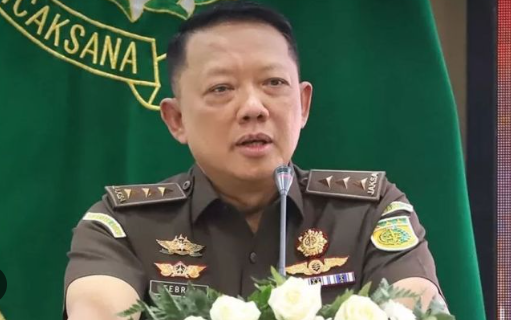
President Prabowo Subianto's administration faces a critical test of its anti-corruption credentials with the investigation into Febrie Adriansyah, until recently the nation's deputy attorney general for special crimes. The case has thrust into public view the difficult mechanics of investigating senior law-enforcement officials and has raised uncomfortable questions about whether Indonesia's institutions can credibly hold their own accountable. Having made combating corruption a cornerstone of his presidency, Prabowo now confronts a situation that reveals whether that commitment extends to the powerful establishment figures who populate Indonesia's judicial machinery.
The case began dramatically when police seized US$26 million in cash and gold bars from a residence owned by Febrie and declared him a suspect in a money-laundering investigation. Yet despite these serious allegations and the dramatic raid, which included a deployment of armed soldiers around his South Jakarta home, Febrie has remained free. The decision by authorities not to detain him has itself become a flashpoint, with legal scholars and lawmakers questioning whether his position and connections have granted him protections unavailable to ordinary suspects. The broader spectacle also underscores a pattern in Prabowo's administration: high-visibility raids and press conferences showcasing seized assets, yet outcomes that sometimes appear less decisive when those implicated occupy the upper echelons of power.
What has most troubled Indonesia's legal community is not merely Febrie's continued freedom, but the police decision to transfer the related cases to the Attorney General's Office itself. This move was justified as strengthening coordination between the two institutions, yet former Constitutional Court Chief Justice Mahfud MD has warned that it lacks any proper legal foundation under Indonesia's criminal procedure code. The transfer creates an obvious conflict of interest, critics argue, since prosecutors would be investigating one of their former leaders and potential colleagues. Some legal scholars have characterised the arrangement as fundamentally compromised, pointing out that the Corruption Eradication Commission would have been far better positioned to handle such a sensitive case precisely because it operates outside the traditional law-enforcement hierarchy.
Zaenur Rohman, an anti-corruption scholar at Gadjah Mada University, offered a candid assessment of the situation. He characterised the transfer not as a procedurally sound decision but as "a political settlement aimed at easing tensions" between the police and the Attorney General's Office. The problem, he explained, is that such settlements bypass the legal framework entirely. By allowing the very institution where Febrie spent his career to lead the investigation, the arrangement risks the appearance—and possibly the reality—of institutional self-protection. Rohman's observation captures a fundamental problem in Indonesia's anti-corruption efforts: the tendency for power struggles between agencies to be resolved through informal accommodation rather than principled application of legal rules.
The case has exposed longstanding structural problems within Indonesia's law-enforcement architecture. The police, the Attorney General's Office, and the Corruption Eradication Commission all possess overlapping mandates to investigate corruption, a redundancy that has periodically sparked institutional competition for visibility, control, and political influence. Rather than creating multiple layers of accountability, these overlapping jurisdictions often generate turf wars and political maneuvering. Prabowo's administration has not resolved these tensions; instead, it has sought to manage them through selective coordination. The coordinating minister for law, human rights, immigration and corrections, Yusril Ihza Mahendra, defended the transfer on efficiency grounds while acknowledging the public concern that it might amount to "oranges eating oranges," an Indonesian expression meaning one institution protecting its own interests.
Febrie's particular prominence amplifies the stakes of this investigation. As head of the Attorney General's Office's Special Crimes Division, he wielded enormous influence over some of Indonesia's most significant corruption cases, overseeing probes into major state-owned enterprises including Pertamina and Timah, as well as politically sensitive investigations involving the military and government programmes. His apparent downfall thus threatens to unsettle networks of influence and relationships built over decades within Indonesia's prosecutorial establishment. The fact that he faced investigation into alleged money laundering rather than straightforward corruption charges also suggests that authorities may be pursuing a different angle, one that potentially implicates financial systems and networks rather than direct official malfeasance.
Yusril's public statements reveal the delicate political choreography surrounding the case. He noted that Prabowo had personally met with both the police chief and attorney general to "give them directions" on managing the transfer, an intervention that itself raises questions about the independence of the investigation. While coordinating ministers routinely interface with law-enforcement agencies, Prabowo's direct involvement in directing how the case should be handled sends a signal about the political nature of the proceedings. Whether this reflects genuine concern for procedural integrity or something more instrumental remains unclear, but the visibility of presidential involvement suggests that even the administration recognises the case's explosive potential.
Parallel developments have further complicated the landscape. Recent legal changes in 2025 have altered the balance of power among Indonesia's law-enforcement institutions in ways still being tested. A revision to the military law now permits active-duty officers to serve in the Attorney General's Office without resignation, while the Attorney General's Office has gained new authority to seek military protection for prosecutors. These changes reflect a broader shift in how Indonesia's political elite are managing institutional relationships, with the military assuming a more visible role in supporting civilian law-enforcement functions. For Southeast Asian observers, these developments illustrate how Indonesia's institutional arrangements continue to evolve in response to political pressures and leadership preferences.
The Febrie case must also be understood within the context of Prabowo's broader anti-corruption campaign, which has generated numerous high-profile investigations targeting state-owned companies, former ministers, and aspects of his own flagship free-meals programme. The programme itself has generated corruption allegations, including the naming of an active police brigadier general as a suspect in connection with the scheme. The Attorney General's Office subsequently ordered regional prosecutors to cease collecting data on the programme, citing the end of the initial collection period and cautioning against abuse of investigative authority. This oscillation between aggressive prosecution and sudden restraint reflects the political pressures that shape how anti-corruption efforts unfold in practice.
Aditya Perdana, a political lecturer at the University of Indonesia, offered an observation that captures the broader problem: "The events don't explicitly prove institutional conflict, but the sequence tells a story." That story is one of institutions protecting turf and managing internal crises through informal arrangements rather than principled application of legal rules. Jacqui Baker, a senior lecturer in Southeast Asian politics at Murdoch University, has noted that criminal investigation powers, particularly in corruption cases, are "jealously fought over by law-enforcement agencies because they lie at the core of their political and economic power." Successive Indonesian presidents have sought to balance these competing institutional interests rather than allowing any single agency to dominate, though Prabowo's administration continues this balancing act with modifications that suggest shifting preferences.
For Malaysian policymakers and observers, the Febrie case offers cautionary lessons about how anti-corruption campaigns can become entangled with institutional politics. Indonesia's experience demonstrates the risks that emerge when multiple agencies possess overlapping investigative mandates, when senior law-enforcement officials occupy positions where they can influence investigations affecting their own career networks, and when political leadership becomes visibly involved in directing specific prosecutions. The case also illustrates broader patterns across Southeast Asia, where anti-corruption rhetoric often outpaces institutional capacity or willingness to follow through on challenging investigations involving powerful figures. As Indonesia's administration navigates this high-profile case, the question of whether Prabowo's anti-corruption commitments will ultimately prove more than ceremonial remains unresolved.
The investigation's trajectory will reveal much about the state of Indonesia's institutional independence and the genuine priorities of the Prabowo administration. For now, the spectacle of seized assets and detained suspects has given way to a more complicated bureaucratic drama involving case transfers, jurisdictional questions, and suggestions of political direction. Febrie's continued freedom, combined with the decision to lodge the investigation with the very institution where he spent his career, sends a message that may ultimately undermine the very anti-corruption narrative that Prabowo has sought to promote. As this case unfolds, it will provide crucial evidence about whether Indonesia's law-enforcement institutions can investigate their own with credibility and independence, or whether institutional self-protection continues to trump genuine accountability.

