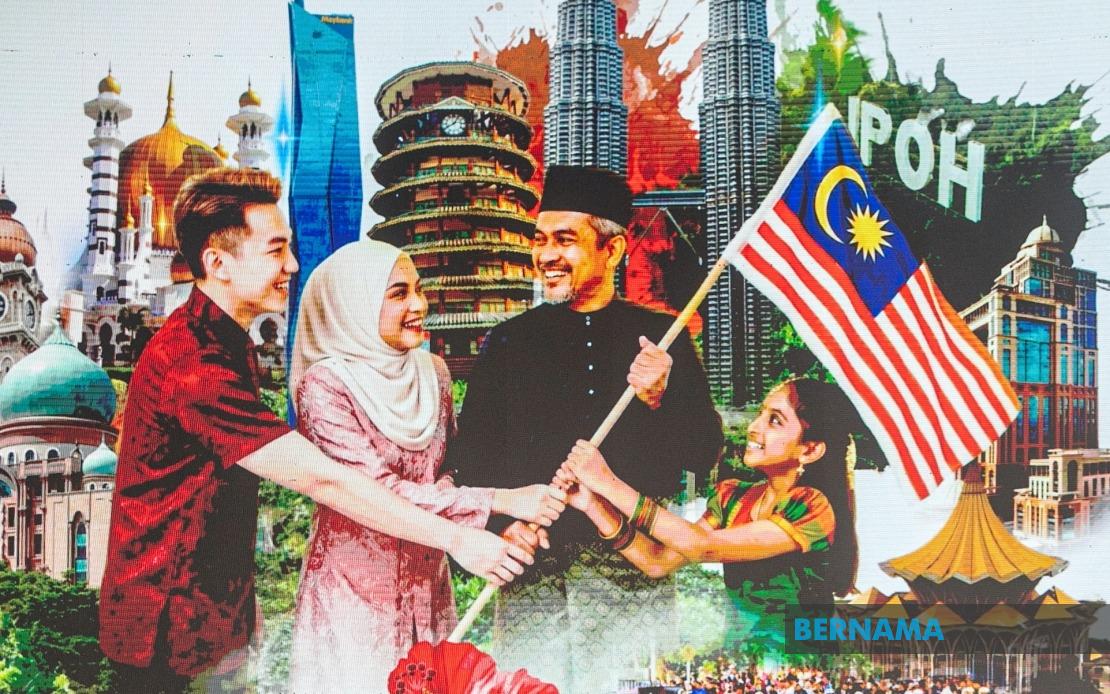
Malaysia's Communications Minister Datuk Seri Fahmi Fadzil has issued a timely reminder to content creators and the general public about the need for precision when deploying artificial intelligence tools to produce material featuring the Jalur Gemilang. The caution was sounded during the launch of the 2026 National Month and Fly the Jalur Gemilang campaign in Ipoh, an event presided over by Prime Minister Datuk Seri Anwar Ibrahim and attended by senior government officials including National Unity Minister Datuk Aaron Ago Dagang and Perak Menteri Besar Datuk Seri Saarani Mohamad.
The core concern articulated by Fahmi centres on the frequent failures of AI technology to accurately reproduce the Jalur Gemilang's distinctive design elements, particularly the flag's 14 characteristic stripes. This issue has grown increasingly relevant as generative AI tools have become more accessible to ordinary Malaysians who may lack specialist knowledge about the precise specifications of national symbols. The minister emphasised that content creators bear responsibility for verifying the accuracy of machine-generated imagery before sharing it across digital platforms, where such errors can rapidly propagate and potentially undermine the dignity of Malaysia's national emblem.
Fahmi's intervention reflects a broader regulatory philosophy that prioritises education and voluntary compliance over punitive measures. When asked about enforcement mechanisms for correcting AI-generated errors, the minister outlined a graduated response framework. The government's initial approach will prioritise advisory and corrective dialogue, seeking to contact individuals or organisations who have inadvertently produced inaccurate representations of the flag and requesting that they amend the content. This soft-touch strategy acknowledges the genuine difficulty many users face in controlling AI outputs, while still upholding standards for national symbol representation.
However, Fahmi did not entirely discount the possibility of invoking existing legislation should voluntary corrections fail to materialise. Malaysia possesses specific legal frameworks governing the appropriate display and representation of national symbols, and these provisions remain available should an advisory approach prove unsuccessful. The minister's framing suggests that legal action would be reserved for egregious or persistent cases where parties deliberately ignore requests for correction, rather than serving as the first recourse for honest mistakes stemming from technological limitations.
To strengthen institutional oversight, the ministry has committed to collaborative engagement with the Malaysian Press Institute and the Malaysian Media Council. These partnerships aim to establish industry standards and best practices for media organisations operating throughout the National Month period. By working through established media institutions rather than imposing top-down restrictions, the government strategy attempts to build genuine consensus around flag representation accuracy while respecting press freedom and creative autonomy. This consultation-based approach may prove more effective at securing industry buy-in than regulatory mandates issued unilaterally.
The emphasis on educating Malaysians about proper flag etiquette forms an integral component of Fahmi's message. Beyond merely warning against AI errors, he encouraged citizens to invest time in understanding the correct protocols for displaying the Jalur Gemilang. This educational dimension addresses a deeper challenge: many Malaysians may lack familiarity with precise flag specifications, making them unable to detect when AI tools produce flawed outputs. By promoting wider knowledge of flag standards, the government seeks to empower citizens themselves to recognise and reject inaccurate representations.
The broader context for this initiative involves Malaysia's annual National Month celebrations, which typically run from Merdeka Day on August 31 through Malaysia Day on September 16. This year's observances carry particular significance as they align with advance planning for 2026's milestone celebrations. The government is encouraging Malaysians to participate in the Fly the Jalur Gemilang campaign by displaying the flag in residential areas, villages, and government premises throughout this extended period. Such visual expressions of national identity and patriotic sentiment are central to Malaysia's commemorative tradition, making the accuracy of flag representation particularly consequential during these symbolically charged months.
The 2026 National Day celebration itself will be hosted in Putrajaya, while Malaysia Day festivities will move to Sarawak, reflecting the federal nature of Malaysian national observance and ensuring different regions participate in hosting flagship celebrations. These venue selections underscore the nationwide scope of the campaign and the government's intention to engage all segments of Malaysian society in accurate, dignified flag representation. By decentralising celebrations across the federation, officials hope to foster patriotic sentiment rooted in genuine understanding of national symbols rather than superficial or aesthetically flawed expressions.
Fahmi's intervention also implicitly acknowledges the rapid evolution of content creation practices in Malaysia's increasingly digital public sphere. As AI tools proliferate and become integrated into mainstream content production workflows—from social media graphics to commercial advertising to news illustration—government bodies must develop coherent policies governing their use with national symbols. The minister's approach balances legitimate concerns about maintaining standards with recognition that prohibitive regulations may prove counterproductive, potentially driving problematic content underground or generating public resentment towards restrictions.
For content creators and media organisations, the key takeaway involves exercising substantive quality control over AI-generated imagery rather than assuming machine outputs require no human verification. This represents a meaningful shift in production practice, as many practitioners have grown accustomed to treating AI outputs as finished products requiring minimal intervention. Fahmi's guidance implies that when national symbols are involved, the traditional journalistic and creative standards of accuracy and dignity must reassert themselves over efficiency considerations.
The underlying tension in this policy framework reflects deeper questions about technological governance in democratic societies. Rather than treating AI as an autonomous agent deserving regulatory protection, Fahmi's approach locates responsibility clearly with human users and institutional gatekeepers. This philosophy extends to media organisations, which retain ultimate accountability for content they publish or distribute, regardless of whether that content originated from human journalists or machine-learning systems. Such clarity may help Malaysian media navigate the complex landscape of AI-assisted content production while maintaining professional standards.

