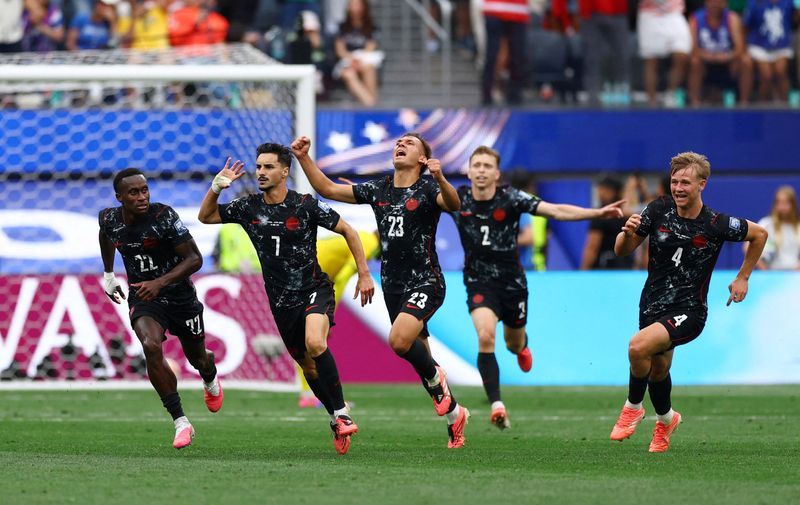
Stephen Eustaquio delivered a moment of redemption for Canada on Sunday, firing home a powerful shot from the edge of South Africa's penalty area in the 92nd minute to secure a 1-0 victory at Los Angeles Stadium and propel the co-hosts into the World Cup knockout stages for the first time. The Canadian midfielder's strike, which found the back of the net past diving goalkeeper Ronwen Williams, capped an increasingly fraught encounter that had tilted toward a penalty shootout before Eustaquio's intervention changed everything.
For Southeast Asian readers following this tournament, Canada's breakthrough holds particular significance as it marks a watershed moment for football in North America. The co-hosts had never previously advanced beyond the group stage in three prior World Cup appearances, making their progression to the round of 16 a historic achievement despite arriving in California with minimal preparation time. They had managed only three days of rest following a dispiriting 2-1 defeat to Switzerland on Wednesday, and this was their first match played outside Canadian territory in the competition.
The match itself unfolded as a tightly contested affair between two nations making their maiden knockout-round appearances. South Africa, who had reached the knockout stage for the first time in their fourth World Cup attempt, approached the encounter with defensive pragmatism, seemingly content to absorb Canadian pressure and test their opponents' resolve over extended time. This tactical conservatism frustrated the home side throughout, with chances at a premium during a particularly quiet opening forty-five minutes that offered little to suggest the dramatic conclusion that awaited.
Canada's clearest opening arrived in the minutes before the interval when a scrambled sequence in South Africa's box created genuine danger. Moise Bombito directed a header toward goal only for Aubrey Modiba to produce a crucial clearance off the line, while Tajon Buchanan's immediate follow-up attempt struck goalkeeper Ronwen Williams directly. The sequence showcased Canada's attacking potential but also highlighted their inability to convert opportunity into reward—a pattern that would dog them until Eustaquio's decisive moment.
Controversy briefly threatened to derail the narrative when Richie Laryea went down under a South African challenge in the penalty area shortly after the Bombito header. Canadian players and supporters erupted in protest, but the referee's initial decision to wave away appeals was upheld following VAR review, drawing audible disapproval from the predominantly red-clad Canadian contingent that had claimed the stadium. Coach Jesse Marsch's continued protestations as the teams departed for halftime underscored the frustration building on the Canadian bench.
The second half saw South Africa settle deeper into defensive positions, apparently accepting that extra time represented their best opportunity to avoid elimination. Canada pressed relentlessly but lacked the clinical finishing to break through, with Jonathan David squandering another opportunity when Tani Oluwaseyi's shot rebounded off Williams, only for Mbekezeli Mbokazi to deliver an excellent defensive intervention. The mounting frustration was palpable as the match progressed toward what appeared an inevitable penalty sequence.
Eustaquio's intervention in the 92nd minute transformed the trajectory of the competition for Canada and rewrote the immediate future for South Africa. Receiving possession on the penalty area's edge, the Canadian midfielder unleashed a fierce, struck shot that beat the diving Williams and settled into the net, igniting scenes of jubilation among Canada's supporters. The goalkeeper had little opportunity to prevent the goal, beaten by the power and placement of a strike that carried the weight of Canadian hopes and aspirations.
In the immediate aftermath, Eustaquio spoke of the collective emotion channeled into his decisive moment. "When I shot it, I felt everybody shot it with me," the midfielder reflected, capturing the sense that the entire Canadian contingent—players, coaching staff, and supporters—had invested themselves fully into reaching this milestone. His explanation conveyed the psychological intensity of the encounter and the significance of progressing beyond a threshold his nation had never previously crossed at the World Cup.
Jesse Marsch's assessment acknowledged both his team's limitations and their ultimate character. The Canadian coach observed that his side had created opportunities throughout but lacked sufficient ruthlessness in execution until Eustaquio's moment. Marsch's observation that his players had become "Canadian heroes" reflected the emotional resonance of their achievement, particularly given the circumstances of their arrival in Los Angeles with minimal preparation and the disappointment of their final group-stage encounter.
Canada's progression sets up a quarter-final date against either the Netherlands or Morocco on July 4 in Houston, representing another step into unexplored territory for the North American co-hosts. The victory also marked a bittersweet conclusion for South Africa's tournament, with 74-year-old coach Hugo Broos indicating that this World Cup represented his final competition in the role. His enigmatic response about his future suggested potential transitions ahead for the South African federation.
The broader implications for Canada extend beyond immediate tournament success. A nation seeking to establish itself as a serious football power demonstrated the resilience and composure required to succeed at sport's highest level, suggesting that their investment in developing competitive infrastructure may be yielding returns. For Malaysian and Southeast Asian observers, Canada's emergence as a genuine World Cup competitor reflects the tournament's capacity to produce unpredictable narratives and the value of sustained development in establishing competitive football programs. The co-hosts' journey from perpetual group-stage exits to knockout-stage participants within a generation illustrates that progression remains possible for emerging football nations willing to commit resources and patience to building competitive frameworks.

