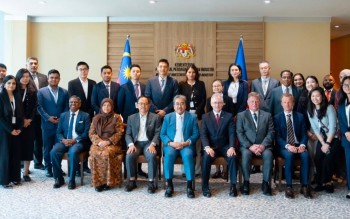
A delegation of more than 70 representatives from over 25 European companies concluded high-level discussions with Malaysian government officials this week, signalling renewed momentum in bilateral economic engagement at a critical juncture for regional trade architecture. The visit, organised by the EU-ASEAN Business Council, brought European investors into direct contact with Malaysian policymakers across multiple ministries, reflecting both sides' commitment to deepen commercial ties and align on strategic priorities affecting the region's economic trajectory.
The three-day engagement, held from August 4-6, represented a deliberate effort by European business leaders to gain clarity on Malaysia's policy direction while demonstrating confidence in the government's reform initiatives. Chris Humphrey, executive director of the EU-ASEAN Business Council, characterised the atmosphere of discussions as exceptionally constructive, noting that meetings with the Economy Ministry yielded detailed explanations of ongoing reform packages and clear articulation of the administration's commitment to sustainable development. The delegation used these forums not merely to gather information but to signal European industry's backing for Malaysia's trajectory toward greener, more digitalised economic structures.
Economic transformation featured prominently throughout the delegation's itinerary. Beyond general endorsements, European companies sought concrete information about circular economy frameworks, digitalisation roadmaps, and the regulatory environment surrounding sustainable development initiatives. These concerns reflect a broader pattern among multinational firms, which increasingly face pressure from shareholders and regulators to demonstrate that their investments align with environmental and social governance standards. Malaysia's willingness to engage substantively on these metrics positions the country advantageously within the competitive landscape for European capital seeking entry points into Southeast Asia.
Finance ministry discussions shifted focus to the mechanics of capital deployment, covering taxation structures, government procurement rules, and the overall investment climate. The reported optimism from these sessions carries significance beyond diplomatic pleasantry; European financial institutions and corporate treasurers make capital allocation decisions based partly on perceived regulatory stability and transparency. The positive tone suggests Malaysia has successfully communicated reforms intended to address long-standing investor concerns about bureaucratic complexity and regulatory clarity.
A substantial portion of the delegation's agenda addressed customs modernisation and trade facilitation—topics often overlooked in headlines but critical for supply chain efficiency. The focus on expediting customs clearance and implementing digitalisation within the Royal Malaysian Customs Department reflects frustrations European exporters have historically encountered. Enhanced procedures promise tangible cost reductions for businesses importing raw materials or exporting finished goods through Malaysian ports and borders. The discussion of combating illicit trade, particularly tobacco smuggling, signals recognition that regulatory coherence benefits legitimate enterprises while undermining criminal networks that distort markets.
Healthcare cooperation emerged as an unexpected yet strategically important agenda item, with European pharmaceutical and medical technology companies positioning themselves to support Malaysia's evolving health infrastructure. The emphasis on innovative financing mechanisms and self-care promotion suggests European firms see opportunities in Malaysia's growing middle-class demand for healthcare services. Such engagement often presages formal partnership agreements and technology transfer arrangements that advance both commercial interests and public health outcomes.
Underlying the entire visit lies the accelerating Malaysia-EU free trade agreement negotiations, which have now completed four rounds with a fifth scheduled for late September in Brussels. The FTA represents a transformational opportunity for Malaysian exporters, potentially reducing tariff barriers and harmonising standards across sectors from automotive to electronics to agricultural products. European negotiators and business representatives have signalled confidence that concluding the agreement by 2027 remains achievable, contingent on continued political will from both administrations and resolution of outstanding technical disagreements over rules of origin, intellectual property, and labour standards.
The strategic importance of this bilateral relationship extends beyond immediate commerce. The EU ranks among Malaysia's five largest trading partners, with 2025 goods trade reaching €48.9 billion, demonstrating the depth of economic interdependence already established. Malaysian exports of €30.3 billion reflect the country's continued role as a crucial supplier of electronics, semiconductors, palm oil derivatives, and refined petroleum products to European markets. Conversely, Malaysian importers rely substantially on EU suppliers for machinery, precision instruments, and chemicals.
European direct investment stock in Malaysia reached €33.1 billion by 2024, concentrated in manufacturing, financial services, and increasingly in renewable energy and technology sectors. This capital base generates employment for hundreds of thousands of Malaysians and anchors sophisticated global supply chains. However, maintaining and expanding this investment flow requires continuous attention to the regulatory environment, infrastructure quality, and competitive positioning against alternative Southeast Asian destinations. The delegation's visit suggests European investors believe Malaysia remains attractive, provided government follows through on announced reforms.
Malaysia's geographical position and infrastructure advantages feature prominently in European assessments of regional investment opportunities. The nation's connectivity to global shipping lanes, developed port facilities, skilled and cost-competitive workforce, and natural resource endowments create a distinct value proposition compared to other Southeast Asian nations. Yet these structural advantages carry no guarantee of sustained competitive advantage; sustained investment requires demonstrated commitment to regulatory predictability, rule of law, and transparent governance.
The breadth of ministry participation in the delegation's schedule—spanning trade, finance, environment, customs, health, agriculture, transport, and tourism—indicates that European companies view investment opportunities across diverse sectors rather than concentrating on traditional manufacturing. This diversification potentially supports Malaysia's goal of developing higher-value economic activities and reducing dependence on commodity exports subject to price volatility.
Looking forward, the September FTA negotiation round in Brussels will prove crucial in determining whether optimistic timelines remain realistic. Specific contentions over tariff schedules, services liberalisation, and non-tariff barriers require resolution through technical diplomacy. Nevertheless, the demonstrated engagement from both Malaysian officials and European business representatives suggests genuine commitment to concluding an agreement that could reshape bilateral commerce for decades. For Malaysia, a comprehensive FTA with the EU would cement its position within European global supply chains and provide valuable counterweight within regional trade architecture dominated by competition between major powers.

