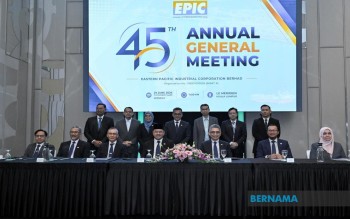
Eastern Pacific Industrial Corp Bhd (EPIC) is charting an ambitious expansion trajectory over the next five years, targeting annual revenue of RM700 million and net asset value of RM1 billion by 2030 as it diversifies operations across integrated oil and gas solutions, port management and renewable energy platforms. The integrated energy services provider unveiled its roadmap following strong recent financial performance, signalling confidence in execution amid Malaysia's evolving energy landscape.
Current performance provides the foundation for this expansion drive. EPIC reported net profit of RM20.6 million for the financial year ended December 31, 2025, representing a 24 percent increase from RM16.6 million in the prior year. Revenue climbed to RM411.9 million from RM403.8 million, extending a consistent growth pattern since 2022 that reflects both operational efficiency and market demand for the group's services. The company's upward trajectory suggests the target of raising revenue by roughly 70 percent over five years is grounded in demonstrated execution capability.
Group Chief Executive Officer Dr Ts Muhtar Suhaili attributed the latest results to several catalysts that positioned EPIC for continued momentum. The acquisition of Rahar Niaga Sdn Bhd bolstered operational capacity, while newly secured Pan Malaysia Maintenance, Commissioning and Modification and Hook-Up and Commissioning contracts from Petronas expanded the revenue base. Simultaneously, higher offshore rig arrivals and increased cargo volumes underscored robust underlying demand for the group's integrated services across Malaysia's critical energy and logistics infrastructure.
Looking ahead to 2026, Suhaili projected another record year driven by a substantial contract pipeline. EPIC currently holds approved contract values totalling between RM1.3 billion and RM1.5 billion across its oil and gas business, though actual earnings depend on work order execution and purchase order timing. This pipeline demonstrates the company has secured sufficient visibility to support its growth claims, though investors should monitor quarterly delivery metrics to validate expectations.
Geographic diversification forms a cornerstone of EPIC's 2030 strategy. The company has progressed beyond its traditional Terengganu base, securing multiple contracts with Petronas across the southern Peninsula region, including Pengerang and Melaka. Recent penetration into Sabah marks a significant expansion eastward, establishing EPIC as a national-scale energy services player rather than a regionally concentrated operator. This geographic spread reduces revenue concentration risk and positions the group to capture opportunities across Malaysia's distributed energy infrastructure.
The renewable energy sector represents a growth pillar with particular strategic importance. EPIC is bidding, alongside parent company Terengganu Inc, for a hybrid hydro-solar project at Kenyir, signalling the company's transition into Malaysia's expanding clean energy domain. This diversification from traditional oil and gas services aligns with Malaysia's renewable energy targets and could provide revenue stability as global energy transition accelerates. Success in renewable projects would materially strengthen the 2030 revenue target while positioning EPIC as an integrated energy solutions provider spanning hydrocarbon and renewable platforms.
International expansion rounds out the growth agenda. EPIC's board has mandated management to pursue opportunities in neighbouring Asian markets while selectively evaluating West Asia prospects despite geopolitical uncertainties. This outward pivot acknowledges ASEAN's energy infrastructure deficits and provides growth optionality beyond Malaysia's domestic market constraints. However, international expansion carries execution risks including regulatory complexity, local competition and currency exposure that warrant careful phasing.
Sabah and Sarawak represent near-term expansion priorities. In February 2025, EPIC's subsidiary EPIC OG Sdn Bhd signed a collaboration agreement with Begas Energy Sdn Bhd to deliver project management services for the Terminal Turnaround, Maintenance and Modification contract in Sabah. This partnership deepens the group's footprint in East Malaysia, a region with substantial oil and gas infrastructure requiring ongoing maintenance and upgrade services. Such collaborations allow capital-efficient market entry while leveraging local partners' regulatory knowledge.
The company's strategic positioning reflects Malaysia's evolving energy landscape. As Petronas continues rationalising its domestic operations while investing in deepwater and regional projects, integrated service providers like EPIC that offer bundled solutions across maintenance, commissioning, modification and project management occupy attractive niches. The group's ability to secure multiple Petronas contracts suggests confidence from Malaysia's national oil company in EPIC's technical capabilities and execution track record.
However, several factors warrant close monitoring. The oil and gas sector's cyclicality means revenue visibility, while currently strong, could deteriorate if commodity prices weaken or Petronas curtails capital spending. The renewable energy segment remains nascent for EPIC, and execution risks around hybrid project deployment could delay expected contributions. International expansion success hinges on management's ability to navigate unfamiliar markets, regulatory environments and competitive dynamics in neighbouring countries.
For Malaysian investors, EPIC presents a recovery story within the energy services sector. The company has demonstrated consistent execution through volatile market conditions, secured substantial contract visibility through 2027, and is diversifying revenue sources beyond traditional oil and gas services. The ambitious 2030 targets appear calibrated to near-term pipeline rather than speculative assumptions, though actual performance will ultimately validate management's projections.

