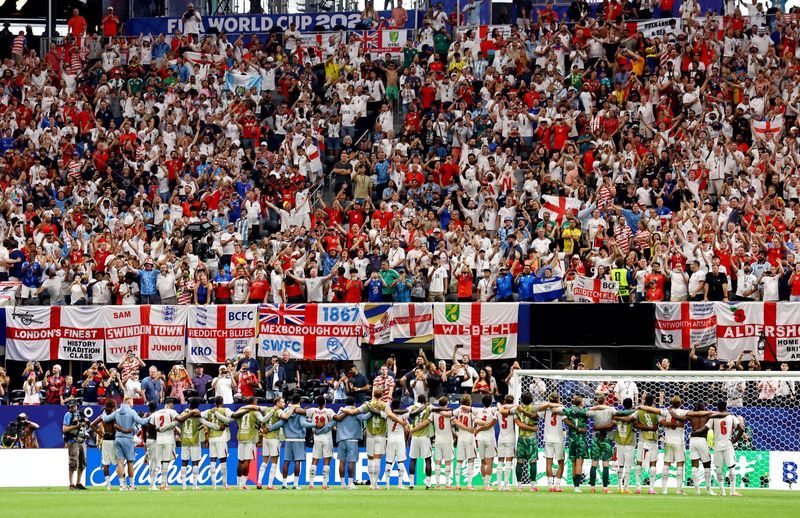
England's passage to the World Cup knockout round came at considerable emotional and tactical cost after a breathtaking 2-1 comeback victory over DR Congo in Atlanta, a result that exposed the lingering fragility threatening their tournament aspirations. The English side entered the match carrying the psychological weight of unconvincing performances—a goalless stalemate against Ghana and a narrow 2-0 victory over Panama had already raised concerns about their defensive solidity under Thomas Tuchel's leadership, even as their opening 4-2 win over Croatia appeared to suggest a team ready to compete at the tournament's highest level.
The narrative shifted dramatically when Brian Cipenga delivered a sucker punch to England's hopes, striking inside the opening ten minutes to give the determined Congolese underdogs an improbable lead. This represented a psychological turning point that transcended mere scoreline—England had never trailed at any stage of the tournament, nor had they managed to overcome a halftime deficit in any World Cup knockout tie throughout their history. The stadium atmosphere transformed instantly from anticipatory to suffocating, with supporters gripped by the tangible dread that their team's campaign might unravel against opponents who had absolutely nothing to lose and everything to prove.
DR Congo's approach was tactically astute and relentlessly committed. The African team required merely a single shot on target to maintain their advantage, yet constructed a defensive fortress around goalkeeper Lionel Mpasi that frustrated England's increasingly desperate attacking forays. The gulf between the teams' tactical discipline was stark—while England squandered numerous opportunities through imprecise finishing and wayward decision-making, DR Congo defended with the desperation of a side knowing this represented their only realistic pathway to glory. When Yoane Wissa struck the post moments before the break and Harry Kane's appeals for a penalty were dismissed, the sense that fortune had deserted England threatened to overwhelm the travelling supporters whose disconsolate faces told the story of a nation confronting the possibility of premature elimination.
Tuchel's halftime adjustments proved instrumental in England's transformation. The introduction of Eberechi Eze and the repositioning of Declan Rice to right back signalled a manager determined to impose English superiority despite the scoreline suggesting otherwise. Following the restart, the momentum gradually shifted as England began to exercise the sort of territorial control expected of a major footballing nation. Jude Bellingham's powerful header forced a magnificent save from Mpasi, while Rashford's close-range effort was denied by heroic goal-line defending, yet the breakthrough stubbornly refused to materialise as minutes accumulated and tension mounted throughout the stadium.
The levelling goal arrived in the 75th minute when Kane executed a glancing header that brushed past Mpasi's fingertips—a moment of such emotional catharsis that the roar seemed capable of shaking the Atlanta structure itself. This was Kane's 83rd international goal, but its significance transcended individual statistics; it represented deliverance from a narrative of potential embarrassment and reinvigoration of England's tournament credentials. Kane's second goal four minutes later secured the passage, yet the victory felt less like a commanding performance and more like survival against the odds, a reality that Tuchel would need to address urgently.
The manager's post-match commentary emphasised resilience and psychological fortitude, highlighting the team spirit and commitment demonstrated under extreme pressure. Tuchel spoke of maintaining belief when circumstances turned difficult, of refusing to surrender patience despite mounting evidence that England's defence remained alarmingly vulnerable. The comeback itself carried historical resonance—this was England's first World Cup comeback victory since their quarter-final triumph over Cameroon in 1990, a gap of exactly 36 years that underscored both the rarity of such escapes and the mounting evidence that this tournament might not follow the script many English observers had anticipated.
For context within the broader Southeast Asian sporting landscape, England's vulnerability against determined defensive opponents carries implications for how regional nations might approach knockout fixtures. The match demonstrated that superior technical ability and individual quality cannot automatically overcome tactical discipline and collective commitment, lessons particularly relevant for developing football nations seeking to compete against established powers. The intensity and passion displayed by DR Congo, a team ranked significantly lower in FIFA standings, illustrated how properly organised teams with clear tactical objectives can trouble even well-resourced opponents.
The immediate challenge ahead presents a fundamentally different examination. Mexico represents not merely another hurdle but a specifically tailored test of England's defensive resilience under contrasting circumstances. Where DR Congo relied upon compact defending and counter-attacking, Mexico typically employs a more aggressive, attacking-minded approach that could exploit the very defensive vulnerabilities that nearly proved England's undoing against the Congolese. Kane acknowledged this distinction frankly, noting that knockout football demands different qualities at each stage and that the margin between success and elimination becomes infinitesimally small.
Geographical and environmental factors compound the challenge considerably. Mexico City's Azteca Stadium sits at an elevation exceeding 2,200 metres above sea level, creating atmospheric conditions that fundamentally alter the parameters of professional football. The reduced oxygen levels, combined with the ball's altered aerodynamic properties at altitude, present physiological and technical challenges that differentiate the fixture from standard conditions. England's players, accustomed to sea-level football and already physically exhausted from battling through an emotionally draining encounter, must rapidly acclimatise to thinner air whilst maintaining the intensity required to overcome an opponent they cannot underestimate.
The psychological dimension deserves equal consideration. Emerging from an encounter requiring such intensity and mental resilience, where mistakes nearly resulted in elimination, presents both advantages and risks. Players may carry momentum and confidence from the comeback, or conversely may enter the Mexico fixture mentally fatigued and psychologically fragile. Tuchel's management of these factors—maintaining belief without overconfidence, preparing players for altitude without inducing anxiety, and addressing defensive deficiencies without abandoning attacking ambition—will substantially determine whether England's narrow escape against DR Congo represents a turning point toward tournament success or merely a temporary reprieve before a more comprehensive reckoning.
England's path through this World Cup, charted across three group matches and one knockout encounter, has revealed a team of considerable offensive capability but defensive organisation that remains work in progress. The victory over DR Congo demonstrated valuable qualities of resilience and determination, yet also exposed gaps that accomplished opponents will certainly seek to exploit. As the tournament progresses toward its climactic stages, England faces not merely Mexico but the internal challenge of reconciling their attacking potential with defensive stability, a balance that Tuchel must achieve whilst managing the physical and psychological demands of competition at altitude.

