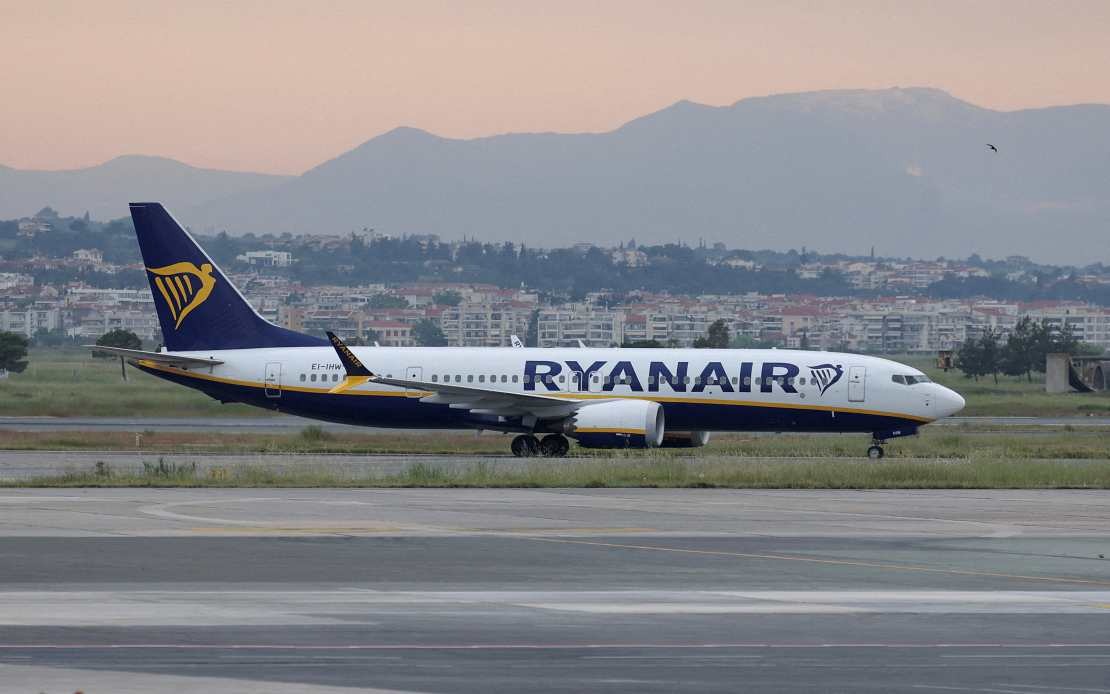
An investigation into a mid-air incident aboard a Ryanair flight operating from Thessaloniki to Munich last month has revealed the alarming sequence of events that endangered a passenger when engine debris violently penetrated the aircraft cabin. The US National Transportation Safety Board released its findings on Thursday, concluding that the Malta Air flight experienced catastrophic fan blade separation in the right engine shortly after departure from Thessaloniki International Airport in Greece, sending fragmented metal directly into the fuselage at high velocity.
The NTSB investigation detailed how the structural integrity of the pressurised cabin was compromised in two distinct locations. Engine fragments smashed through the window at row 11, completely shattering the pane and breaching the fuselage wall. Additional damage extended to the lower fuselage skin positioned behind the right wing-to-body fairing, indicating the extent of the penetration and the violent force involved. The multiple breach points demonstrated how quickly a single mechanical failure can cascade into a life-threatening emergency at altitude.
The passenger assigned to seat 11F bore the brunt of the incident. According to the investigation report, the individual became partially lodged in the damaged window frame as the cabin's pressurised air attempted to equalise with the lower pressure environment outside. At cruise altitude, such a situation would create enormous outward force, yet the passenger did not become completely dislodged. Other passengers in the cabin immediately responded to the crisis, working together to pull their fellow traveller back inside the aircraft before the situation deteriorated further.
For Malaysian and Southeast Asian aviation enthusiasts, this incident underscores the resilience of modern aircraft design and the critical importance of cabin pressurisation systems. Despite the window's complete destruction and the compromised fuselage, the aircraft remained structurally sound enough to return safely to Thessaloniki. The cabin pressure, while breached, did not lead to catastrophic decompression that might have rendered the aircraft uncontrollable. Pilots and crew managed the emergency descent and landing without further incident, highlighting training protocols that prove effective even in worst-case scenarios.
The investigation also uncovered evidence of bird remains, including feathers, scattered throughout various sections of the engine. This discovery points toward a bird strike as the likely catalyst for the fan blade failure. Bird strikes represent an occupational hazard for aviation across the world, including the busy air corridors of Southeast Asia. While modern engines incorporate substantial protective measures, large birds or multiple strike impacts can occasionally overwhelm these safeguards, as occurred in this instance.
For the injured passenger, the ordeal resulted in injuries, though the final medical outcome was not detailed in the investigation report. The swift intervention by neighbouring passengers undoubtedly prevented a far more tragic conclusion. Had the passenger become fully dislodged from the aircraft at altitude, survival would have been impossible. This element of the incident highlights the human factor in aviation safety—alertness and courage from ordinary travellers can become lifesaving in emergency situations.
The incident occurred in July, and the subsequent investigation represents the meticulous documentation process that aviation authorities undertake following any significant accident or near-accident. The NTSB's involvement reflects international protocols whereby the country where an aircraft is registered participates in investigations even when incidents occur elsewhere. This case involved a Malta Air operation, explaining the American safety board's role in examining the technical evidence.
For regional carriers operating across Southeast Asia, including Malaysia, the incident provides valuable data on engine failure modes and cabin integrity. Airlines and maintenance providers continually review such findings to refine inspection schedules and identify potential stress points in similar aircraft models. The documentation of how fan blade separation progressed and the resulting damage pattern contributes to an ever-growing database that informs engineering improvements and operational procedures.
The fact that the aircraft successfully returned to its departure airport despite structural damage in critical areas reflects decades of aviation safety evolution. Modern jet airliners incorporate redundancy in hydraulic systems, flight control surfaces, and engine architecture precisely to survive scenarios that would have proven catastrophic in earlier generations of aircraft. The ability to land safely after such damage represents the culmination of lessons learned from previous incidents and continuous technological advancement.
This event also reinforces the significance of passenger safety procedures and the importance of an alert cabin crew. While this particular situation involved passengers' instinctive response rather than formal emergency protocols, trained flight attendants play an essential role in managing cabin pressurisation emergencies, assisting injured passengers, and maintaining order during high-stress situations. Airlines operating across Southeast Asian routes maintain rigorous training standards to ensure crew readiness for such contingencies.
Looking forward, the investigation findings will likely contribute to broader discussions within the aviation industry regarding engine maintenance intervals, bird strike prevention measures at airports, and cabin window specification standards. Manufacturers of both engines and aircraft structures continuously evaluate such incidents to determine whether design modifications or enhanced inspection protocols are warranted. For passengers throughout the region, these investigations ultimately serve as reassurance that the aviation system learns from every incident to make future flights safer.

