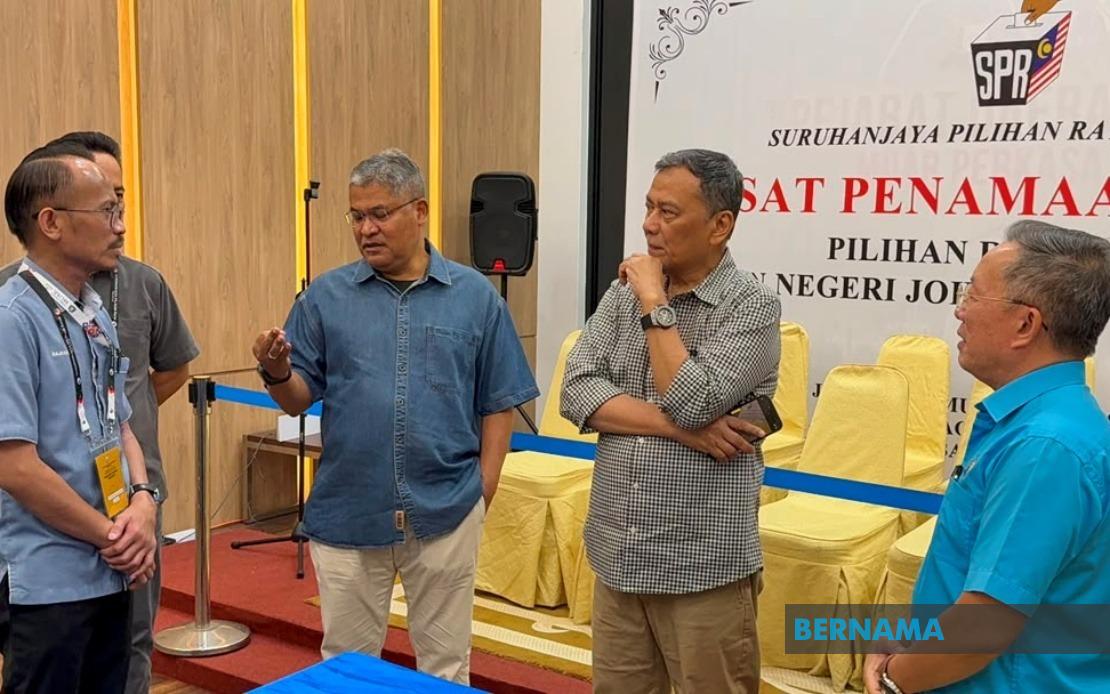
Johor's electoral machinery entered its final preparatory phase on Wednesday as the Election Commission put finishing touches to logistics and security arrangements ahead of the nomination day for the state's 16th general election. A survey of multiple Candidate Nomination Centre locations across Johor Bahru revealed that technical setup work was proceeding on schedule, with returning officers expressing confidence that proceedings would commence without disruption on Thursday morning.
The Perling state constituency centre at Dewan Jubli Intan Hall exemplifies the Commission's readiness. Returning Officer Nazatul Shima Mohamad confirmed that venue layout arrangements and full-scale simulations involving all participating agencies had been finalised. Speaking to media representatives, she underscored the unified commitment of the electoral management body and allied organisations, noting that comprehensive rehearsals had validated operational procedures. Prospective candidates were advised to arrive punctually with all mandatory documentation, including nomination deposits, to expedite the processing.
Security and crowd management occupy paramount concern in the Commission's operational blueprint. At the Kota Iskandar nomination centre, situated in the Main Hall of Iskandar Puteri City Council's Medini complex, returning officer Shahrulizam Abdul Rashid detailed an intricate framework designed to accommodate anticipated candidate supporters whilst maintaining public order. The protocol encompasses selective road closures around the polling venue, a 50-metre exclusion perimeter beyond which party supporters must remain, demarcated tent areas outside the main hall, and physical barriers to segregate competing partisan groups. These measures reflect electoral authorities' experience managing volatile nomination periods where political ferment occasionally spills into public spaces.
Public conduct guidelines issued by electoral officials carry implicit acknowledgment of the emotional intensity surrounding nomination processes. Supporters of rival candidates are consistently reminded to exercise restraint and resist engaging in provocative exchanges that might escalate into confrontations. The emphasis on prudence reflects recognition that nomination day generates heightened political passions, particularly in constituencies with competitive multi-candidate contests. By establishing spatial separation and clear behavioural expectations, the Commission attempts to channel enthusiasm into orderly participation rather than disruptive conduct.
The structural scale of Thursday's exercise underscores the magnitude of Johor's electoral responsibility within Malaysia's political landscape. Fifty-six nomination centres will simultaneously process candidate registrations across the state, beginning at 9 am and concluding at 10 am. Following the nomination window's closure, returning officers will formally announce eligible candidates whose documentation satisfies statutory requirements. This compressed timeline, whilst efficient, demands flawless coordination across numerous venues to prevent bottlenecks or procedural failures that might disadvantage candidates or complicate subsequent electoral stages.
The electorate participating in this contest encompasses diverse voter categories reflecting Malaysia's institutional pluralism. Commission statistics reveal a registered voter population of approximately 2.73 million, comprised of 2.70 million ordinary citizens, alongside 12,041 military personnel and associated spouses, and 12,710 police personnel and spouses. The inclusion of uniformed service members within the electoral franchise demonstrates the inclusive architecture of Malaysian democratic participation, though their voting logistics require separate administrative protocols. This heterogeneous voter base necessitates tailored communication strategies and operational provisions to ensure equitable access to the franchise.
The electoral timeline demonstrates the compressed schedule governing Johor's political process. The State Legislative Assembly's dissolution on June 1 initiated the formal election cycle, with nomination day positioned less than a month later. Early voting operations have been scheduled for July 7, permitting absentee voters and specific eligible categories to exercise the franchise before the primary polling day of July 11. This condensed calendar places substantial logistical pressure on electoral administrators to complete sequential processes without administrative slippage that might necessitate timeline adjustments. Each stage's successful execution becomes prerequisite for subsequent phases.
The nomination process itself represents a critical procedural juncture where formal candidate eligibility is verified against statutory criteria. Beyond submitting nomination forms and deposits, prospective candidates must satisfy constitutional and legal prerequisites relating to citizenship, age, residence, and absence of disqualifying convictions or other impediments to candidacy. Returning officers bear responsibility for scrutinising documentation and confirming compliance with these requirements. The preliminary approval granted on nomination day remains provisional until formal candidate announcements are issued, preserving scope for subsequent challenges or administrative clarifications.
For Malaysian political observers and Southeast Asian electoral specialists, Johor's election mechanics illustrate the operational sophistication of the Malaysian Electoral Commission's institutional capacity. Despite occasional controversies regarding boundary delineation and electoral administration, the Commission's competency in executing large-scale, multi-venue logistical operations remains evident. The integration of security protocols, crowd management systems, and procedural standardisation across geographically dispersed locations reflects institutional learning accumulated across numerous electoral cycles. The successful execution of nomination processes establishes psychological momentum favouring similarly smooth implementation of subsequent electoral phases.
The broader political significance of Johor's election extends beyond administrative considerations. As Malaysia's second-most populous state and a traditional stronghold of the ruling coalition, electoral outcomes in Johor carry implications for national political trajectories. The nomination process determines which candidates will contest, effectively narrowing the field of potential outcomes and establishing parameters within which voters will make their July 11 choices. The diversity of candidates presenting themselves—whether representing government parties, opposition coalitions, or independent aspirants—will substantially influence campaign dynamics and voter engagement levels. Election Commission efficiency in processing nominations therefore possesses political consequences extending far beyond administrative propriety.

