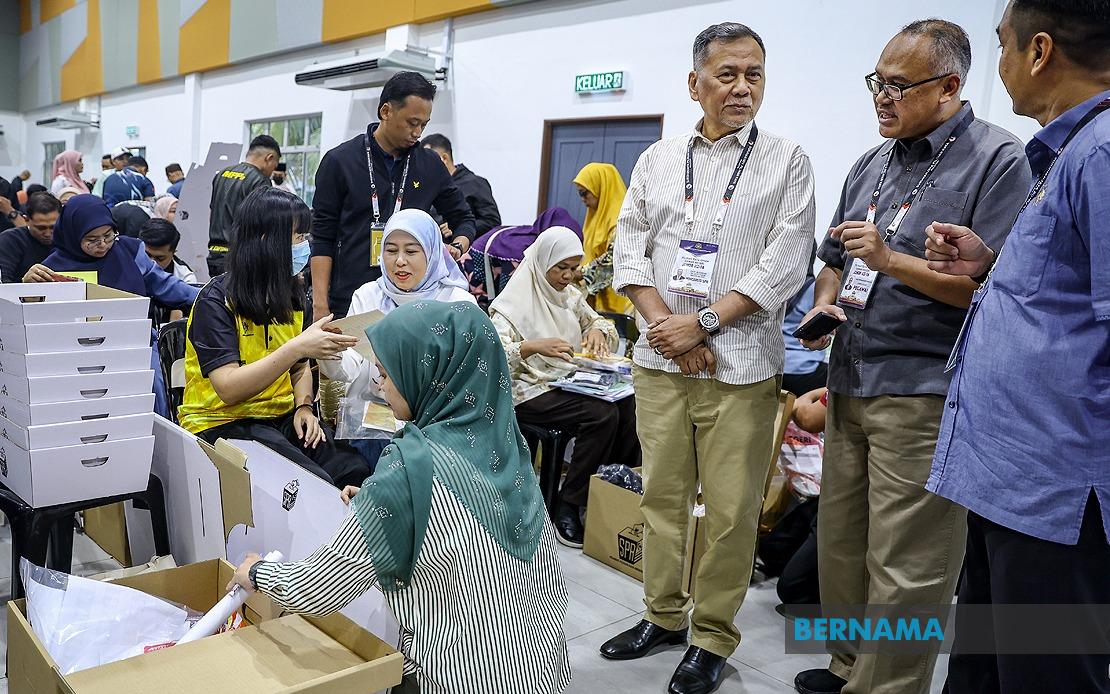
The Election Commission in Johor is in its final hours of preparation for the 16th State Election, with personnel across the southern state working through last-minute checks to ensure the machinery of democracy functions without hitches when voting begins tomorrow. Commission Chairman Datuk Seri Ramlan Harun confirmed that extensive verification of ballot boxes and electoral equipment for all 56 state seats has been completed, a process he characterised as foundational to delivering a seamless polling day for the state's 2.7 million registered voters.
The thoroughness of these preparations extends well beyond simple checklist compliance. Inspections conducted at the Sultan Ibrahim Jubilee Hall in Pontian and the Permas Multipurpose Hall in Kukup revealed the meticulous nature of the Commission's approach, with Ramlan noting that Returning Officers across all 56 centres have substantially concluded their preparatory duties. This level of coordination represents the institutional backbone that underpins electoral integrity, particularly crucial in a state like Johor where demographic diversity and geographic spread present genuine logistical complexity.
On the ground, the reality of these preparations is reflected in activities at individual polling centres. At Sekolah Kebangsaan Bukit Mutiara, election personnel were engaged in labelling materials, arranging furniture, and installing directional signage—the unglamorous but essential work that transforms ordinary school buildings into functional voting venues. For the Puteri Wangsa constituency, 12 classrooms have been converted into separate polling streams, with 74 election staff and a security detail of 12 police officers allocated to manage approximately 3,000 expected voters in that centre alone.
The scale of this operational effort becomes clearer when examining individual constituencies. In Kluang's Mahkota state seat, 30 personnel spent considerable effort establishing five polling streams specifically designed to process around 3,000 voters efficiently. Similar preparatory intensity characterised activities in Batu Pahat, where the Sekolah Menengah Kebangsaan Dato' Seth in Yong Peng received special attention to accessibility arrangements, reflecting growing recognition that voting accessibility for elderly citizens, younger first-time voters, and persons with disabilities directly impacts electoral participation rates.
Accessibility measures have become more sophisticated than mere token gestures. The Commission has explicitly provided wheelchairs and mobility assistance at polling centres, acknowledging that infrastructure design either facilitates or impedes democratic participation. This attention to physical accessibility carries broader implications for electoral legitimacy—when voters face barriers to voting, regardless of intent, it undermines the representative principle underlying democratic governance.
The geographic complexity of Johor, however, presents unique challenges that standard polling centre arrangements cannot easily address. The Mersing area, encompassing the Tenggaroh constituency, encompasses four island communities: Pulau Aur, Pulau Pemanggil, Pulau Sibu, and Pulau Tinggi. Transporting ballot boxes and election materials to these islands via Mersing Jetty required mobilisation of approximately 50 personnel, supported by security contingents from both the Marine Police Force and district police headquarters. This logistical undertaking underscores how electoral administration in Malaysia must adapt to diverse geographic realities, from urban conurbations to isolated island communities.
Voter participation in these remote areas depends substantially on the reliability of these maritime operations. When island residents must vote via materials transported across water, any breakdown in coordination threatens their ability to exercise franchise rights. The tight security escort accompanying these operations reflects not merely procedural caution but recognition that maintaining public confidence in electoral integrity requires transparent demonstration of proper asset protection.
The electoral field itself presents considerable diversity, with 172 candidates contesting the 56 seats. Pakatan Harapan and Barisan Nasional both field complete slates across all constituencies, presenting voters with two established national coalitions. Perikatan Nasional contests 33 seats, representing the emergence of a third major contending force in Malaysian electoral politics. Smaller parties including Parti Bersama Malaysia, MUDA, Malaysian Orang Asli Party, and the Socialist Party of Malaysia collectively field 21 candidates, while six independent candidates provide further choice.
This candidate diversity reflects evolving patterns in Malaysian electoral competition. The substantial presence of Perikatan Nasional candidates across more than half the state constituencies indicates consolidated opposition positioning, while smaller party participation—particularly MUDA's four candidates—suggests younger voters possess alternative institutional channels beyond the dominant coalition framework. These structural patterns will substantially influence campaign dynamics and voter decision-making across Johor's diverse communities.
Voters have received guidance regarding participation protocols that, while seemingly routine, carry practical importance for overall voting efficiency. The Commission recommends that voters use their designated time slots to prevent centre congestion—advice becoming increasingly critical as states implement staggered voting arrangements to manage pandemic-related health protocols and infrastructure constraints. Voters are reminded to bring identity cards and follow polling officials' instructions, procedural compliance requirements that experience demonstrates require active reinforcement despite widespread voter familiarity with electoral processes.
The Commission's preparations reflect institutional learning accumulated across multiple recent electoral cycles. Each election cycle generates operational experience that improves subsequent performance. The attention to physical accessibility, the coordination of island-based voting logistics, and the management of multiple polling streams across diverse locations demonstrates an institution becoming progressively more sophisticated in administering elections across Malaysia's geographic and demographic complexity.
As Johor's voters prepare to participate tomorrow, these behind-the-scenes preparations largely invisible to the public establish the infrastructure within which democratic choice occurs. The 2.7 million registered voters across 56 constituencies will encounter polling centres that, owing to these final preparations, should function smoothly. Whether this technical competence translates into high participation rates and broad voter confidence will become apparent only after voting concludes and results are declared, but the Commission's meticulous preparation work certainly establishes a solid foundation.

