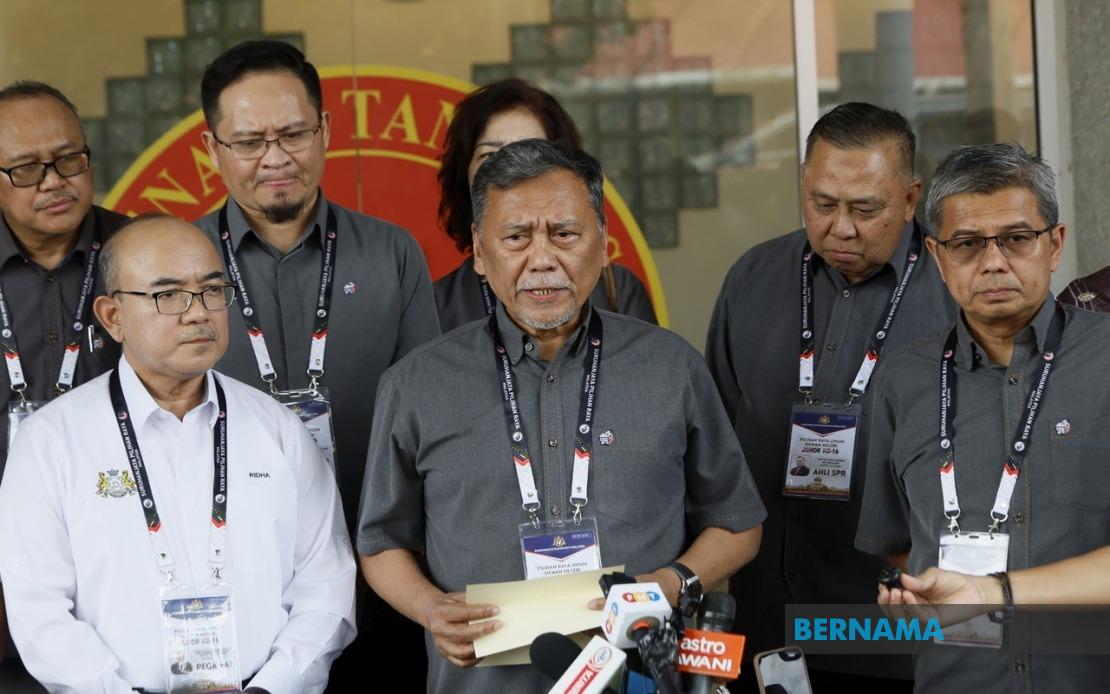
The Election Commission has set an ambitious 96 per cent turnout target for the early voting phase of the Johor state election, reflecting confidence in strong participation from military and police voters who form the core of this preliminary polling segment. EC chairman Datuk Seri Ramlan Harun disclosed the projection during a visit to observe voting procedures at Kem Mahkota in Kluang, indicating that the commission's expectations are grounded in established patterns from previous electoral cycles where early voting has consistently achieved comparable participation levels.
The logistical framework for early voting encompassed 62 dedicated polling centres distributed across Johor, each opening at 8 am to accommodate the restricted voter cohort. The temporal staggering of centre closures reflected organisational efficiency and voter convenience, with 29 locations concluding operations at noon, five additional centres closing at 2 pm, and the remaining 28 facilities operating until 5 pm. This graduated schedule enabled the commission to manage voting flows while ensuring adequate time for all eligible electors to participate.
The early voting electorate comprised 20,607 registered voters drawn exclusively from security sector families. This group included 8,544 military personnel and their spouses, alongside 12,063 police officers and their dependents. The reliance on these organised, disciplined voter blocs typically produces reliable turnout figures, which partly explains the commission's confidence in achieving the 96 per cent projection. Military and police voters generally demonstrate higher civic participation rates than the general population, influenced by institutional culture and occupational requirements.
Election security and ballot integrity formed critical considerations in the commission's procedural design. All completed early ballot papers were to be transferred to police stations immediately following the close of each voting centre, where they would remain under secure custody until the commencement of the official counting process. This arrangement ensured tamper-proof storage while preventing premature result disclosure that might influence the general voting phase scheduled for Saturday.
The decision to delay early vote counting until Saturday evening represented a deliberate structural choice to maintain electoral integrity and prevent information asymmetries. Ramlan indicated that tallying would commence at 5 pm on Saturday, with expectations that comprehensive results would be announced by 10 pm, though the commission remained cautiously optimistic about achieving earlier disclosure by midnight. This timing strategy balanced the desire for swift result announcement against the procedural requirements of systematic, verifiable counting.
With 2.7 million ordinary voters eligible to participate in the general polling phase, the Election Commission extended an appeal for maximum citizen engagement, framing electoral participation as a fundamental democratic responsibility. The appeal sought to mobilise the broader electorate beyond the restricted early voting cohort, encouraging all registered voters to treat the Saturday ballot as a meaningful opportunity to exercise their constitutional rights and contribute to democratic governance at the state level.
The Johor state election represented a significant political event within Malaysia's electoral calendar, requiring comprehensive organisational coordination across multiple layers of administration. The Commission's structured approach to early voting, incorporating temporal staggering, geographically distributed centres, and robust security protocols, reflected institutional learning from previous electoral exercises and demonstrated systematic refinement of democratic processes.
Early voting mechanisms serve particular importance in Malaysian electoral practice by accommodating voter segments whose occupational duties would otherwise prevent participation during general polling. By institutionalising this accommodation for military and police personnel, the electoral system recognises both the security demands that constrain these voters' availability and the principle of universal suffrage that requires alternative pathways to democratic participation.
The projection of 96 per cent early voting turnout should be contextualised within broader participation trends across Malaysia's electoral history. While early voting consistently registers higher participation percentages than general voting phases, the commission's confidence in achieving this specific benchmark reflected accumulated data from comparable electoral exercises. The discipline and organisational capacity of military and police institutions typically translate into reliable voter mobilisation, distinguishing this electorate from general population voting patterns.
The Saturday polling day would represent the culmination of the electoral process and the primary opportunity for the vast majority of Johor's electorate to exercise their franchise. The commission's emphasis on public participation and civic responsibility sought to cultivate broad-based engagement with the democratic process, extending beyond the organised participation of security sector voters to encompass the wider citizenry. Turnout levels in the general polling phase would substantially influence perceptions of the election's legitimacy and representativeness within Malaysian political discourse.

