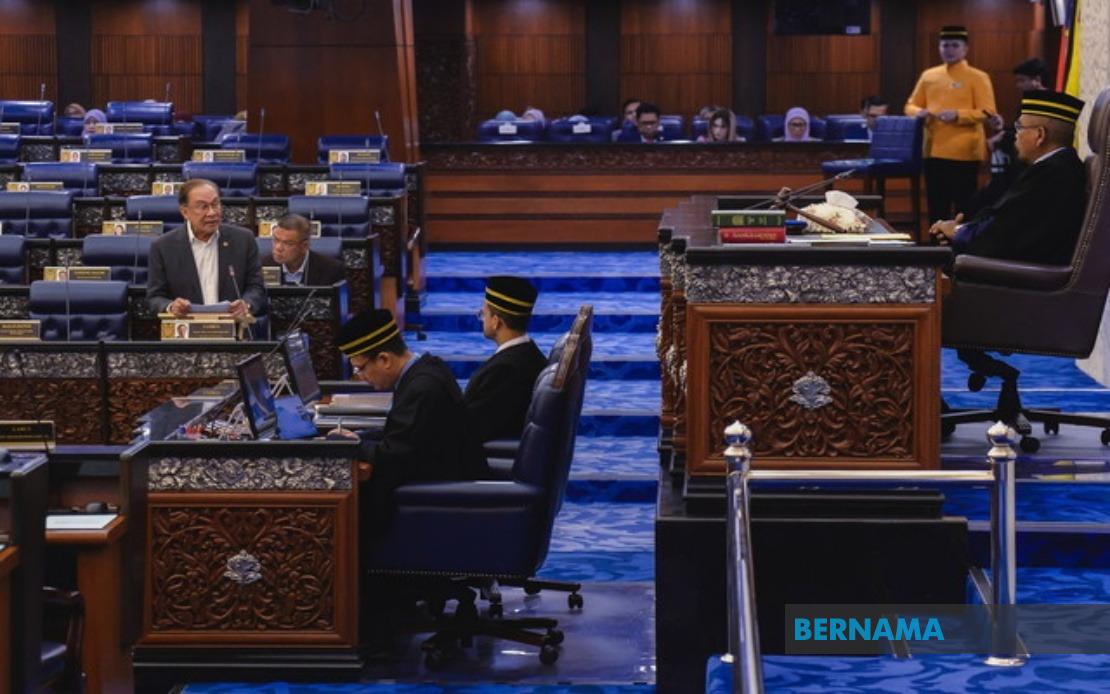
Prime Minister Datuk Seri Anwar Ibrahim has reinforced the government's commitment to enforcing election regulations that ban the announcement of fresh projects or policies during campaign periods, responding to parliamentary questions about compliance ahead of upcoming state elections. The restriction applies uniformly across all levels of governance, from federal to local authorities, and forms a cornerstone of Malaysia's electoral framework designed to ensure fair competition among candidates and parties.
The legal foundation for this prohibition rests on Section 24B of the Election Offences Act 1954, which Anwar cited during parliamentary proceedings. The Prime Minister's reaffirmation comes at a critical moment, as Malaysia prepares for state elections in Johor, Melaka, and Negeri Sembilan. The timing of his statement underscores the government's determination to maintain electoral integrity and prevent the misuse of state resources that could unfairly advantage the ruling coalition.
During Minister's Question Time in the Dewan Rakyat, Anwar elaborated on what constitutes a violation of these regulations. Government machinery at all levels—whether city councils, state governments, or federal agencies—cannot be mobilised to trumpet fresh initiatives once the nomination process begins. This stipulation reflects a broader principle that campaign periods should be characterised by merit-based competition rather than administrative leverage. The restriction extends to both direct project announcements and policy pledges, recognising that new policy commitments can be equally influential in swaying voters.
A significant exception exists within the framework, however. Anwar clarified that projects which have already received formal approval and budgetary allocation in previous federal budgets do not fall foul of election regulations. This distinction is crucial, as it allows governments to continue implementing pre-approved infrastructure or development initiatives without unnecessarily hampering the delivery of public services. The carve-out recognises the practical reality that governments must continue functioning during election periods while still maintaining fair electoral standards.
The question posed by Datuk Seri Dr Shahidan Kassim of Perikatan Nasional represents the variety of concerns that arise when multiple elections occur across different states. Opposition figures and government scrutineers alike focus on enforcement mechanisms, understanding that rules without rigorous supervision become merely symbolic gestures. Anwar's response signals that the government takes these concerns seriously and views the upcoming state elections as an opportunity to demonstrate electoral compliance at the highest levels.
Enforcement of these provisions typically falls to the Election Commission, which possesses investigative powers and can examine whether announcements qualify as genuinely new projects or merely re-announcements of previously sanctioned initiatives. This institutional responsibility creates a buffer between political actors and the adjudication of electoral propriety. Yet questions persist about whether the distinction between new and pre-approved projects can always be applied cleanly in practice, particularly when government messaging emphasises fresh commitments to existing frameworks.
For Malaysian voters and the broader democratic process, such regulations serve essential functions. Election campaigns should theoretically occur on relatively level ground, where candidates compete through their vision, track record, and policy platforms rather than through privileged access to state resources and machinery. When governments can freely announce projects during campaigns, voters face difficulty distinguishing between genuine electoral choice and engineered consensus driven by administrative advantage. The prohibition therefore aims to preserve the principle that electoral outcomes should reflect genuine voter preference.
The relevance of these rules extends beyond the immediate state elections. Since Malaysia operates within a Westminster-influenced system where governments hold considerable administrative power, continuous vigilance about electoral propriety becomes necessary. Opposition parties depend on equal enforcement of such rules to level the playing field, while governments must prove their commitment to fairness even when doing so constrains their own strategic options. This delicate balance defines the maturity of Malaysian democracy.
Southeast Asian perspectives on electoral regulation underscore how Malaysian standards compare regionally. Neighbouring democracies face similar challenges regarding resource misuse during campaigns. Malaysia's formal codification of these principles, even if enforcement remains imperfect, represents an institutional attempt to manage these tensions. The ongoing discussion about compliance reinforces that these rules exist not as mere formalities but as contested terrain where political actors negotiate the boundaries of acceptable campaign behaviour.
Looking forward, the Johor, Melaka, and Negeri Sembilan elections will test whether stated principles translate into consistent practice. Media scrutiny, opposition monitoring, and institutional oversight mechanisms will collectively determine whether the government's restatement of these rules proves substantive or merely rhetorical. The Prime Minister's parliamentary clarity reduces ambiguity about official policy, creating benchmarks against which future conduct can be measured and evaluated.

