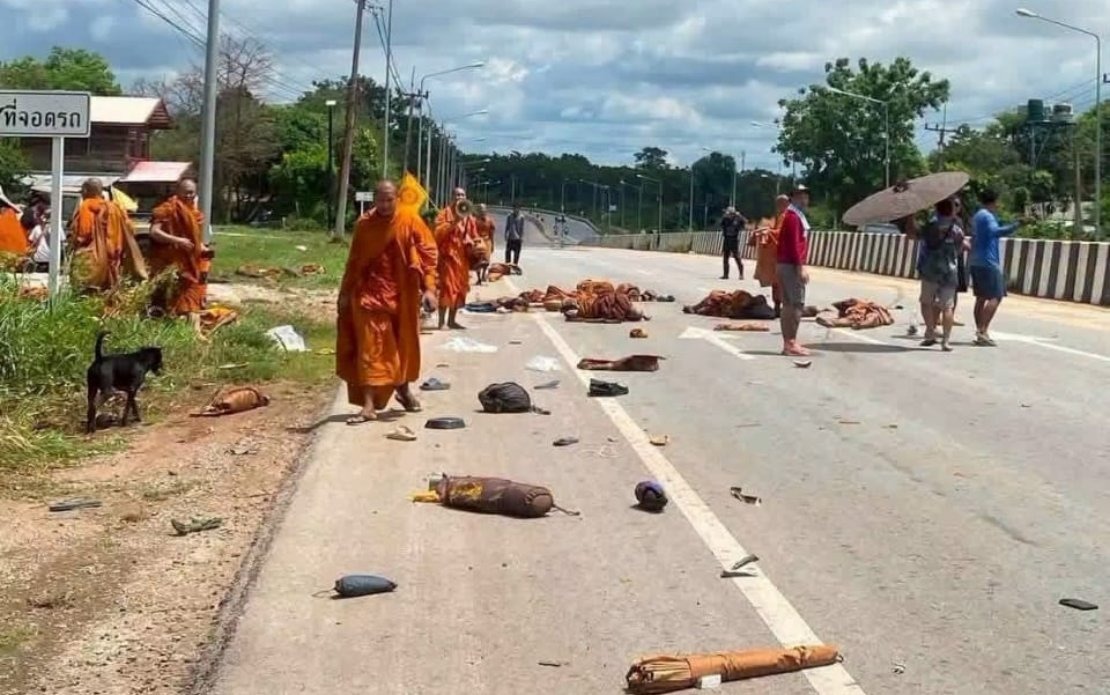
A tragic road accident in Thailand's Mukdahan province on Thursday claimed the lives of eight Buddhist monks and left another 14 injured when a pickup truck veered into a religious pilgrimage group walking along a provincial highway. The collision represents one of the most serious incidents involving monks in the region in recent years, raising fresh concerns about road safety in rural Thailand and parental oversight of young drivers across Southeast Asia.
The monks had embarked on their spiritual journey at approximately 11 am, undertaking a foot pilgrimage from their starting point toward Nam Khun district in the neighbouring Ubon Ratchathani province. According to accounts from Mukdahan authorities, the group was adhering to established pedestrian safety protocols by walking against the direction of vehicular traffic along Ban Na Si Nuan Road in Mueang district. This decision to face oncoming traffic, a standard safety measure taught across Thailand, proved insufficient to prevent the catastrophe that unfolded.
The immediate impact of the collision proved devastating. Five monks perished at the accident scene, their deaths confirmed by emergency responders dispatched to Ban Na Si Nuan Road. Three additional monks, who survived the initial impact, subsequently died from their injuries while receiving treatment at a local hospital. The deaths occurred across two locations—the roadside and the medical facility—highlighting the severity of the injuries sustained in the crash. Dr Narong Chankaew, Mukdahan Provincial Public Health Chief, confirmed that four victims suffered critical injuries requiring intensive medical intervention, while ten others sustained moderate injuries necessitating hospitalisation.
The scale of the incident extended beyond the fatal casualties. A total of 23 individuals, comprising 22 monks and one civilian laysperson, were admitted to Mukdahan Hospital for treatment and observation. This mass admission strained hospital resources and triggered an emergency appeal for blood donations to sustain the treatment operations for the injured survivors. The involvement of civilians alongside the religious community underscored the unpredictability of road accidents and their capacity to affect multiple segments of society simultaneously.
Eye-witness testimony gathered at the scene revealed that the pickup truck had suddenly lost control before deviating from the roadway in a direction that brought it directly into contact with the walking group. The monks who initially spotted the vehicle's trajectory managed to escape harm, with five individuals successfully evading the errant truck. However, the remaining members of the pilgrimage group, positioned approximately two metres from the road's edge, could not react with sufficient speed. They bore the full force of the collision, absorbing the impact from the vehicle that had careened off the asphalt.
The driver involved in the incident emerged as a significant detail in the investigation. Mukdahan Provincial Police Commander Police Major General Phairoj Thaiputra disclosed that the individual operating the pickup truck was a juvenile under 15 years of age. The driver was taken into police custody immediately following the crash, marking the beginning of what authorities acknowledged would be a comprehensive investigative process. The involvement of a child driver immediately shifted focus toward questions of supervision, vehicle access, and the circumstances that enabled an underage individual to operate a motor vehicle on a public thoroughfare.
Investigative authorities have initiated a multi-faceted inquiry into the root causes of the accident. Police Major General Phairoj Thaiputra outlined that investigators are actively gathering physical evidence from the crash site while simultaneously conducting detailed questioning of the juvenile driver and their parents. This dual approach seeks to establish precisely what circumstances led to the truck losing control and veering toward the pedestrian group. The investigation encompasses mechanical factors related to the vehicle itself, environmental conditions such as road surface or weather, and human factors related to the driver's actions and state.
The potential for criminal liability has extended beyond the young driver to their parents. Police authorities are actively considering whether negligence charges could be brought against the child's guardians for permitting an underage individual to operate the vehicle. This investigative angle reflects broader accountability frameworks that seek to identify systemic failures enabling such incidents. The consideration of parental liability demonstrates that Thai law recognises the duty of guardians to prevent minors from engaging in activities that pose risks to themselves and others.
Mukdahan Governor Warayan Boonnarat emphasised that preliminary investigations had confirmed the monks were following established safety protocols at the time of the incident. The governor's statement carried implications for how Thai authorities would frame responsibility, potentially shifting focus toward the driver and vehicle rather than attributing fault to the victims themselves. This framing proved significant given the religious and cultural standing of Buddhist monks in Thai society, where such tragedies provoke deep community response and widespread public concern.
The incident occurs within a context of longstanding road safety challenges across Thailand and the wider Southeast Asian region. Rural provincial roads, including those in Mukdahan, frequently experience accidents involving pedestrians and vehicles, though collisions of this magnitude remain comparatively rare. The involvement of a juvenile driver reflects broader questions about enforcement of traffic regulations, vehicle ownership restrictions for minors, and parental supervision practices. For Malaysian readers, the incident parallels domestic concerns about young drivers operating vehicles without proper licensing or oversight, issues that have prompted periodic enforcement campaigns and public safety initiatives.
Buddhist communities across Thailand and neighbouring countries have expressed shock and sorrow at the deaths of the eight monks. The pilgrimage they were undertaking represents a central spiritual practice in Theravada Buddhism, making their deaths particularly poignant within religious contexts. Temple communities in Mukdahan, Ubon Ratchathani, and surrounding provinces have begun conducting commemorative activities, while the incident has sparked broader discussions about monk safety during religious activities and the responsibilities of secular authorities to protect religious practitioners.
The legal proceedings against the juvenile driver will unfold under Thailand's juvenile justice framework, which emphasises rehabilitation over punitive measures for offenders under 15 years of age. Police Major General Phairoj Thaiputra stated that legal action would proceed in accordance with applicable Thai law, though the specific charges and sentencing framework remain subject to investigation outcomes and prosecutor discretion. The case will likely attract sustained attention from Thai media and civil society organisations focused on road safety and youth driver accountability.

