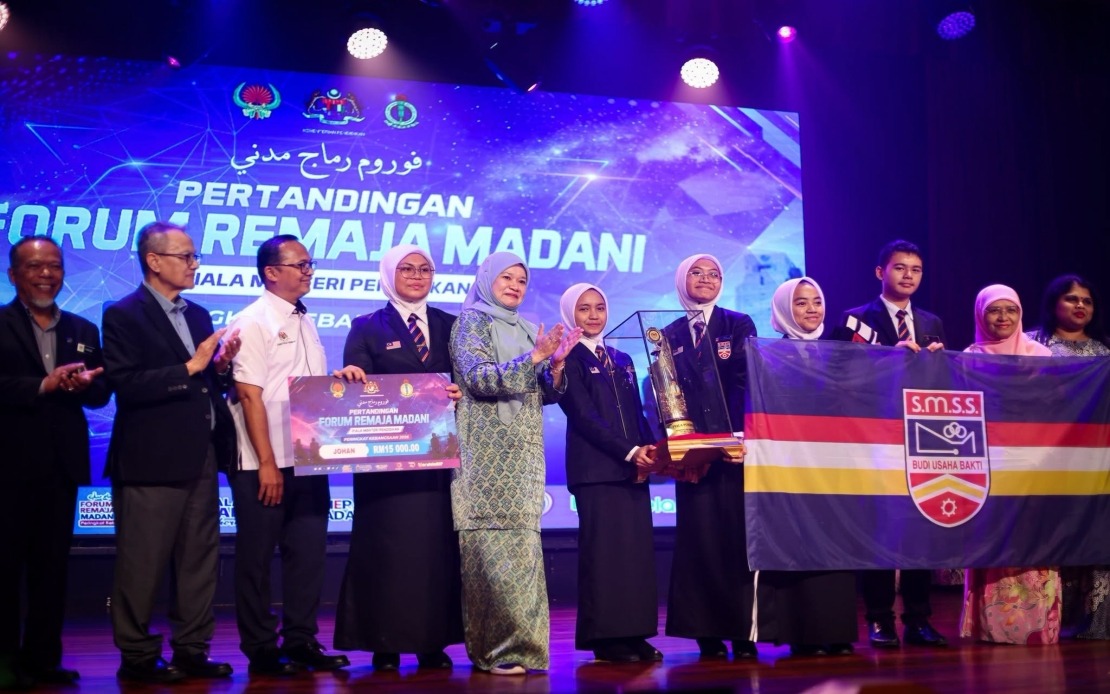
Education Minister Fadhlina Sidek has outlined a vision for character development that goes beyond traditional moral instruction, arguing instead that schools should cultivate environments where young people feel empowered to articulate their perspectives while engaging thoughtfully with those who disagree. Speaking after observing the National MADANI Youth Forum, Fadhlina described witnessing participants learn to formulate and defend their positions while simultaneously remaining open to alternative viewpoints—a balance she characterizes as the essence of modern character education.
The minister's remarks represent a significant shift in how Malaysia's education establishment approaches youth development. Rather than emphasizing conformity or passive acceptance of established norms, Fadhlina's framework prioritizes active intellectual engagement. She stressed that educators bear responsibility not for dictating what young people should think, but for equipping them with the foundational knowledge and rhetorical tools necessary to construct coherent arguments and the social grace to listen when others present competing ideas.
This approach carries particular significance for Malaysia, where discussions around freedom of expression and political participation have often reflected generational tensions. Young Malaysians increasingly demand meaningful avenues for civic engagement, yet traditional educational models have sometimes prioritized discipline and hierarchy over dialogue. Fadhlina's emphasis on encouraging youth to "speak up confidently" acknowledges this evolving expectation while grounding it in frameworks of mutual respect and intellectual rigor.
Central to the minister's vision is the notion that mature democratic societies do not require unanimous agreement. Rather, she argued, national strength derives from populations that understand how disagreement functions—how to challenge ideas without attacking individuals, how to defend positions without dismissing opponents, and how to navigate profound differences while maintaining social cohesion. This distinction between disagreeing with ideas and disrespecting people represents a crucial pedagogical goal for a diverse, multi-ethnic nation like Malaysia.
Fadhlina further connected character education to language policy, specifically the promotion and strengthening of Malay as Malaysia's national language. She observed that the Malay language would achieve renewed vitality among younger generations only if they perceived it as a dynamic medium capable of expressing complex thoughts, contemporary concerns, and innovative ideas. When youth view a language primarily as an obligation or historical artifact rather than a living tool for self-expression, engagement inevitably diminishes. By contrast, when students see their national language as an instrument for articulating their authentic voices, adoption becomes intrinsically motivated.
The minister's framing suggests that language revitalization efforts must align with broader educational objectives around critical thinking and self-expression. Creating dedicated forums and spaces where young people can engage in substantive discussions conducted in Malay addresses both linguistic and pedagogical goals simultaneously. Such initiatives demonstrate practical respect for youth perspectives while normalizing the use of Malay in intellectual and political discourse.
Fadhlina's comments reflect wider regional conversations about how Southeast Asian nations should prepare young people for participation in increasingly complex societies. Across the region, governments grapple with balancing social stability and national cohesion against younger generations' demands for voice, transparency, and meaningful engagement in decisions affecting their futures. Malaysia's approach—emphasizing critical thinking, respectful disagreement, and confident self-expression—positions youth development as fundamentally compatible with democratic values and national unity rather than in tension with them.
The concept of character education presented here also responds to contemporary concerns about polarization and misinformation. When young people develop genuine critical thinking skills—the capacity to evaluate sources, recognize logical fallacies, and distinguish between reasoned argument and emotional manipulation—they become more resistant to divisive messaging and more capable of navigating disagreement productively. Fadhlina's framework treats critical thinking not as an academic skill confined to classroom exercises but as a life competency essential for citizenship.
Implementing such an approach requires significant shifts in classroom practice, teacher training, and curriculum design. Educators must themselves model respectful engagement with ideas they find challenging, create safe spaces for students to voice unpopular opinions without fear of reprisal, and facilitate discussions where competing viewpoints receive serious consideration. These demands extend beyond traditional subject matter expertise into territory requiring emotional intelligence, facilitation skills, and genuine commitment to pluralistic values.
Fadhlina's emphasis on courtesy alongside critical thinking also addresses concerns about online discourse and youth activism. As young Malaysians increasingly engage in political and social commentary through digital platforms, developing norms around respectful disagreement becomes crucial. The minister's vision suggests that assertiveness and civility are complementary rather than contradictory—one can speak boldly while remaining courteous, defend positions firmly while acknowledging legitimate counterarguments.
Looking forward, translating these principles into systematic educational change will test Malaysia's institutional capacity and political will. The vision Fadhlina articulates—of young people confidently exercising voice while respecting difference—represents an investment in long-term social resilience and democratic maturity. Whether schools, parents, and communities embrace this model with sufficient commitment will significantly influence how Malaysia's next generation engages with critical national conversations.

