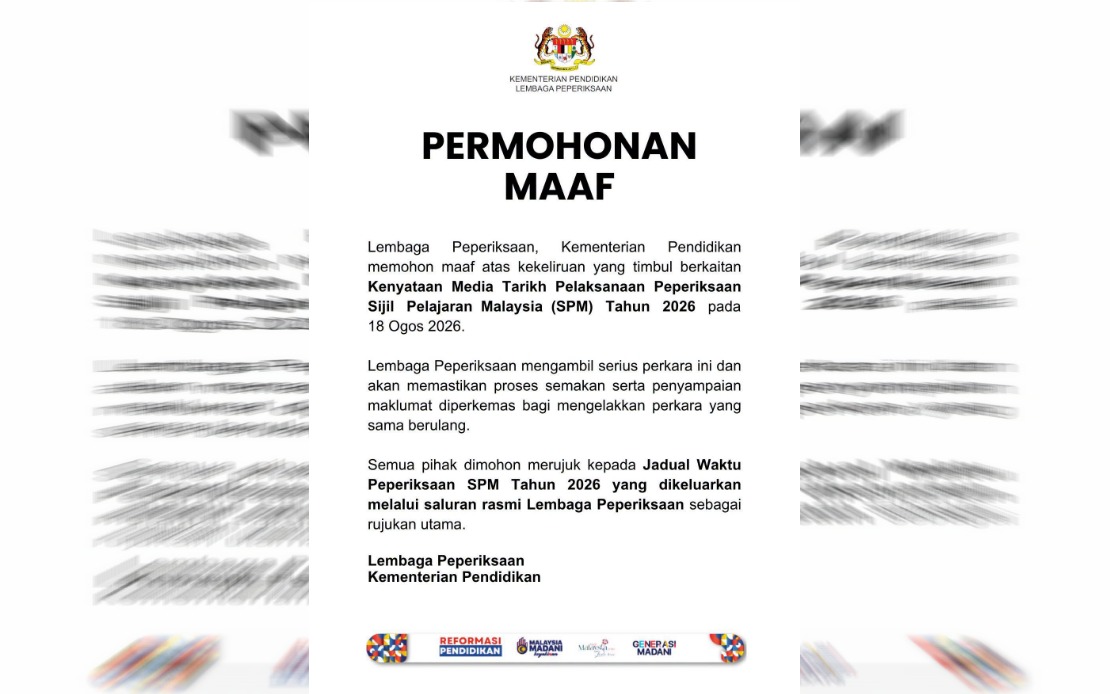
The Examination Board under the Ministry of Education has acknowledged and apologised for the confusion surrounding a press release issued yesterday regarding the implementation schedule for the 2026 Sijil Pelajaran Malaysia examination. In a follow-up statement released today, the Board indicated that the matter has been treated with appropriate gravity and assured stakeholders that review mechanisms and information delivery procedures will be strengthened to forestall similar incidents in the future.
The clarification comes as significant relief to students, parents, educators, and school administrators who depend on accurate and timely information from official channels to plan examination preparations and logistical arrangements. The confusion underscores the critical importance of precision in official communications, particularly when announcements affect hundreds of thousands of Malaysians. Given the high stakes involved in national examinations, even minor discrepancies in scheduling information can create unnecessary anxiety and disrupt study timetables across the country.
The Examination Board has specifically instructed all interested parties to rely exclusively on the official 2026 SPM Examination Timetable distributed through its designated communication channels. This directive is intended to eliminate any lingering uncertainty and establish a single authoritative reference point for all stakeholders. By consolidating information distribution through established official pathways, the Board aims to prevent the proliferation of conflicting or outdated details that may have contributed to yesterday's confusion.
The 2026 SPM examinations are scheduled to commence on November 23 and conclude on December 17, a seven-week window that encompasses the crucial pre-holiday examination period. This timeline is significant for Malaysian secondary education as it positions the national examination during the final quarter of the academic year, with results likely to be released early in 2027. The schedule carries implications for university admission timelines and the broader tertiary education intake process across Malaysia's higher education institutions.
Registration data reveals substantial participation in the upcoming examination cycle, with exactly 420,879 candidates having enrolled to sit for the 2026 SPM across 3,334 examination centres distributed nationwide. This figure represents the baseline cohort of examination candidates and underscores the massive logistical undertaking required to administer the national qualification examination. The distribution of test centres across the country reflects efforts to ensure geographical accessibility for students in both urban and rural areas.
For Malaysian readers and those with children approaching this examination milestone, the incident highlights the importance of verifying information through official government portals and education ministry websites rather than relying on secondary sources or social media circulation. Parents and students should bookmark the Examination Board's official website and enable notifications to receive any subsequent announcements regarding examination procedures, result release dates, or any further schedule modifications.
The examination board's acknowledgment of the administrative error represents a best practice approach to public accountability. By transparently admitting the mistake and outlining corrective measures, the Board has attempted to restore confidence in its operational competence. Such transparency is particularly important in the education sector, where public trust directly influences student and parental confidence in the examination system's integrity and fairness.
The strengthening of review and information delivery processes mentioned in the statement suggests that the Examination Board will implement more rigorous verification protocols before releasing official announcements. This may involve multi-stage approval mechanisms, cross-checking between departments, and potentially expanded testing of communications before public distribution. These procedural improvements, while not preventing all errors, should significantly reduce the likelihood of similar confusion arising during future examination administration cycles.
For schools and educational institutions nationwide, yesterday's confusion may have created temporary scheduling complications as staff attempted to reconcile conflicting information. Today's clarification allows these institutions to revert to their original planning and preparation frameworks. However, schools may wish to double-check that all internal communications regarding examination dates have been updated to reflect the official schedule, ensuring consistency across all levels of their organisations.
The incident also carries implications for how Malaysian government agencies communicate with the public during peak information periods. As the education sector continues to modernise its examination systems and introduce new assessment methodologies, the reliability and timeliness of official communications become increasingly central to public confidence. The 2026 SPM examination represents a continuation of Malaysia's commitment to standardised national assessment, and administrative clarity is essential to supporting this educational objective.

