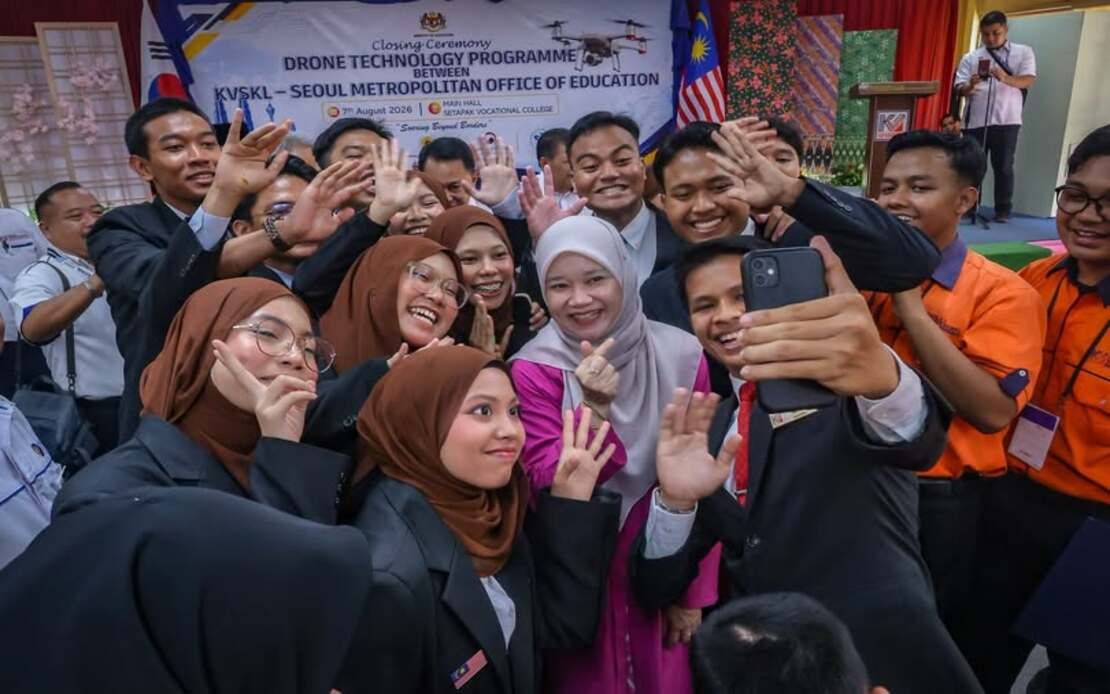
Education Minister Fadhlina Sidek has set an ambitious challenge for students at Setapak Vocational College: develop practical drone-based security solutions for their campus within the next month. The initiative reflects a broader strategic effort within Malaysia's education system to bridge the gap between classroom learning and real-world problem-solving, particularly in emerging technologies that are reshaping global workforces.
The challenge emerged during a collaborative programme between the Seoul Metropolitan Office of Education and Setapak Vocational College, attended by South Korean Ambassador to Malaysia Yeo Seung-bae. This partnership underscores Malaysia's growing recognition that technical education must increasingly draw on international expertise and best practices, particularly from technology-advanced nations like South Korea. The exchange programme creates a structured environment for students to not merely observe drone operations but to conceptualise solutions grounded in their immediate surroundings.
Fadhlina articulated a vision of technical education that extends beyond operational competency to encompass critical thinking and innovation. Her insistence that students present comprehensive proposals demonstrates an expectation that practical knowledge should translate into substantive strategic thinking. She emphasised that simply learning to pilot drones represents only the first step; students must progress toward identifying genuine institutional challenges and engineering technological responses to address them. This pedagogical approach mirrors skills demanded by contemporary employers across multiple sectors.
During her visit, Fadhlina observed students demonstrating various technological capabilities, including drone flights, robotic operations, and hands-on technological engagement. She noted that not all attempts succeeded, yet characterised these setbacks as integral to authentic learning rather than failures. This framing is significant because it normalises the iterative, often frustrating nature of technological problem-solving and encourages students to view errors as data rather than defeats. Such resilience-building proves essential when students eventually encounter workplace challenges requiring persistence and creative troubleshooting.
The minister's remarks reflected an understanding that robotics, drone technology, and artificial intelligence have transitioned from theoretical constructs to practical tools already embedded within contemporary economic structures. Malaysian education has historically struggled with a perception gap where cutting-edge technologies seem remote from daily institutional reality. By situating drone applications within the tangible context of campus security, Fadhlina anchors abstract technological concepts in concrete, locally relevant problems that students can comprehend and address.
This initiative arrives amid broader international conversation about skills mismatches in Southeast Asia's workforce development. Countries across the region grapple with the tension between traditional educational approaches emphasising theoretical knowledge and employer demands for applied technical capabilities combined with creative problem-solving. Malaysia's vocational education sector, which serves students who may not pursue traditional university pathways, stands positioned to lead in this transformation if institutions can effectively integrate emerging technologies into curricula while maintaining pedagogical rigour.
The one-month timeline creates meaningful urgency without imposing impossible constraints, potentially yielding sophisticated proposals from motivated student cohorts. Setapak Vocational College students will benefit from exposure to Seoul's educational methodologies during this collaboration, potentially observing how South Korean institutions integrate technological innovation into technical curricula. This cross-cultural knowledge transfer could catalyse systemic improvements extending beyond this single campus.
Security applications represent a particularly appropriate use case for student drone projects. Educational institutions worldwide increasingly employ drone technology for perimeter monitoring, facility inspection, and rapid threat assessment—making this challenge directly applicable to vocational students' future employment prospects. Students completing this project will possess portfolio evidence of applied technical capability, strengthened problem-solving processes, and documented innovation experience that distinguishes them in competitive labour markets.
The challenge also signals governmental commitment to vocational pathway legitimacy. By publicly championing student innovation at a vocational college, Fadhlina reinforces messages that technical education produces capable innovators rather than merely trained operatives. This attitudinal shift remains essential for attracting capable students toward vocational trajectories rather than exclusively academic ones, addressing Malaysia's persistent skills shortages in technical fields where vocational graduates could significantly contribute.
Looking forward, the outcomes from Setapak's drone security challenge could establish replicable models for other vocational institutions nationwide. Successful student proposals might inform actual institutional security enhancements whilst simultaneously creating templates for future challenges. Such success would demonstrate that Malaysian vocational education can produce locally-rooted technological solutions rather than merely consuming imported expertise.
The broader implications extend to Malaysia's positioning within Southeast Asia's digital economy. As regional competitors increasingly integrate advanced technologies into educational frameworks, Malaysia must demonstrate equivalent commitment to developing innovation-capable workforces. Fadhlina's challenge, whilst focused on one vocational college, emblematises aspirations for systemic educational modernisation aligned with technological realities shaping twenty-first century employment.

