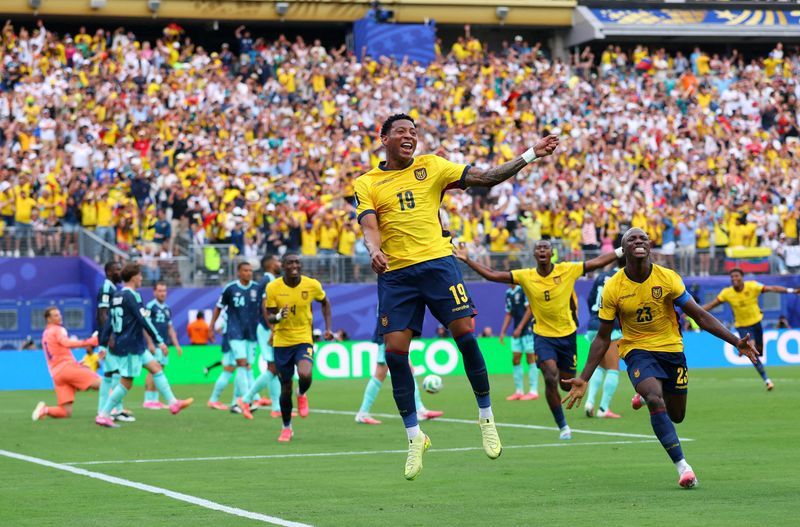
Ecuador delivered one of the tournament's most dramatic turnarounds at the New Jersey stadium on Thursday, overcoming an early German onslaught to claim a 2-1 victory that propelled them into the World Cup's last 32. The South American outfit arrived at the match facing elimination after a disappointing draw and defeat in their opening games, but produced a resilient comeback that defied their prior struggles and breathed new life into their campaign.
The Germans came out with characteristic intensity, capitalising on Ecuador's nervous start when Leroy Sane finished clinically in just the second minute. The winger, making his 15th appearance in major international competition, seized on a quick throw-in and incisive pass from Florian Wirtz to apply a left-footed strike from inside the penalty area. The goal appeared tainted by a controversial challenge in the build-up, with Aleksandar Pavlovic's raised foot catching Pedro Vite in the head, yet referee Tori Penso adjudged the play legal and the goal stood—a decision that would prove pivotal in shaping the remainder of the contest.
Ecuador's response came with remarkable swiftness, showcasing the attacking intent their tournament had previously lacked. After managing 39 shots without finding the net in their opening matches, the team finally broke their scoring drought in the ninth minute when Nilson Angulo executed a delicate curled finish from the edge of the box. Manuel Neuer's positioning suggested hesitation, and Angulo ruthlessly exploited the gap to draw the sides level. The goal triggered jubilant scenes among Ecuador's supporters, whose yellow-clad contingent transformed the sold-out stadium into a sea of colour and noise.
Despite Germany's status as group winners requiring only a draw, the defending champions remained dangerous throughout the second period. Their confidence received a boost in the 54th minute when the referee awarded a penalty after Felix Nmecha released Kai Havertz into the box, with Joel Ordonez appearing to impede the German forward's progress. The decision, however, did not survive VAR scrutiny—officials identified a prior foul by Germany in the build-up and instructed Penso to overturn the award. This reversal proved crucial in maintaining momentum for Ecuador, preventing what would have been a decisive psychological blow.
With clear-cut opportunities proving rare for both sides during the middle stages, the match reached a climactic moment in the 78th minute. Gonzalo Plata demonstrated superior reactions when substitute Kevin Rodriguez flicked a corner kick toward the near post, and the Ecuador midfielder reacted quickest to stab a finish past Neuer. The goal unleashed pandemonium throughout the stadium, as Ecuador's players and supporters celebrated what appeared an unlikely victory against one of world football's traditional powerhouses.
Germany's defensive brittleness throughout the group stage presented a concerning pattern for the tournament's latter rounds. By conceding in all three of their matches, the four-time champions exposed vulnerabilities that opposing teams had efficiently exploited. While the Germans secured top spot with six points and a superior goal difference over Ivory Coast—who defeated Curacao 2-0—their journey to the knockout stage masks deeper structural issues within their defensive organisation.
Ecuador's qualification as one of the eight best third-placed teams represented a remarkable redemption arc. Arriving in New Jersey under considerable pressure and facing realistic elimination, the South Americans summoned the resilience and tactical flexibility required to overcome a superior opponent. Their victory underscores how tournament football can reward teams that combine fighting spirit with clinical finishing, and offers encouragement for other underdog sides still competing for advancement.
The match highlighted the crucial importance of early momentum and psychological advantage in knockout football stages. Germany's early goal appeared to signal a routine passage into the next round, yet Ecuador's immediate response demonstrated that international football remains unpredictable and vulnerable to tactical shifts and emotional swings. The Germans' failure to convert a late penalty opportunity represented another missed chance to stamp decisive authority on the encounter.
For Malaysian and Southeast Asian observers, Ecuador's performance carried particular relevance as a case study in tournament resilience and strategic adaptation. The team's initial struggles highlighted how early tournament results can obscure underlying potential, while their comeback vindicated a commitment to attacking football despite defensive shortcomings. As regional qualification campaigns intensify, Ecuador's example serves as a reminder that tactical discipline combined with individual brilliance can overcome seemingly insurmountable obstacles within the compressed timeframe of group-stage football.

