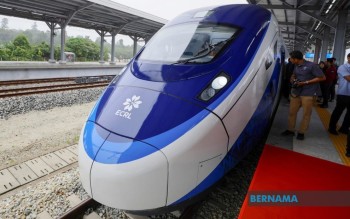
Malaysia's East Coast Rail Link (ECRL) is expected to deliver substantial long-term economic returns, with projections indicating a cumulative contribution of RM80 to RM90 billion to the country's gross domestic product by 2047. According to Deputy Economy Minister Datuk Mohd Shahar Abdullah, these gains will materialise primarily through the development of 21 Economic Accelerator Projects (EAPs) strategically positioned along the rail corridor to maximise wealth creation and investment returns across the East Coast region.
The government's vision for the ECRL extends far beyond its primary role as a transportation conduit connecting the peninsula's east and west coasts. Rather, policymakers are positioning the infrastructure as a transformative economic catalyst capable of reshaping regional development patterns and reversing decades of geographic imbalance that have concentrated wealth and opportunity on the western seaboard. This strategic reframing reflects recognition that modern infrastructure projects must serve multiple functions simultaneously—moving goods and people while simultaneously anchoring industrial clusters and attracting investment capital to underserved regions.
Central to realising these ambitions are three newly designated logistics hubs positioned at key ECRL junction points. Pasir Puteh in Kelantan will feature 213 acres of dedicated logistics space, while Kemaman in Terengganu and Temerloh in Pahang will develop facilities spanning 68 and 50 acres respectively. These hubs represent more than mere cargo-handling facilities; they are intended as comprehensive economic zones designed to integrate transportation, warehousing, light manufacturing, and value-added services. The strategic placement of these nodes at railway nodes reflects sophisticated economic planning aimed at creating natural clustering effects where logistics efficiency becomes a competitive advantage attracting businesses across multiple sectors.
Mohd Shahar emphasised that the ECRL functions as complementary infrastructure within Malaysia's broader logistics ecosystem rather than a disruptive replacement for established international shipping routes. This positioning is particularly significant for Southeast Asia's regional trade dynamics, as it allows the ECRL to enhance rather than cannivalise existing trade networks. For Malaysian businesses engaged in regional commerce, the railway offers an additional efficiency option without rendering current maritime and trucking arrangements obsolete. This inclusive approach increases the likelihood of sustained private-sector investment and operational support from existing logistics providers who might otherwise view the project with competitive concern.
A concrete indicator of private-sector confidence materialised through Perodua's commitment to establish a logistics hub at Paya Besar in Kuantan, with the first phase expected to complete by 2029. Perodua's involvement carries particular symbolic weight, as Malaysia's national automotive manufacturer expanding logistics operations signals confidence in the corridor's medium-term viability and commercial potential. The manufacturing sector's integration with rail-based logistics represents exactly the type of industrial clustering the government seeks to encourage, potentially triggering wider supply-chain optimisation as other manufacturers consider similar facilities.
The broader policy framework supporting these initiatives derives from the 13th Malaysia Plan, which employs sophisticated allocation mechanisms including the Malaysia Development Composite Index and MyRMK system to ensure resources flow toward areas with the greatest development need. This systematic approach prevents infrastructure investment from becoming merely symbolic, instead anchoring it to measurable development indicators. For the East Coast region, long disadvantaged by transport costs and geographic isolation, such targeted investment represents a meaningful policy shift toward spatial equity within national economic development.
The ECRL's physical specifications underscore its hybrid passenger-cargo orientation. The project incorporates 11 six-car electric multiple unit train sets dedicated to passenger services alongside 12 electric locomotives engineered specifically for freight operations. This dual-purpose design reflects transportation planners' understanding that sustainable corridors require both people-movement and goods-movement capabilities; a rail line serving only one function would prove economically underutilised. The electric propulsion technology also aligns with Malaysia's broader environmental commitments while reducing long-term operational costs compared to diesel alternatives.
Financial commitment to the ECRL remains substantial at RM50.27 billion, reflecting serious governmental investment in East Coast transformation. Scheduled for completion in December 2026 with operations commencing January 2027, the project timeline places the infrastructure's full economic impact beyond the current political cycle, suggesting a commitment transcending short-term electoral considerations. This extended timeframe also aligns appropriately with the long-term GDP contribution projections extending to 2047, which reflects realistic expectations for infrastructural economic returns requiring years of accumulated activity and investment clustering.
For Malaysian policymakers, the ECRL represents an attempt to engineer spatial economic redistribution—deliberately shifting investment and opportunity toward historically marginalised regions. Success requires not merely completing construction but nurturing the complementary private investments that transform infrastructure into economic engines. The government's emphasis on the 21 Economic Accelerator Projects suggests recognition that rail corridors alone generate limited economic impact without accompanying industrial activity, logistics operations, and manufacturing clusters. This sophisticated understanding distinguishes the ECRL from purely symbolic infrastructure investments.
The project's significance extends into Southeast Asian regional dynamics, as successful East Coast development could enhance Malaysia's role in regional supply chains and trade networks. Improved East Coast connectivity provides alternative routing options for regional goods movement, potentially reducing congestion on western corridor routes while offering Southeast Asian trading partners additional logistical flexibility. This regional dimension positions the ECRL as more than a domestic development tool but as infrastructure strengthening Malaysia's competitive position within the broader Asian economic landscape.
For investors and businesses evaluating opportunities along the East Coast, the convergence of improved transportation, designated logistics hubs, and governmental commitment through the 13th Malaysia Plan creates conditions favourable to medium-term expansion. Manufacturing enterprises considering relocation or expansion from congested western regions may find ECRL-corridor locations increasingly attractive, particularly as logistics hub infrastructure matures. The Perodua hub and similar industrial anchors provide reference points demonstrating tangible commitment to corridor development.
Ultimately, the RM80 to RM90 billion GDP projection represents not merely an optimistic forecast but a policy target around which the government has structured complementary initiatives and resource allocations. Whether actual outcomes approach these projections will depend substantially on private-sector responsiveness to improved infrastructure and government's sustained commitment to supporting development through mechanisms like the Malaysia Development Composite Index. The ECRL thus represents perhaps the most significant spatial development initiative in contemporary Malaysian planning, offering East Coast regions possibilities for economic transformation previously constrained by geographic handicaps.

