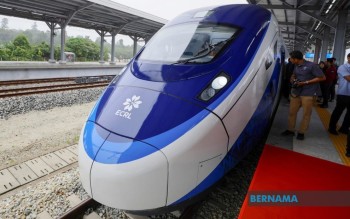
The East Coast Rail Link (ECRL) is positioned to become far more than a transportation artery for the peninsula's east coast region—it represents a comprehensive economic transformation that could fundamentally reshape entrepreneurial possibilities across Pahang, Terengganu, Kelantan and Selangor. According to Datuk Mohd Shahar Abdullah, Deputy Minister of Economy and Member of Parliament for Paya Besar, the infrastructure initiative will catalyse the emergence of an interconnected economic ecosystem extending well beyond conventional rail operations into supply chain development, service provision, and employment generation.
The depth of potential impact extends across multiple dimensions of economic activity. Rather than functioning simply as a conduit for passengers and freight, the ECRL framework incorporates what planners term transit-oriented development, positioning the rail corridor as a nucleus for concentrated commercial and industrial activity. This strategic approach means that warehousing facilities, logistics hubs, and manufacturing complexes will emerge organically along the route, creating dense pockets of economic interdependence where businesses can operate with heightened efficiency and reduced overhead costs. The construction and subsequent maintenance phases themselves will generate substantial employment and procurement opportunities for contractors, suppliers, and service providers across multiple sectors.
For entrepreneurs currently operating within conventional geographic constraints, the ECRL fundamentally alters the competitive landscape. Small and medium-sized manufacturers traditionally hampered by prohibitive transportation expenses will suddenly find market accessibility within economically viable parameters. A textile producer in Kelantan, for instance, could theoretically distribute products to Selangor markets at a fraction of current road freight costs and within dramatically compressed timeframes. This efficiency translates directly into operational economics—businesses can expand production volumes with confidence that distribution infrastructure supports higher throughput, allowing unit costs to decline and competitiveness to increase proportionally. The mathematics are compelling: a manufacturer scaling from ten thousand to twenty thousand units monthly achieves inherent cost advantages that enable more aggressive pricing without sacrificing profitability.
The logistics sector stands to experience particularly pronounced transformation. Contemporary supply chain management depends heavily on predictable transit times, reliable infrastructure, and cost-effective movement mechanisms. The ECRL provides all three elements simultaneously. Beyond simple freight movement, integrated logistics facilities positioned strategically along the corridor will enable sophisticated warehousing, distribution consolidation, and value-added services that simply cannot exist in isolation. This clustering effect creates downstream opportunities for specialized service providers—customs brokers, packaging specialists, inventory management consultants—who establish themselves within or adjacent to these hubs.
The tourism dimension represents another substantial but often underappreciated economic multiplier. Enhanced regional connectivity inevitably attracts both leisure and business travellers seeking experiences across multiple east coast destinations. This visitor influx reverberates through local economies in ways that statistically outpace direct rail revenue. Small-scale traders selling traditional handicrafts, batik artisans, and local food vendors suddenly access customer bases far exceeding their traditional catchment areas. Rural manufacturing enterprises producing batik, handicrafts, or food products gain exposure through increased foot traffic and improved transportation links that reduce the friction between production sites and consumer markets. The cumulative effect concentrates economic benefits throughout communities rather than concentrating gains narrowly within transport operators.
The project's current progress trajectory reinforces its imminent significance. As of April, the overall mega project had achieved 93.66 per cent completion, with the Pahang segment specifically reaching 97.33 per cent progress. Scheduled completion in December marks the threshold where theoretical benefits transition into operational reality. This timeline compresses into months the window between planning and implementation, suggesting that entrepreneurs must prepare quickly to capture first-mover advantages as the system becomes operational.
Yet realizing this potential demands active adaptation rather than passive opportunity-waiting. Datuk Mohd Shahar's counsel to industry participants emphasises that traditional business models will prove inadequate in the transformed landscape. Technologies facilitating real-time inventory tracking, digital logistics coordination, and e-commerce integration become not peripheral luxuries but operational necessities. Entrepreneurs who cling to conventional approaches risk watching competitors exploit technological advantages built into the new infrastructure. The ECRL effectively raises the performance bar—businesses must simultaneously adopt modern methodologies while capitalizing on transport advantages to remain competitive.
For Malaysian policymakers, the ECRL represents infrastructure investment calibrated toward inclusive regional development. Unlike projects concentrating benefits within established economic cores, the east coast corridor promises dispersed economic activity across multiple states simultaneously. Pahang gains particular advantage given the Pahang segment's advanced completion status, but Kelantan and Terengganu stand to experience material economic diversification as market access improves and manufacturing competitiveness increases. This geographic distribution of opportunity addresses longstanding regional development imbalances that have historically concentrated economic activity and employment within Klang Valley and Penang clusters.
From a Southeast Asian perspective, the ECRL positions Malaysia within broader regional logistics networks increasingly critical to competitive manufacturing. As supply chains fragment across multiple countries pursuing cost optimization and risk diversification, efficient intra-national connectivity becomes strategically significant. The east coast corridor enhancement potentially attracts manufacturing relocations seeking both improved internal distribution capabilities and enhanced regional positioning. Vietnamese or Thai manufacturers considering Malaysian sites as production or transshipment bases will evaluate infrastructure comprehensively—and the ECRL significantly strengthens that evaluation calculus.
The synergies between physical infrastructure and business development create potential for substantial multiplier effects extending far beyond simple transportation provision. When warehousing density increases, service providers emerge. When manufacturing clusters concentrate, specialized suppliers follow. When production scaling occurs, technological adoption accelerates. These reinforcing cycles generate economic momentum that self-amplifies throughout the region. The critical variable determining whether potential translates into actual prosperity remains the preparedness of the business community to embrace adaptation and innovation rather than extrapolating existing operational patterns across the enhanced infrastructure.

