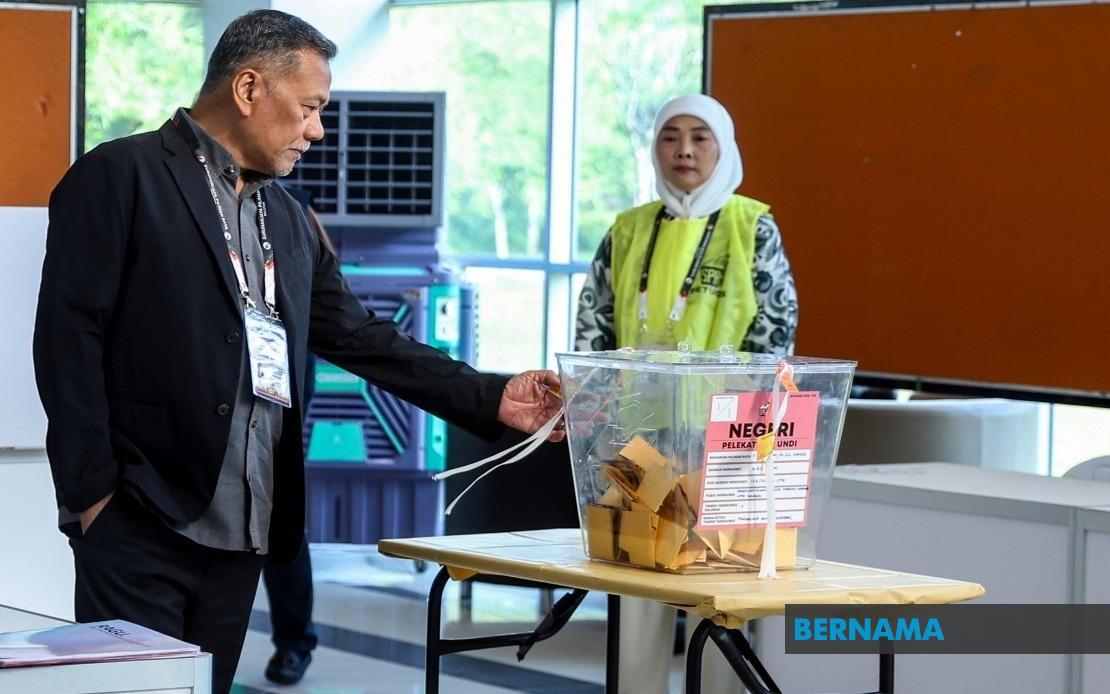
Datuk Seri Ramlan Harun, the Election Commission chairman, conducted a series of inspections across Johor Bahru on July 11 to assess the management and administration of the 16th Johor state election, visiting four strategically selected polling centres to verify that voting operations were unfolding without impediment and adhering to established procedures.
The inspection tour commenced at approximately 8.50 am at Dewan Raya Taman Ungku Tun Aminah, which served as the polling venue for the Skudai constituency. This location operated seven distinct polling streams, reflecting the high volume of registered voters in this urban constituency. The selection of Skudai as the first stop underscores its significance as one of Johor's more densely populated electoral divisions, requiring careful monitoring to handle the expected turnout efficiently.
Following his initial assessment, Ramlan proceeded to the Raja Zarith Sofiah Library at Universiti Teknologi Malaysia (UTM), which hosted voting for the Senai constituency. This polling centre operated with two polling streams, a notably smaller configuration compared to Skudai, reflecting the different voter demographics and geographic spread of this constituency. Universities typically serve as important polling locations in Malaysian elections, as they accommodate both on-campus residents and surrounding community members, necessitating close oversight of procedures.
The inspection itinerary continued to Sekolah Agama Taman Bukit Mewah, which managed voting for the Kempas constituency using six polling streams. Religious schools in Malaysia frequently double as polling centres, and this arrangement requires particular attention to ensure that voting operations do not interfere with the institution's primary educational functions. The EC chairman's visit to this venue signalled the importance of maintaining orderly processes across diverse facility types.
The tour concluded at Sekolah Menengah Kebangsaan Bandar Uda Utama in the Perling constituency, which accommodated the largest number of polling streams with nine separate operations. Secondary schools typically handle substantial voter volumes given their centralised locations and ample facilities, making them crucial nodes in the state election infrastructure. The variety of venues visited—from cultural halls to university libraries to religious and secondary schools—demonstrated the commission's commitment to monitoring operations across different settings and electoral demographics.
Throughout these visits, Ramlan received detailed briefings from election officials stationed at each polling centre, acquiring first-hand knowledge of logistical operations, staff performance, and procedural compliance. These interactions provided the EC leadership with direct insight into challenges faced on the ground and enabled officials to address any emerging issues promptly. The chairman's presence also served as a reassurance mechanism for election personnel, reinforcing the importance of maintaining high standards of conduct.
In addition to procedural briefings, Ramlan conducted thorough examinations of the physical infrastructure and amenities made available to both voters and election workers. This assessment encompassed evaluating the accessibility of polling booths for elderly and disabled voters, the adequacy of ventilation and seating arrangements, the security of ballot storage areas, and the clarity of directional signage. The condition of facilities directly impacts voter confidence in election integrity and the morale of polling staff managing extended working hours under potentially challenging conditions.
The systematic nature of these inspections reflects the EC's recognition that successful elections depend on meticulous attention to detail at every polling centre. By visiting multiple constituencies across Johor Bahru, the chairman obtained a representative snapshot of election-day implementation rather than relying solely on reports from subordinates. This hands-on approach enables leadership to identify systemic issues that might otherwise remain invisible to administrators working within the system.
For Malaysian voters and observers, EC oversight visits carry particular significance given Malaysia's history of intense electoral competition and public scrutiny of election management. The Johor state election represents a significant political contest, and transparent monitoring by the commission's top leadership reinforces public confidence that voting procedures are being conducted fairly and competently. Regional media coverage of such inspections also communicates to voters that their ballots will be properly counted and their votes respected.
The inspection programme concluded with Ramlan scheduled to conduct a press conference, providing an opportunity to communicate his preliminary observations to the media and public. Such briefings typically address voter turnout figures, any procedural irregularities encountered, and the overall assessment of election-day operations. The public communication from the EC leadership helps set the narrative around election administration and demonstrates accountability to the electorate.
These inspections underscore the EC's operational responsibility to ensure that the 16th Johor state election meets both legal requirements and public expectations for orderly democratic practice. By the time Ramlan completed his tour of these four polling centres, a clearer picture of implementation challenges and successes would have emerged, informing any necessary adjustments to procedures in subsequent polling locations or serving as baseline data for post-election reviews.
The visit to multiple constituencies with varying facility types and voter demographics also provided valuable data about whether the same operational standards were being maintained uniformly across the electoral landscape. Consistency in election administration across all constituencies—whether urban or semi-urban, in schools or other public venues—remains essential for public confidence that all votes receive equal treatment regardless of location or timing.
As the Johor state election unfolded, these leadership inspections represented both a practical quality-control measure and a symbolic affirmation of the commission's commitment to democratic governance. For regional observers monitoring Malaysian electoral processes, the visible presence of EC leadership at polling centres demonstrated institutional engagement with the mechanics of voting implementation, setting a standard for transparency that extends to other Southeast Asian elections.

