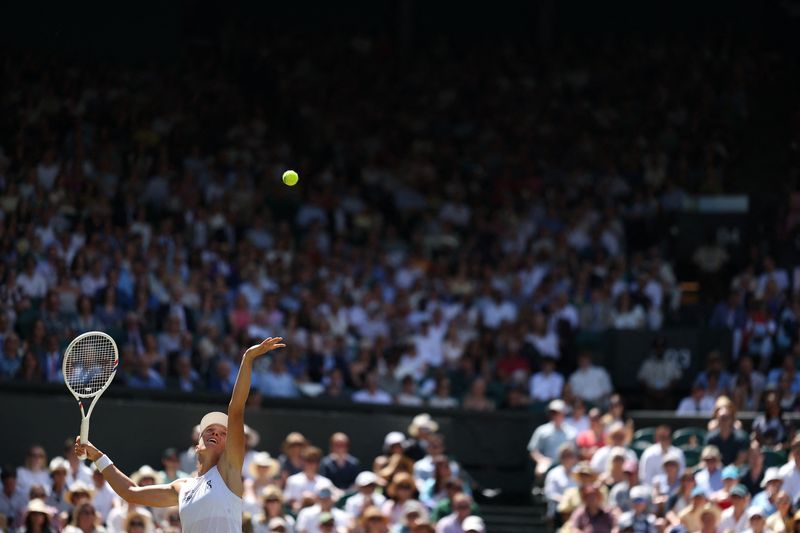
Alexandra Eala's remarkable ascent in professional tennis reached new heights on Saturday when the rising Filipina star toppled Iga Swiatek, the Polish third seed and defending Wimbledon champion, with a commanding 7-6(9) 6-2 victory in the third round at the All England Club. The result marked a defining moment for Eala, whose powerful baseline game proved too much for the reigning title holder under the blazing London afternoon sun, earning her a place in the fourth round against 2024 runner-up Jasmine Paolini.
Swiatek arrived at this year's championships attempting to defend the crown she captured twelve months earlier, yet her preparation and form heading into the tournament had been far from ideal. The 25-year-old suffered an unexpected early exit at Bad Homburg, a traditional tune-up event for grass-court specialists, and carried doubts about her consistency and readiness into what promised to be a challenging fortnight. Despite navigating victories over Taylor Townsend and Karolina Pliskova in her opening two matches, Swiatek appeared vulnerable against an opponent who had clearly identified weaknesses in the Pole's grass-court technique.
The Centre Court encounter unfolded as a compelling contest between two players with contrasting recent histories. Eala had shocked Swiatek on hard courts in Miami the previous year, but the Pole had swiftly regained the psychological upper hand when the pair reconvened at Madrid on clay, territory where Swiatek has long reigned supreme. This Wimbledon clash, however, took place on the very surface where Swiatek's dominance had been questioned throughout her career before last year's breakthrough triumph. Grass presented an entirely different battleground, and Eala's powerful shot-making from the baseline began establishing immediate pressure that Swiatek struggled to manage from the match's opening exchanges.
The opening set proved particularly revealing about each player's competitive state. Neither competitor offered their opponent breathing space, with both delivering aggressive baseline drives and refusing to concede important points without ferocious resistance. The intensity proved so high that the set ultimately required a tiebreak to determine a winner, Eala prevailing 9-7 in a dramatic conclusion that showcased exceptional tennis from both women. Swiatek's visible frustration during and immediately after the set—captured in moments when she remonstrated with her coaching team in the stands and slammed her racket—underscored her growing awareness that the match was slipping beyond her grasp.
By contrast, Eala appeared energised and emboldened as she moved into the second set, her confidence visibly climbing with every successful passing shot and service hold. The crowd's enthusiastic response to her attacking tennis further lifted the Filipino player's spirits, creating an increasingly hostile environment for the defending champion. Swiatek's serve and court positioning, usually so reliable, began to falter as Eala's aggressive returns and baseline aggression forced errors and created break opportunities.
Eala's dominance accelerated significantly at the start of the second set when she broke Swiatek's serve twice in succession to establish a commanding 3-0 lead. This early advantage appeared to have settled the contest's outcome, yet Swiatek briefly threatened a comeback when she retrieved one of the broken serves. However, Eala proved unfazed by this momentary resistance, maintaining her aggressive approach and promptly breaking again to definitively seize control of the match. The psychological momentum had shifted irreversibly in Eala's favour, and Swiatek simply lacked the answers needed to stage a genuine rally.
Eala's left-handed stroke production proved particularly effective in troubling Swiatek throughout their encounter. The Filipino's powerful forehand drives consistently moved the Pole around the court, while her willingness to attack on second serve returns put additional pressure on Swiatek's service games. These technical advantages, combined with superior tactical awareness and mental resilience during crucial moments, enabled Eala to execute her game plan with impressive consistency despite the magnitude of facing a former champion on one of tennis's grandest stages.
The match concluded when Eala struck a decisive forehand winner, emphatically announcing her arrival as a genuine threat at the sport's highest level. For Malaysian and Southeast Asian observers, Eala's breakthrough holds particular significance. The performance demonstrates that professional tennis excellence at Grand Slam level is increasingly within reach for talented players from the region, challenging longstanding assumptions about talent distribution and development pathways. Eala's victory arrives amid growing investment in Asian tennis and reflects broader global shifts in the sport's competitive landscape.
Swiatek's exit raises questions about whether her Wimbledon breakthrough last year was merely an anomaly or the beginning of sustained grass-court improvement. The early loss in Bad Homburg suggested the Pole's form remained fragile, and this defeat to Eala confirms that other rising competitors are beginning to neutralise the techniques that brought Swiatek success elsewhere. Her inability to pressure Eala's returns and establish dominance with her usually formidable serve indicates deeper issues requiring urgent attention before upcoming tournaments.
For Eala, the victory opens a fourth-round clash against Jasmine Paolini, the player who reached last year's final and has emerged as one of tennis's form players this season. This matchup represents an opportunity for Eala to announce herself as a future Grand Slam contender, though facing an in-form Paolini on grass presents a significantly elevated challenge. Nevertheless, her dismissal of Swiatek demonstrated that Eala possesses the technical weaponry, mental fortitude, and competitive hunger required to compete with the sport's established elite.

