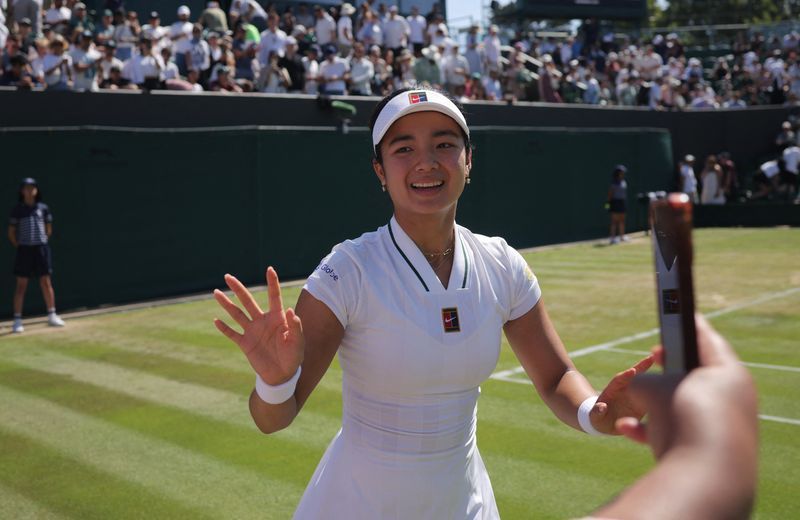
Alexandra Eala etched her name into Philippine sporting history on Thursday at Wimbledon, becoming the first player from the archipelago to advance to the third round of a Grand Slam tournament. The 21-year-old from Quezon City delivered a commanding performance against Australia's Maya Joint, securing a 3-6 6-2 6-0 victory that marked a stunning turnaround after a tentative opening set. The dramatic comeback exemplified the resilience and fighting spirit that has driven Eala's meteoric rise through professional tennis ranks in recent years.
Inscribed on the back of Eala's sun visor during the match was a Tagalog phrase that translates to "once it grows, it cannot be stopped" — words that proved remarkably prescient as she dismantled her opponent in the latter stages. Joint, who notably eliminated Serena Williams in the first round, found herself overwhelmed by Eala's accelerating intensity and precision. The 29th seeded Filipino completely dominated the final two sets, dropping just two games combined as she steadily imposed her game on the court.
Eala's achievement carries profound significance for Philippine tennis, which has long struggled to produce world-class competitors on the Grand Slam stage. Her breakthrough serves as inspiration for aspiring players across Southeast Asia, demonstrating that sustained commitment and quality coaching can elevate athletes from smaller tennis markets into contenders against the world's elite. The milestone also underscores the growing competitive depth of women's tennis globally, with emerging talents from diverse backgrounds challenging established powerhouses.
The journey to this historic moment has been carefully cultivated. As a 21-year-old contesting only her sixth Grand Slam tournament, Eala has shown remarkable composure and tactical intelligence well beyond her years. She trains at the prestigious Rafa Nadal Academy in Mallorca, where she has absorbed the methodical approach and strategic acumen that characterize Spain's coaching philosophy. This exposure to elite-level instruction has fundamentally shaped her development as a player.
Eala's connection to her heritage has become central to her identity on court. Working closely with her sponsor Nike, she incorporates meaningful cultural symbols into her match kit. For the Wimbledon fortnight, the company supplied custom apparel bearing the Filipino slogan, while previous tournaments have seen her sporting a hair tie adorned with the sampaguita — the national flower of the Philippines. These touches are far more than aesthetic choices; they represent a deliberate commitment to carrying her identity and national pride onto the world's grandest stages.
The emotional weight of representing an entire nation has not been lost on Eala. In reflecting on her achievement, she emphasised how profoundly her heritage shapes both who she is and who she aspires to become professionally. She described her appearance at Wimbledon and other major tournaments as an opportunity to showcase the Philippines on the biggest platforms in world sport. This sense of purpose beyond personal achievement distinguishes her from many of her contemporaries and provides powerful motivation during the gruelling demands of professional competition.
Eala's performances on grass surfaces this season have been particularly striking. She claimed the Birmingham title last month and reached the semi-finals in Berlin, demonstrating that her success at Wimbledon is no fluke but rather part of an ascending trajectory. Her rapid ascent through the rankings last year, when she broke into the top 50, has continued this year with steady improvement and consistent deep tournament runs. She now stands as the sole representative of the Philippines in the main draw at Wimbledon, a distinction that has elevated her profile significantly both domestically and internationally.
Her next challenge will test her mettle against defending champion Iga Swiatek on Saturday — a daunting prospect that would intimidate most players at this stage of career development. The Polish champion, a six-time Grand Slam winner, represents the highest echelon of competitive tennis. Yet Eala approached the prospect with measured confidence, suggesting she would not be overawed by the occasion. She acknowledged the formidable challenge ahead while expressing genuine belief in her capacity to compete effectively.
Eala's demeanor throughout her breakthrough run has been notably grounded and authentic. She has resisted the temptation to assume a persona different from her true self, instead channeling her regional background and personal values into her competitive drive. This authenticity appears to resonate powerfully with her, providing an emotional anchor during intense moments on court. She views each barrier she breaks through not merely as a personal achievement but as a representation of possibility for her nation.
The implications of Eala's Wimbledon run extend far beyond the grass courts of southwest London. Her success validates the potential of Philippine athletes in traditionally underrepresented sports and may catalyse increased investment in tennis infrastructure and coaching across Southeast Asia. For Malaysian readers, Eala's trajectory offers valuable perspective on how regional players can compete globally through combination of talent, systematic development, and unwavering commitment to excellence. Her story illustrates that geographic location or national tennis tradition need not limit aspirations or achievement on the world stage.

