The impeachment trial of Philippine Vice President Sara Duterte entered its third day on Wednesday with her defence team mounting a forceful counterattack, arguing that the threats she made in 2024 against President Ferdinand Marcos, First Lady Liza Araneta-Marcos, and former House Speaker Martin Romualdez fall short of the constitutional threshold required to remove her from office. The core of the defence strategy centred on distinguishing between personal statements made by a private citizen and official acts that would constitute impeachable offences under the 1987 Philippine Constitution.
Defence counsel Mark Vinluan presented a compelling reframing of Duterte's controversial remarks made during an online press briefing on November 23, 2024. Rather than viewing them as threats issued by the Vice President in her official capacity, Vinluan argued that Duterte was responding as a private individual—as a wife, mother, daughter, and sister—seeking to protect her family from what he characterised as genuine security threats. This distinction between the personal and the official represents a fundamental legal argument that challenges whether her conduct, however provocative, can meet the stringent definition of "other high crimes" enumerated in the Constitution as grounds for impeachment.
The prosecution's case has relied heavily on a video recording of Duterte's press briefing, with prosecutors seeking to demonstrate through her statements that she possessed criminal intent to contract an assassin. However, during cross-examination, Vinluan seized on admissions from the prosecution itself to undermine this narrative. The prosecution had conceded that the video recording alone does not establish with absolute certainty that Duterte actually hired someone to commit murder, a potentially fatal weakness in their case that suggests the statements, divorced from corroborating evidence, may be insufficient to prove criminal conspiracy or contracted assassination.
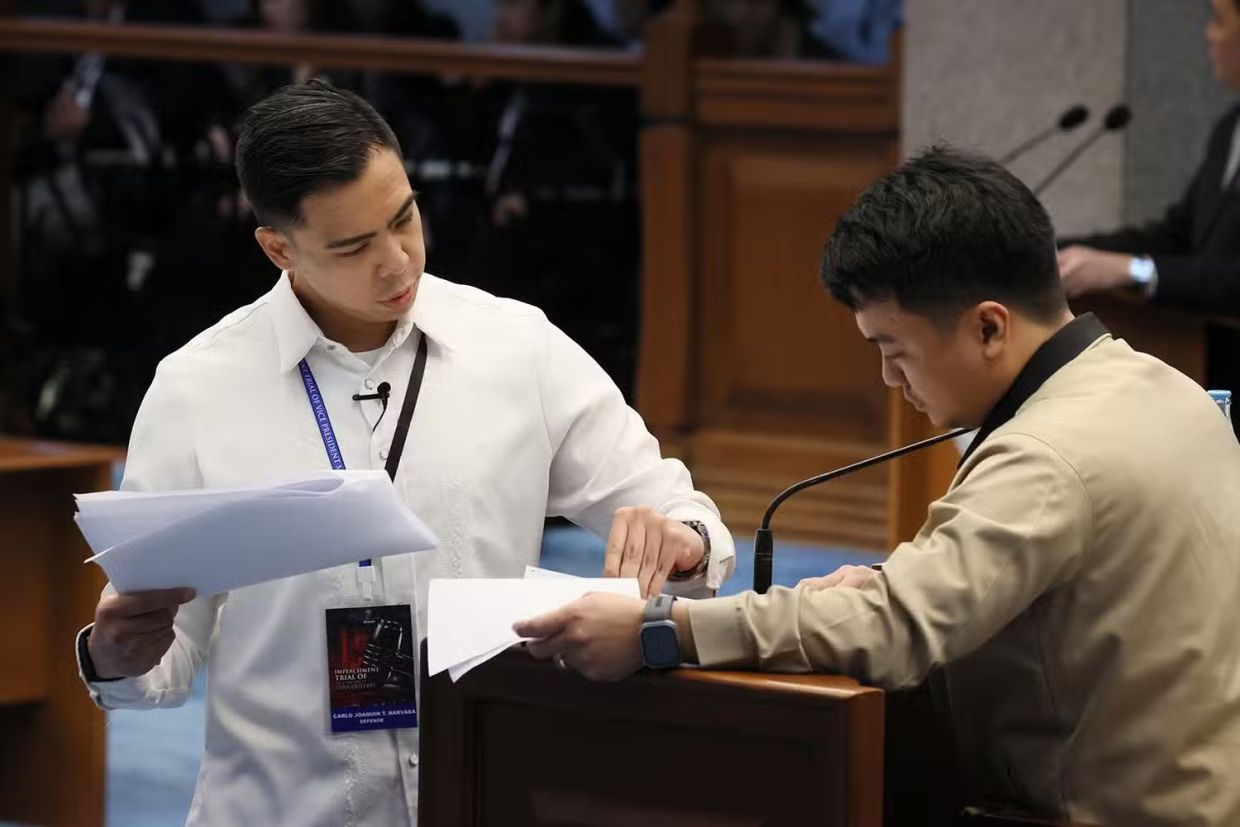
The defence further strengthened its position by scrutinising the National Bureau of Investigation's handling of the case. Lawyer Carlo Narvasa pointed out significant procedural gaps in the investigation, most notably the absence of formal complaints from the three alleged victims. Neither Marcos, Araneta-Marcos, nor Romualdez personally appeared before the NBI to file charges, raising questions about the legitimacy and completeness of the investigation. The NBI conducted its inquiry motu proprio—on its own initiative—without a formal complainant driving the process, a procedural irregularity that could undermine the credibility of the investigation itself.
NBI senior agent John Mark Calilung's testimony proved vulnerable to the defence's methodical deconstruction. When pressed about the absence of sworn statements from the offended parties and the journalists present at the press briefing, Calilung acknowledged these significant evidentiary gaps. The revised affidavit filed by the NBI on February 10, 2025, notably excluded statements from the alleged victims or independent witnesses who attended the November 2024 briefing, substantially weakening the prosecution's documentary foundation. Narvasa's pointed question—"Did you really investigate this case?"—crystallised the defence's challenge to the thoroughness of the government's investigation.
The defence contextualised Duterte's statements within what it described as a broader pattern of "systematic oppression" by government institutions. Vinluan argued that Duterte and her associates, including her chief of staff Zuleika Lopez, had been subjected to unauthorised intelligence and surveillance operations that exposed them to security threats and caused significant psychological trauma. The defence presented video evidence from the November 23 briefing showing Lopez breaking down as she faced contempt charges and a forced transfer, contending that Duterte's subsequent remarks were a direct response to this perceived governmental harassment rather than premeditated threats.
The introduction of Operation Romanov into the defence narrative introduced an additional layer of complexity. Vinluan claimed this intelligence operation posed a genuine threat to Duterte's family, thereby providing what he characterised as justified, if unconventional, grounds for her statements. This argument effectively repositioned the Vice President not as an aggressor issuing threats but as a defensive actor responding to what she believed were existential threats against her loved ones. The defence asserted that understanding her remarks requires acknowledging the context of fear and vulnerability that prompted them.
The constitutional framework governing impeachment emerged as a critical battleground. Article XI, Section 2 of the 1987 Constitution specifies that impeachable offences include culpable violation of the Constitution, treason, bribery, graft and corruption, betrayal of public trust, and "other high crimes." The defence's position is that mere threats, particularly those lacking evidence of actual criminal conspiracy or official misconduct, do not automatically qualify as "other high crimes" contemplated by the framers. This interpretation, if accepted by the Senate impeachment court, would substantially narrow the scope of what conduct the legislature can use to justify removing a sitting Vice President.
During the proceedings, Senator Francis Escudero acknowledged that the trial had identified its central issue: whether Duterte's acts constitute impeachable offences under the Constitution. Later, the presiding officer cautioned senator-judges against posing questions that compel counsel to draw legal conclusions, noting such matters belong in closing arguments. Senator Risa Hontiveros pressed the prosecution on whether the video evidence conclusively proved Duterte hired an assassin, and when prosecutors acknowledged it did not provide absolute proof, the defence team capitalised on this admission to argue the case rests on supposition rather than substantiated fact.
The defence also challenged the semantics of the prosecution's allegations by noting that the term "assassin" was supplied by others interpreting Duterte's remarks, not explicitly used in her original statements. This subtle point suggests that the prosecution may have engaged in interpretive overreach, reading criminal intent into words that, while clearly hostile and inappropriate, may not unambiguously communicate a contract killing. The distinction between intemperate speech and criminal conspiracy becomes crucial in determining whether impeachment is the appropriate remedy.
The trial's progression reveals deepening tensions between institutional prerogatives and procedural propriety. The defence's critique of the House committee's conduct, particularly the chairmanship of Representative Joel Chua, who now serves as a House prosecutor, raises questions about potential conflicts of interest and the political dimensions underlying the impeachment proceedings. The assertion that Duterte and her associates experienced "systematic oppression" through House committee activities suggests the trial may be viewed by the defence, and potentially by sympathetic observers, as politically motivated rather than focused on genuine constitutional violations.
For Malaysian observers, the Philippine impeachment proceedings illuminate broader patterns in contemporary Southeast Asian politics regarding the weaponisation of legal mechanisms for political purposes. The reliance on circumstantial evidence, procedural irregularities in investigation, and the blurred lines between private statements and official conduct raise questions relevant to how democracies in the region balance accountability with the protection of political opposition figures from potentially partisan prosecution. The trial's outcome may establish precedents affecting how future impeachment cases are adjudicated across the region.
The Senate impeachment court must ultimately resolve whether Duterte's conduct, even if inappropriate or inflammatory, crosses the constitutional threshold into impeachable territory. The defence strategy of contextualising her remarks within a narrative of institutional harassment and family protection, combined with methodical deconstruction of the prosecution's evidentiary foundation, has positioned the case as fundamentally contested not merely on factual grounds but on fundamental questions of constitutional interpretation and the proper scope of impeachment powers.

