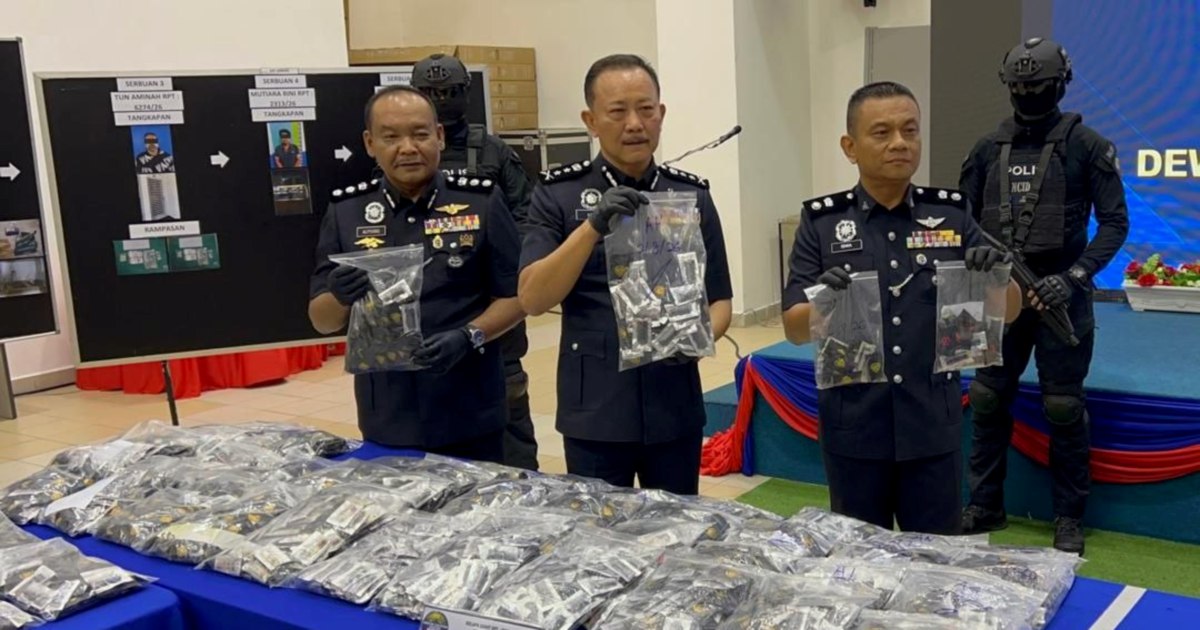
Law enforcement authorities in Johor have successfully disrupted a major organised crime network engaged in the production and retail distribution of vape cartridges laced with controlled substances. The operation, which culminated in five coordinated enforcement actions on Sunday, resulted in the detention of seven individuals suspected of involvement in the scheme. Police have valued the seized contraband at RM10.68 million, underscoring the substantial financial scale of the illicit enterprise.
The simultaneous raids represent a carefully planned intelligence-led response to what officials characterise as a growing threat within the state. Rather than focusing enforcement efforts on a single location, the coordinated approach prevented suspects from alerting associates or destroying evidence during the operation. This tactical methodology reflects an increasingly sophisticated approach to combating transnational and organised drug trafficking networks that have begun exploiting vaping technology to mask and distribute narcotics more effectively.
The use of vape cartridges as a delivery mechanism for controlled substances reflects an alarming trend across Southeast Asia, where criminal syndicates continuously adapt their methods to circumvent traditional detection systems. The vaping format appeals to traffickers because cartridges can be discreetly transported, appear innocuous to casual observation, and offer plausible deniability when intercepted by authorities who may mistake them for legitimate nicotine products. For consumers, the disguised nature of drug-infused cartridges significantly amplifies the health risks associated with consumption, as users often remain unaware of the substances they are inhaling.
Johor's vulnerability to such operations stems from multiple factors inherent to its geography and commercial landscape. As Malaysia's southernmost mainland state with extensive land and maritime borders with Singapore, Johor functions as a crucial transit point and distribution hub for contraband goods flowing throughout the region. The state's substantial population density, thriving urban centres, and numerous industrial estates provide ideal cover for clandestine manufacturing operations. Criminal networks have increasingly recognised the lucrative potential of processing bulk precursor chemicals into finished products within the state, rather than trafficking finished goods across borders.
The successful dismantling of this particular operation demonstrates the Royal Malaysian Police's capacity to execute complex, multi-location enforcement actions requiring substantial coordination and intelligence gathering. The seven detainees will undergo detailed questioning to establish their respective roles within the organisational hierarchy, identify upstream suppliers and downstream distributors, and uncover links to potentially international trafficking networks. Intelligence derived from this operation will inform future enforcement strategies and may facilitate parallel investigations in neighbouring states or other ASEAN nations.
The financial magnitude of this seizure—RM10.68 million—reflects both the commercial viability of the illicit drug market and the substantial profit margins that incentivise criminals to persist despite enforcement risks. Manufacturing costs for drug-infused cartridges remain relatively minimal compared to retail street value, meaning seizures of this scale represent a meaningful disruption to traffickers' revenue streams. However, the figure also illustrates that even large enforcement successes represent merely fragments of a substantially larger underground economy serving persistent consumer demand.
The emergence of sophisticated narcotics syndicates exploiting vaping technology represents a critical evolution in Malaysia's drug threat landscape. Conventional enforcement approaches developed during previous decades of prohibition increasingly prove inadequate against adaptive criminal enterprises leveraging modern technology and supply chain sophistication. The vape cartridge vector presents particular challenges for border control agencies, laboratory forensics capabilities, and public health messaging, as citizens may not recognise the hazards associated with counterfeit or adulterated products.
For Malaysian consumers, particularly young people drawn to vaping culture, this operation underscores the dangers inherent in sourcing such products through unregulated channels. Illicit vape cartridges containing unknown substances pose severe health consequences ranging from acute respiratory distress to longer-term neurological or cardiovascular complications. The inability to verify ingredient authenticity or purity transforms recreational consumption into a substantial medical gamble, yet public awareness of these specific risks remains comparatively limited.
The investigation will likely extend beyond the seven arrested individuals as authorities trace the source materials, financial flows, and customer networks connected to this operation. Forensic examination of manufacturing facilities, financial records, and communications data typically yields additional suspects and operational intelligence. Cooperation with international counterparts, particularly Singapore's Central Narcotics Bureau given Johor's proximity to the city-state, may facilitate understanding of larger regional trafficking architectures.
Moving forward, this seizure presents an opportunity for Malaysian authorities to reassess enforcement strategies and resource allocation within drug prevention frameworks. The sophistication demonstrated by this syndicate suggests that traditional reactive enforcement must be complemented by proactive intelligence operations targeting the chemical precursors, manufacturing equipment, and logistical networks that enable large-scale production. Simultaneously, public education campaigns highlighting the specific risks of illicit vape products could help reduce demand, particularly among younger demographics vulnerable to normalised vaping culture messaging.

