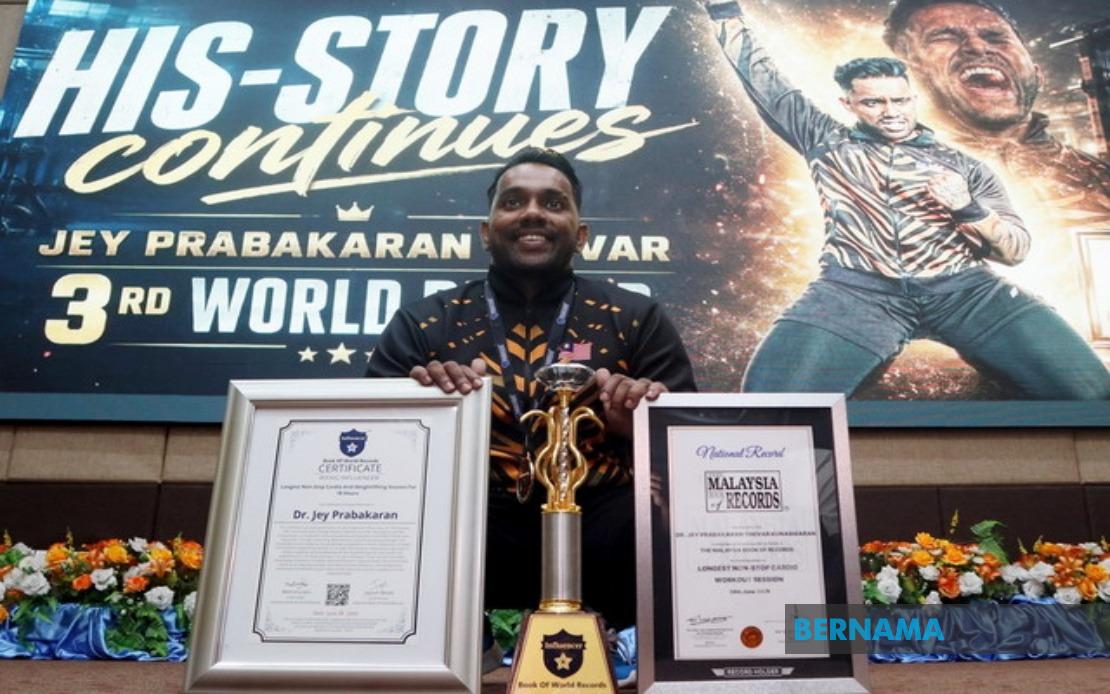
Malaysian fitness athlete K. Jey Prabakaran Thevar, professionally known as Dr Kjey, has added another chapter to his remarkable athletic career by shattering his third world record. The 29-year-old from Kuala Lipis accomplished the extraordinary feat during an 18-hour non-stop cardio and weightlifting marathon that began at 4 am and concluded at 11 pm last Sunday at Healthland Kuala Lipis in Pahang. The achievement marks a significant milestone not only for the athlete himself but also for Malaysian fitness on the global stage, with his name now etched into both the Malaysia Book of Records and the Influencer Book of World Records.
What distinguishes this particular record from Dr Kjey's previous accomplishments is the deeply personal dedication behind it. The athlete has chosen to honour the memory of his father, Kunasigaran Suppiya Thevar, who passed away on March 3, 1999, when Dr Kjey was still a child. Growing up without paternal guidance shaped the trajectory of his life in unexpected ways, transforming an early tragedy into a catalyst for relentless determination. "Despite growing up without a father's love, the loss was a source of inspiration and strength that motivated me to continue fighting until I succeeded in bringing glory to the country on the world stage," Dr Kjey explained to reporters following his achievement.
The progression of Dr Kjey's record-breaking accomplishments reveals a methodical approach to pushing human endurance limits. His first venture into world record territory came in 2023 when he successfully completed a 12-hour continuous cardio and weightlifting challenge, earning recognition in both the Malaysia Book of Records and Guinness World Records. The following year saw him elevate his ambitions further, setting an Asian record by sustaining 13 hours of non-stop exercise and subsequently breaking his own record with a 15-hour marathon in 2024. Each successive attempt has demonstrated not merely incremental physical improvement but a psychological fortitude that continues to expand the boundaries of what might be considered physically achievable in this discipline.
The preparation phase for this latest record attempt began immediately following his participation in the National Sports Day challenge in October of the previous year. Rather than coast on his established reputation, Dr Kjey undertook comprehensive physiological and dietary modifications to prepare his body for the unprecedented 18-hour ordeal. The training regimen extended across several months and involved sacrificing conventional eating patterns in favour of a strictly vegetarian diet. The commitment proved substantial, with Dr Kjey shedding 32 kilogrammes during the preparation period, a dramatic weight loss that fundamentally altered his physical composition while maintaining the muscular strength necessary for such intensive exertion.
During the actual record attempt, Dr Kjey confronted the full spectrum of physical and mental challenges that emerge when the human body is pushed to such extremes. Beyond the obvious muscular fatigue that accumulates during relentless exercise, he battled constant drowsiness and the psychological pressure of maintaining focus across an 18-hour window. These obstacles are not merely inconveniences but genuine threats to the success of such an endeavour, as a single moment of lost concentration or physical collapse would have invalidated the entire attempt. His ability to navigate these hurdles speaks to months of preparation that extended beyond dietary modification into mental conditioning and strategic planning around rest cycles and nutritional intake during the actual challenge.
Beyond personal achievement, Dr Kjey holds a broader vision for the fitness landscape in Malaysia. As president of the Malaysian India Fitness Association, he leverages his platform and accomplishments to advocate for healthier lifestyle choices among younger Malaysians. The visibility of his world records creates an accessible narrative for youth who might otherwise dismiss fitness excellence as an unattainable fantasy. By demonstrating that a Malaysian athlete can compete at the absolute pinnacle of global fitness standards, he challenges prevailing assumptions about local capability in specialized athletic domains. His message extends beyond mere exercise adherence to encompass a holistic philosophy of personal discipline, goal-setting, and resilience in the face of adversity.
Looking ahead, Dr Kjey has already mapped his next athletic objective. He intends to pursue a national record by executing 5,000 jumping jacks within a five-hour timeframe, an initiative he plans to unveil in October during the next National Sports Day celebration. This forthcoming challenge suggests that his competitive drive remains undiminished and that the 18-hour record represents a milestone rather than a culmination of his ambitions. The strategic alignment of his record attempts with national sporting occasions also demonstrates awareness of how individual athletic achievement can intersect with broader patriotic and community engagement narratives.
The significance of Dr Kjey's achievements extends beyond individual accolades to reflect emerging patterns in Malaysian sports excellence. The country has increasingly produced athletes capable of competing credibly on international platforms, challenging long-standing perceptions of Malaysian sporting capacity. Dr Kjey's progression through successive world records in cardio and weightlifting represents one facet of this broader trend, demonstrating that excellence in specialized fitness disciplines remains accessible to Malaysian athletes willing to invest extraordinary effort. His records serve as benchmarks against which future aspirants will measure themselves, potentially inspiring a generation of fitness enthusiasts to pursue international recognition.
The intersection of personal tragedy and athletic triumph in Dr Kjey's narrative also touches upon something universally compelling. His story illustrates how loss and absence, when channelled productively, can become powerful motivational forces. In dedicating his achievements to his late father, Dr Kjey transforms what might have been merely individual glory into an act of remembrance and filial honour. This dimension adds emotional resonance to the physical feat, suggesting that the 18 hours of non-stop exertion carried meaning beyond the physiological challenge itself.

