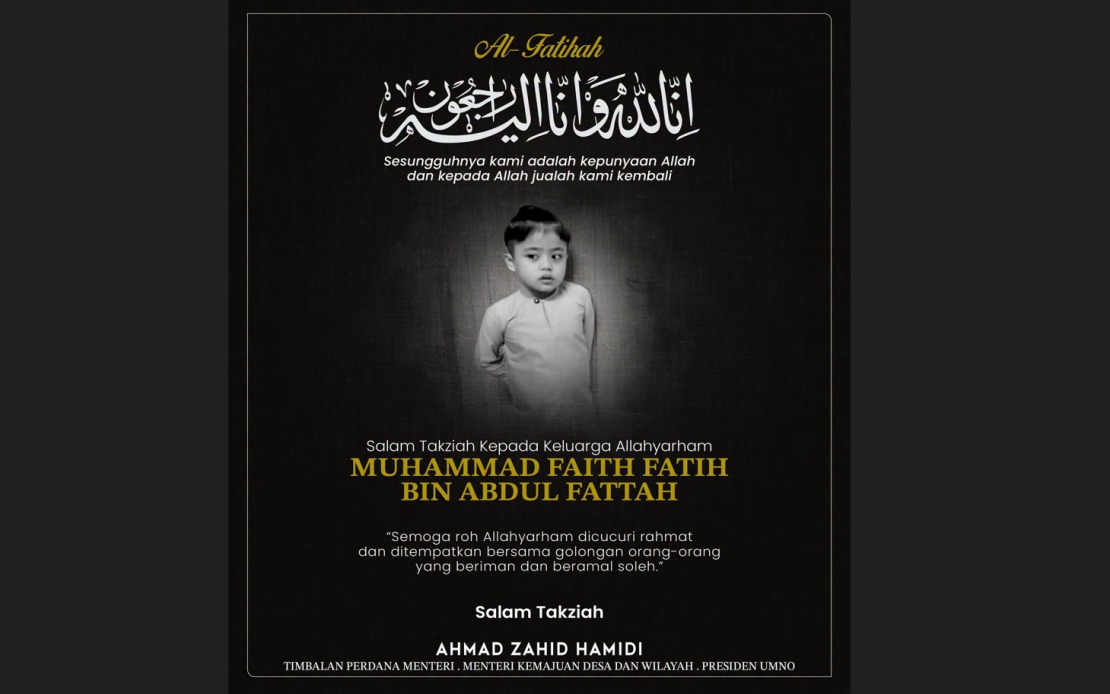
Deputy Prime Minister Datuk Seri Dr Ahmad Zahid Hamidi has offered his sympathies to the bereaved family following the tragic death of Muhammad Faith Fatih Abdullah Fattah, a six-year-old boy with autism, whose body was recovered from an oil palm plantation near Sungai Sumun in Hutan Melintang on the evening of July 1. The discovery came after an intensive search operation mounted by rescue teams, underscoring the particular vulnerability of children with special needs and the profound challenges families face when a young person goes missing.
Ahmad Zahid, who represents Bagan Datuk in Parliament, shared his condolences through a Facebook statement that reflected on the irreplaceable bond between parents and their children. He acknowledged that the loss of a child represents among life's most devastating trials, a sentiment that resonated across communities given the circumstances surrounding the boy's death. The Deputy Prime Minister's public response highlighted the gravity of the incident and the broader concern about child safety across Malaysia, particularly affecting families managing additional care responsibilities.
In his remarks, Ahmad Zahid emphasised the exceptional burden borne by parents of children with special needs, recognising that families raising autistic children often navigate unique challenges in supervision, communication, and securing appropriate support systems. His reference to the boy's special needs status underscored how such tragic incidents raise critical questions about community awareness, accessible assistance programmes, and the infrastructure required to support vulnerable populations more effectively.
The Deputy Prime Minister invoked Islamic traditions of compassion and spiritual comfort, calling upon members of the public to recite Al-Fatihah and offer prayers for the deceased. This spiritual dimension of his condolence message reflected the predominantly Muslim context in which the tragedy unfolded and provided a framework through which the broader Malaysian community could participate in collective mourning and support.
According to the police timeline documented by Bagan Datuk police chief Supt Mohammad Ali Mohd Jali, officers received an initial report at approximately 4.54 pm on July 1 indicating that the child had disappeared from his family home. The boy was last observed in the living room before vanishing, prompting immediate notification to authorities. This relatively swift reporting allowed search and rescue teams to mobilise promptly, though unfortunately the operation concluded with the discovery of the child's body rather than a reunion with his family.
The recovery occurred around 10.08 pm the same evening when search personnel located the boy's body in a drainage channel within the expansive oil palm plantation zone. The discovery location in an agricultural area adjacent to the residential community raises questions about perimeter security, maintenance of drainage infrastructure, and hazard awareness within estates bordering residential settlements. Such findings often lead to renewed examination of how plantation operations and rural communities can better coordinate on safety protocols.
The incident illustrates the particular risks faced by children with autism, who may possess limited awareness of dangerous situations, difficulty communicating their location, and challenges navigating unfamiliar terrain. Parents and caregivers of autistic children frequently report heightened anxiety about community integration and outdoor access, aware that their children's safety vulnerabilities require constant vigilance. This tragedy reinforces discussions within disability advocacy circles about inclusive community design and the need for enhanced preparedness in search and rescue operations involving children with special needs.
The case also draws attention to the support networks available to families during acute crises and the longer-term mental health implications of such devastating losses. Malaysian authorities and civil society organisations have increasingly recognised that families experiencing the loss of a child face extraordinary psychological trauma that extends far beyond initial shock, requiring sustained counselling and community support mechanisms.
The Deputy Prime Minister's intervention in expressing official condolences carries symbolic weight in Malaysian political culture, signalling that such tragedies command serious governmental attention. His statement encourages broader reflection on how communities can better protect vulnerable members, including through improved coordination between estate management, local authorities, and community watch networks in rural and semi-rural areas.
The incident underscores persistent gaps in Malaysia's approach to child safety and special needs support infrastructure. While the country has made progress in autism awareness and educational inclusion, challenges remain in creating truly safe environments for children with developmental differences, particularly in less densely populated areas where professional support services and emergency response capabilities may be more limited.

