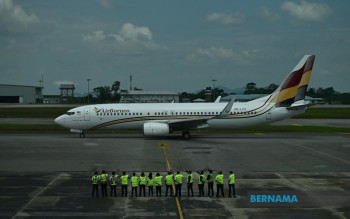
Deputy Prime Minister Datuk Seri Fadillah Yusof greeted AirBorneo Airways' inaugural commercial flight upon its arrival at Kuala Lumpur International Airport Terminal 1 on July 20, marking a significant moment for aviation in East Malaysia. Flight MY5005 carried Sarawak Premier Tan Sri Abang Johari Tun Openg and numerous state officials and dignitaries, underscoring the political importance attached to the carrier's launch. The presence of federal ministers alongside Sarawak's political leadership reflected the collaborative approach between federal and state governments in advancing regional aviation infrastructure.
The establishment of AirBorneo Airways represents a strategic initiative by Sarawak to exercise greater control over its own air connectivity rather than remaining dependent on other carriers for inter-state and regional services. This aspiration aligns with broader Southeast Asian trends where regional governments increasingly view aviation as an essential economic lever. AirBorneo chairman Datuk Amar Mohamad Abu Bakar Marzuki, who also serves as Sarawak state secretary, emphasised that the carrier's launch embodies Sarawak's determination to position itself as a more autonomous player in the region's aviation landscape. The dual appointment underscores how deeply embedded the airline initiative is within Sarawak's state machinery and economic planning.
The timing of AirBorneo's commercial operations carries particular significance for Sarawak's economic diversification agenda. As a state heavily dependent on palm oil, timber and energy sectors, aviation connectivity serves as a catalyst for attracting tourism, business investment and high-value services. Mohamad Abu Bakar articulated this perspective explicitly, framing aviation not merely as a transport service but as an economic lifeline that bridges communities and unlocks commercial opportunities. For Malaysian policymakers, the success of this venture could influence how other states approach infrastructure development and regional integration.
Operationally, AirBorneo enters the commercial market with two wet-leased Boeing 737-800 aircraft, aircraft that are increasingly common among emerging regional carriers in Southeast Asia. The wet-lease arrangement—where aircraft are leased with crew and maintenance included—allows the airline to commence operations without the substantial capital outlays required for aircraft ownership. This approach reduces financial risk during the critical early operational phase, a pragmatic strategy adopted by numerous successful startup carriers across the region. From July 21, 2026, the airline will operate twice-daily service on the Kuching-Kuala Lumpur sector, positioning itself to capture a significant share of business and leisure traffic between Sarawak and the federal capital.
Pricing represents a crucial competitive element in AirBorneo's market strategy. One-way fares are set at RM375 for Economy Class and from RM736 for Business Class, rates that position the new carrier competitively against established carriers while reflecting the airline's aspiration to maintain service quality standards. The availability of Business Class seating signals AirBorneo's intention to serve corporate travellers and premium passengers, a market segment with higher yields that enhances overall financial performance. These pricing levels suggest the airline is not pursuing a low-cost carrier model but rather positioning itself as a conventional full-service carrier offering competitive rates.
The Kuching-Kuala Lumpur route serves as AirBorneo's foundational route, but management articulated clear intentions for systematic expansion. Chief Executive Officer Megat Ardian Mohd Aminuddin emphasised that the current launch represents a turning point marking the transition toward a growth phase, with expansion to additional domestic destinations anticipated in subsequent stages. This measured approach to network development reflects prudent business planning, allowing management to optimise operations on the flagship route before extending the network. For passengers and shippers in Sarawak, the establishment of reliable twice-daily service on this crucial corridor addresses a longstanding capacity constraint on the region's busiest aviation route.
International expansion figures prominently in AirBorneo's strategic roadmap, with Singapore designated as the airline's first destination beyond Malaysia. This choice is logical given Singapore's status as a regional aviation hub and the substantial business and tourism linkages between Sarawak and the city-state. Successful penetration of the Kuching-Singapore market would represent a significant competitive achievement and would position AirBorneo as a cross-border carrier capable of competing in regional markets. For Malaysian aviation, the emergence of this Sarawak-based carrier adds diversity to the competitive landscape, potentially benefiting consumers through expanded choice and improved service offerings on key routes.
The federal government's evident support for AirBorneo, demonstrated through ministerial attendance at the inaugural flight ceremony, reflects recognition that regional aviation development aligns with broader national economic integration objectives. Tourism Minister Datuk Seri Tiong King Sing's participation particularly underscores the connectivity-tourism nexus; improved air services stimulate tourism demand by enhancing accessibility. Deputy Transport Minister Datuk Hasbi Habibollah's attendance signalled transport ministry endorsement of the venture. This governmental backing provides AirBorneo with an enabling environment and suggests infrastructure investments at KLIA and Kuching International Airport will support the carrier's operational requirements.
AirBorneo's launch occurs within a competitive but expanding regional aviation market. The Kuching-Kuala Lumpur sector has historically been served by established carriers, primarily Malaysia Airlines and AirAsia variants, with robust demand driven by Sarawak's business activity and tourism potential. The introduction of a state-backed carrier creates a three-way competitive dynamic that could drive service improvements and efficiency gains across the market. For travellers, the additional capacity and service choice represent immediate benefits, while competitive pressure may encourage all carriers to enhance their offerings on this commercially important corridor.
The inaugural flight event also carried symbolic significance beyond aviation logistics. It represented a demonstration of Sarawak's growing economic confidence and institutional capacity to execute major commercial initiatives. The participation of Sarawak's senior leadership alongside federal representatives reinforced the cooperative federal-state relationship essential for major infrastructure and transport projects. As Malaysia seeks to strengthen regional development and economic integration, successful execution of initiatives like AirBorneo validates the model of state-level entrepreneurship supported by federal frameworks.
Looking forward, AirBorneo's viability will depend on consistent execution across multiple dimensions: operational reliability, service quality, financial management, and strategic network development. The first six to twelve months will be critical for establishing reliable operations and building passenger confidence. Success could validate the model for other Malaysian states considering aviation ventures, while challenges might constrain such ambitions. For regional aviation observers, AirBorneo's trajectory offers valuable lessons about how emerging carriers establish themselves in competitive markets and the role of government support in facilitating such ventures.
The commencement of AirBorneo's commercial operations represents more than a routine airline launch. It reflects Sarawak's strategic assertion of control over its own connectivity infrastructure, federal government recognition of regional aviation's importance to national development, and the evolving structure of Southeast Asian aviation markets where regional players increasingly compete with established carriers. As the airline expands its network and strengthens its operational foundation, its success will likely influence aviation policy and investment decisions across Malaysia and neighbouring jurisdictions.

