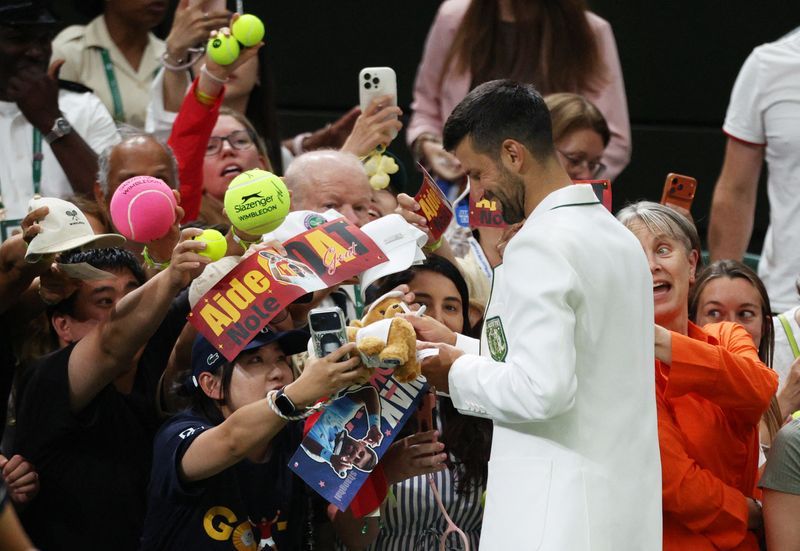
Novak Djokovic's commanding performance against Stefanos Tsitsipas at Wimbledon proved so lopsided that the 24-time Grand Slam champion had the luxury of entertaining the crowd with impromptu antics. In one particularly revealing moment during his 6-3 6-4 6-2 demolition on Wednesday, Djokovic enlisted a ball girl to help remove black athletic tape from his right shoulder. As she carefully wielded a pair of scissors near his shoulder, he suddenly cried out in mock agony, leaving the young assistant genuinely alarmed and clutching her chest in horror at what she feared she had done.
The prank's effectiveness lay entirely in its timing and the ball girl's authentic concern for the Serbian great's wellbeing. For a split second, she appeared genuinely distressed, genuinely convinced she had injured one of tennis's greatest competitors in front of a global television audience numbering in the millions. The moment captured perfectly how far Djokovic's dominance had extended—he possessed sufficient control of both the match and his own nerves to orchestrate elaborate gags during play. Within an instant, Djokovic burst into laughter, immediately putting his anxious helper at ease. Her shocked expression transformed into relieved giggles as she realised the entire incident had been carefully orchestrated entertainment rather than a catastrophic workplace mishap.
Djokovic's own assessment of his playful behaviour revealed considerable self-awareness about the psychology of competitive sport. He acknowledged during his post-match on-court interview that such levity emerges naturally when one enjoys a commanding advantage, noting that being two sets to love up rather than two sets to love down fundamentally alters a player's mental state and behaviour. His willingness to deliberately destabilise his own composure through laughter demonstrated the psychological security of someone thoroughly in control of proceedings. The prank itself served as a form of pressure release, allowing Djokovic to shed the intense focus required at the highest levels of professional tennis and reconnect with the sport's fundamental enjoyment.
The Greek challenger Tsitsipas offered virtually no resistance to Djokovic's onslaught, representing minimal competitive threat despite being seeded in the tournament. The scoreline of 6-3 6-4 6-2 reflected a match that never developed meaningful tension or drama. Djokovic's dominance was so complete that he progressed through the contest in a state of relative relaxation, his mind liberated to engage in theatre and social interaction. This ease of victory had psychological ripple effects, allowing positive emotions to flow rather than the intense concentration required during competitive struggles.
The on-court interview following his triumph provided Djokovic with an unexpected opportunity to showcase his charisma beyond tennis. Observing Northern Irish golfer Rory McIlroy seated in Centre Court's prestigious Royal Box, Djokovic couldn't resist comment on the two-time Masters champion's distinctive attire. McIlroy was sporting his Green Jacket, the iconic trophy awarded annually to the Masters Golf Tournament winner, a garment representing one of sport's most coveted prizes. Djokovic's cream-coloured personalised blazer, which he had worn throughout the championships, suddenly seemed inadequate by comparison.
What followed demonstrated Djokovic's sharp competitive instinct extending even to friendly banter. Rather than simply complimenting McIlroy's achievement, Djokovic pivoted toward proposing a cross-sport wager with considerable entertainment value. He suggested a head-to-head tennis match with extraordinarily high stakes—his jacket exchanged for McIlroy's Green Jacket. The proposal was delivered with sufficient charm and levity that it elicited approving roars from the Wimbledon crowd, appreciating both the audacity of the challenge and the camaraderie between champions from different sporting disciplines.
Djokovic's insistence that McIlroy must play tennis rather than golf as the competitive medium revealed his confidence in his own dominance across athletic endeavour. The implicit assertion—that victory would be inevitable if the contest occurred on tennis courts—carried an undertone of respectful superiority. Yet the proposal was couched entirely in humour rather than arrogance, with McIlroy's visible amusement suggesting genuine appreciation for Djokovic's wit and personality. The exchange transcended sporting tribalism, offering viewers a glimpse of how contemporary champions across different sports acknowledge and celebrate each other's achievements.
For Malaysian and Southeast Asian observers, the incident illustrated dimensions of Djokovic's persona often overshadowed by his ruthless competitive drive. While his dominance across tennis has occasionally provoked criticism regarding his intensity and singular focus, moments like these reveal a fundamentally engaging and personable competitor. His ability to navigate the psychological demands of elite sport while maintaining genuine humour and social grace represents a holistic approach to athletic excellence that extends beyond mere trophy accumulation.
The juxtaposition of Djokovic's complete tactical mastery over Tsitsipas and his relaxed, playful demeanour throughout the match speaks to his current confidence level heading into the latter stages of the season. Rather than treating Wimbledon as a grim test of technical supremacy, Djokovic appeared to be genuinely enjoying the competition, deriving satisfaction from the contest itself rather than becoming consumed by outcome-focused anxiety. This psychological comfort often precedes sustained excellence in professional tennis, suggesting that the Serbian champion may yet add to his already formidable Grand Slam collection.
The Green Jacket moment also highlighted the broader cultural currency of sporting achievement in contemporary society. McIlroy's Masters victory was sufficiently recent and prestigious that Djokovic immediately recognised it as deserving acknowledgement and light-hearted covetousness. In an era where sporting accomplishments transcend individual sports to achieve broader cultural significance, such cross-disciplinary recognition reinforces the importance of championship performances regardless of sporting context. Both figures understood themselves as representatives of excellence, worthy of mutual respect and engagement.

