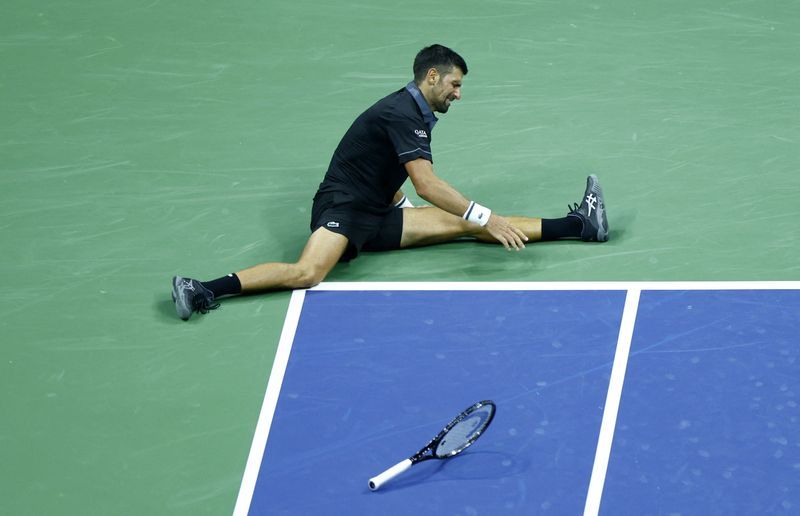
Novak Djokovic's pursuit of a record 25th Grand Slam title has come to an abrupt and shocking end at Flushing Meadows, where the Serbian tennis icon exited the US Open in the first round on Sunday—the earliest departure of his storied career at this particular major championship. Unseeded Argentine Mariano Navone delivered a stunning upset, winning 7-6(5) 5-7 4-6 6-2 6-1 in a physically and emotionally draining contest that lasted four hours and 36 minutes and left the 39-year-old visibly distraught. For a player who has dominated professional tennis for nearly two decades and has won the US Open four times, this defeat represents not merely a tournament loss but a troubling marker of deteriorating form and persistent health concerns that have haunted Djokovic throughout 2024.
Djokovic arrived in New York already beset by doubts about his physical condition and competitive sharpness following a discouraging performance at Cincinnati two weeks prior, where he fell to Thiago Agustin Tirante in straight sets. These warning signs proved prescient, as the Serbian legend appeared increasingly compromised as the match against Navone progressed. The world number four began promisingly, racing to a 3-0 lead in the opening set under humid New York conditions, yet the contest took a dramatic turn when rain forced the closure of the Arthur Ashe Stadium roof during a rain delay. As play resumed, Navone systematically clawed back into contention, levelling the set at 4-4 and eventually forcing a tiebreak that he captured with growing confidence, announcing to the crowd and the tennis world that this would be no routine dismissal of an underdog.
Though Djokovic reclaimed the second set through sheer competitive instinct and experience, the toll of his physical struggles became impossible to mask. During the third set, the veteran player was forced to vomit into a courtside bin—an alarming moment that underscored the severity of his condition. Despite this distressing episode, Djokovic managed to recover sufficiently to break Navone's serve and establish a commanding 5-4 advantage in the same set, closing it out despite a shaky service game. For a fleeting moment, it appeared that Djokovic's championship mettle and Grand Slam pedigree might carry him through this stern test. Yet Navone, displaying composure and fighting spirit that belied his world ranking of 49, refused to capitulate.
The Argentine's capture of the fourth set proved the decisive turning point, capitalising on Djokovic's deteriorating physical condition, particularly a troublesome back issue that severely compromised his serving mechanics in the closing stages. With momentum decisively shifting in his favour and the Serbian legend visibly struggling with pain and fatigue, Navone held his nerve throughout the fifth set to seal a momentous victory. The emotional aftermath was telling: Djokovic left the court with tears streaming down his face, while Navone struggled to comprehend the magnitude of his achievement, checking his phone to find it inundated with messages from home in Argentina.
In a raw and revealing post-match interview, Djokovic acknowledged the cascading failures of his body that conspired to derail his campaign. He described a vicious cycle of deterioration beginning with persistent nausea and vomiting—symptoms that have plagued him repeatedly throughout the year—which then triggered a domino effect of cramping and widespread pain throughout his frame. "My whole body starts to collapse, basically," he reflected, pointing specifically to the back and shoulder giving way when he needed them most. He admitted that despite being a break up in the fourth set, he lacked the physical reserves to consolidate that advantage and push toward victory. His voice cracked with genuine emotion as he acknowledged the futility of his efforts: "I didn't enjoy myself," he said simply, a stark admission from a competitor who has built his legacy on deriving strength and satisfaction from elite competition.
Yet Djokovic was characteristically gracious in defeat, consciously deflecting excessive focus from his own struggles toward acknowledging Navone's meritorious performance. He praised his opponent as "a nice guy, a fighter," offering genuine congratulations for a win that will define a pivotal moment in the Argentine's nascent professional career. Djokovic explicitly stated he did not wish to diminish Navone's achievement by dwelling excessively on his own limitations, a gesture of sportsmanship that reflects decades of experience in handling both triumph and defeat at the highest levels of professional sport.
Navone's perspective presented a starkly different emotional landscape. Still in a state of stunned disbelief, the 25-year-old Argentine attempted to process the enormity of having defeated someone he regards as the greatest tennis player of all time across five sets. "It's not something you do every day," he said in the immediate aftermath, his voice tinged with the surreality of the moment. "It's a dream come true." Later, speaking with ESPN, Navone acknowledged that the psychological reality of his victory had not yet fully penetrated his consciousness, describing how the adrenaline coursing through his body prevented immediate comprehension of what he had accomplished. He marveled at the cascade of messages flooding his phone, imagining the commotion and celebration that would greet news of his triumph in Argentina.
This result carries profound implications for Djokovic's immediate future and the broader tennis landscape heading into autumn. The loss to Navone marks only the second time since 2006 that Djokovic has exited a Grand Slam tournament in the opening round—a statistic that starkly illustrates both the rarity of such outcomes for the Serbian legend and the concerning nature of his current physical predicament. At 37, few athletes can maintain the extraordinary levels of fitness and competitive acuity that grand slam tennis demands, yet Djokovic's persistent health issues suggest that age-related decline may finally be intersecting with cumulative physical wear. For Malaysian and Southeast Asian tennis enthusiasts who have followed Djokovic's dominance across nearly two decades, witnessing such a precipitous fall from his usual elite standing serves as a poignant reminder of professional sport's transient nature.
The broader narrative extends beyond individual match outcomes to questions about whether Djokovic can continue competing at the highest levels given these systemic health problems. The vomiting, cramping, and musculoskeletal pain he described are not isolated incidents but recurring phenomena that he has "been carrying, unfortunately, pretty much every match this year." Such persistent physiological dysfunction raises legitimate questions about whether continued competition at the Grand Slam level serves his long-term wellbeing. For a player still chasing records and championships at an age when most of his contemporaries have retired, the calculus between continuing to pursue glory and accepting physical limitations becomes increasingly urgent.
Navone's victory also represents a significant turning point for emerging talent in professional tennis. The Argentine's capacity to maintain composure against one of the sport's most formidable competitors, while capitalising on his opponent's physical vulnerability, demonstrates the kind of mental fortitude and tactical intelligence necessary to climb the professional ranks. His ranking of 49 positions him as a rising prospect rather than an established elite player, yet this triumph provides both confidence and credibility that could accelerate his ascent substantially. For developing tennis nations and emerging players across Asia and the wider tennis world, Navone's achievement illustrates that even the most dominant figures remain vulnerable when physical condition deteriorates.

