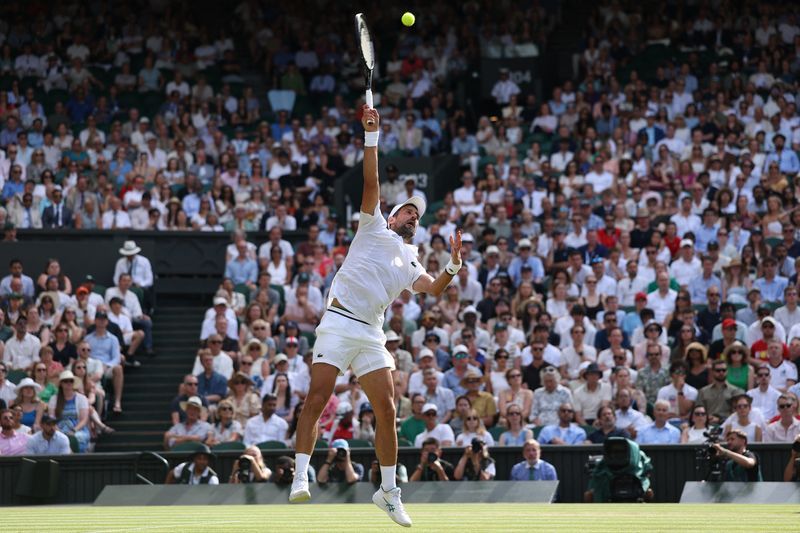
Novak Djokovic reached another Wimbledon quarter-final on Sunday with a hard-fought victory over Russian qualifier Roman Safiullin, but the Serbian champion's path to the last eight proved considerably more taxing than might be expected from a seventh seed facing a world number 132. The 7-6(6) 6-3 3-6 6-3 triumph on Centre Court, however, came with significant historical weight: Djokovic etched his name further into Wimbledon folklore by claiming his 106th match victory at the All England Club, finally moving past the revered Roger Federer's long-standing benchmark on the grass court circuit.
The milestone underscores Djokovic's extraordinary dominance at Wimbledon across nearly two decades. While Federer's eight titles remain the gold standard at the tournament, the accumulation of victories speaks to a different kind of mastery—the ability to sustain excellence across multiple campaigns, adapting to changing conditions and opponents while maintaining the mental fortitude required for deep runs. For Malaysian tennis enthusiasts and Southeast Asian fans who have watched Djokovic's career arc closely, this represents another reminder of his place among the sport's immortals. At 39 years old, the chance to equal Federer's eight championships remains within realistic reach, a prospect that would fundamentally reshape the conversation around greatest Wimbledon champions.
Sunday's encounter revealed a Djokovic who, while ultimately in command, showed vulnerability against Safiullin's aggressive baseline game. The Russian qualifier, returning from months sidelined with a hip injury, brought considerable intensity and precision to the contest, forcing the seventh seed into uncharacteristic errors and defensive positions. Safiullin broke serve twice in the opening set, a rarity for Djokovic at his level, yet the champion demonstrated the tactical acumen and mental resilience that separates consistent title contenders from occasional challengers. Trailing in the opening set tiebreak, Djokovic saved two set points before claiming the breaker at 8-6, a moment that appeared to shift momentum decisively.
The second set showcased Djokovic's capacity to execute when clarity emerges. Once he secured the early break at 2-4, the quality differential became apparent. His serve-and-volley sequences, a deliberate strategic shift against Safiullin's relentless groundstroke game, produced clean winners and forced errors. The third set, however, saw an unusual reassertion from the qualifier, who broke serve and claimed the set 6-3, suggesting that complacency or a tactical adjustment by Safiullin kept the match competitive longer than scorelines might suggest. This extended challenge across the first four rounds—Djokovic has already dropped sets in three of his opening four matches—raises questions about whether the 39-year-old is operating at his absolute peak or conserving energy for the knockout stages.
Djokovic's own commentary following the match provided insight into his tactical thinking. He acknowledged that Safiullin's solid baseline tennis, combined with challenging wind conditions that favoured the Russian's court positioning, required him to abbreviate rallies and rely more heavily on his first-serve penetration. The willingness to abandon preferred patterns and adapt demonstrated maturity; younger players might have persisted with ineffective approaches rather than fundamentally shifting the match's rhythm. By the fourth set, the adjustment had taken full effect, with Djokovic elevating his level sufficiently to secure the victory without significant distress.
The quarter-final assignment will pit Djokovic against either Felix Auger-Aliassime, the third seed from Canada, or Spain's Alejandro Davidovich Fokina. Both represent different stylistic challenges. Auger-Aliassime's power and athleticism require management of pace, while Davidovich Fokina's defensive prowess and slice expertise could test Djokovic's patience. Each successive round at Wimbledon presents mounting difficulty, and Djokovic's relative struggles through the first week suggest the tournament's unpredictability has intensified even for the sport's most decorated competitor.
For Southeast Asian and Malaysian sports audiences, Djokovic's continued presence at this level carries significance beyond individual championships. His longevity challenges conventional wisdom about athletic aging and demonstrates that strategic intelligence, mental conditioning, and technical mastery can compensate for the inevitable physical toll of professional tennis. Regional athletes and coaches monitor such performances closely for insights into sustained excellence. Furthermore, Djokovic's pursuit of a 25th Grand Slam title maintains one of sport's most compelling narrative threads—the question of whether he can ultimately overtake the historical records currently held by Federer and Nadal.
The broader context of this Wimbledon campaign involves Djokovic's return to the tournament following health challenges and scheduling disruptions that defined the previous year. His re-emergence as a credible title contender, despite his age and the emergence of younger competitors like Jannik Sinner and Carlos Alcaraz, testifies to the durability of his game. The match against Safiullin, rather than exposing terminal decline, instead illustrated the resilience of a champion who can navigate adversity while maintaining strategic focus.
Looking ahead, Djokovic's trajectory through the second week will determine whether this Wimbledon represents a genuine push for an eighth title or merely a respectable tournament where advancing to the quarter-finals represents the realistic ceiling. His ability to consistently elevate when necessary, as demonstrated against Safiullin, suggests that deeper runs remain possible. However, the necessity to drop sets against lower-ranked opposition signals that peak performance levels may not be as readily accessible as during his dominance in previous seasons. The quarter-final matchup will provide clearer indication of whether Djokovic possesses the sustained intensity required to mount a serious title challenge or whether his historic record at the All England Club will remain remarkable primarily for its breadth rather than its contemporary depth.

