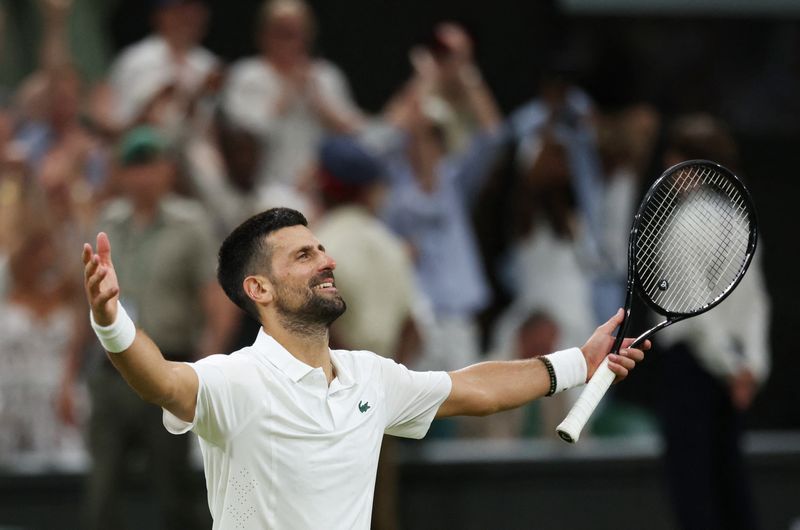
Novak Djokovic's remarkable run at the All England Club shows no signs of slowing. The 39-year-old Serbian champion advanced to the Wimbledon semi-finals for an unprecedented eighth consecutive year on Tuesday, outlasting Canadian Felix Auger-Aliassime in the longest quarter-final in tournament history. The scoreline of 7-6(10) 3-6 6-3 6-7(4) 7-6(10-4) barely captures the intensity and drama of their five hour and 15 minute encounter, which left both players and spectators emotionally drained by the climax.
Djokovic's journey through the quarter-final represented another chapter in his remarkable longevity at the sport's highest level. By claiming his 106th victory at the All England Club in the previous round, he had already surpassed Roger Federer's record for most match wins at this venue. With his advancement past Auger-Aliassime, the Belgrade native became the first male player in the tournament's long history to reach the semi-finals eight times consecutively, further distancing himself from the Swiss legend whose earlier dominance once seemed insurmountable. For Malaysian and Southeast Asian tennis fans accustomed to watching the sport's older generation retire gracefully, Djokovic's continued excellence at an age when most athletes have moved into commentary booths presents a compelling study in dedication and physical maintenance.
The match itself swung dramatically across its five sets, with neither competitor able to establish decisive control for prolonged periods. Auger-Aliassime, the Canadian representing a new generation of players, competed with the determination and technical skill that has elevated him into the world's elite ranks. Yet Djokovic's superior experience in high-pressure situations ultimately proved the decisive factor in the final tiebreak scenarios. The opening set epitomised the match's competitive nature, requiring a lengthy tiebreak that extended to 10-12 before Djokovic prevailed when his opponent's volley sailed beyond the baseline.
Following that narrow escape, Auger-Aliassime seized momentum by breaking Djokovic's serve twice in the second set, ultimately securing it 6-3 to restore parity in the contest. The Canadian's aggressive approach had temporarily disrupted the champion's rhythm, suggesting that a younger player's attacking tennis might overwhelm Djokovic's methodical baseline game. However, as the match progressed toward evening, the closing of the Centre Court roof proved a subtle turning point. The change in atmospheric conditions seemed to benefit Djokovic, whose experience reading such environmental shifts gave him subtle advantages that compound over extended matches.
Djokovic responded to the second-set loss with renewed intensity, breaking through Auger-Aliassime's defence in the third set's sixth game and consolidating his advantage with cleaner striking and superior positioning. The champion's trademark consistency—that ability to construct points methodically rather than relying solely on explosive winners—reasserted itself as the match wore on. Where Auger-Aliassime occasionally pursued aggressive strategies that risked unforced errors, Djokovic's patience and court sense wore down his opponent's resistance through the third and into the fourth sets.
The fourth set presented another opportunity for Auger-Aliassime, who broke Djokovic's serve immediately and appeared positioned to force the contest to a decider with the match freshness still on his side. Yet Djokovic's mental resilience, honed through decades of competing at this level, allowed him to refocus and re-enter the set's tiebreak. The Canadian's frustration boiled over visibly, striking his chair with his racket in a moment that captured the match's emotional intensity. Such displays suggest the psychological toll that playing five-set tennis against one of the sport's all-time greats demands, particularly when victories remain within reach yet somehow persistently elusive.
The fifth-set marathon showcased precisely why Djokovic's legacy will endure long after his retirement. For 12 games, neither player gained advantage, with service breaks proving impossible and both competitors serving reliably when most needed. The deciding super tiebreak, extended to 10-4 victory for Djokovic, became a masterclass in managing extreme pressure. The crowd's deafening applause as Djokovic finally sealed victory underscored how thoroughly both players had entertained Wimbledon's devoted spectators, transforming a quarter-final into an event of semi-final significance.
Post-match, Djokovic characterised his victory with refreshing candour. He acknowledged that the contest required not merely superior racket technique but the emotional fortitude to maintain focus across an exhausting duration. His reference to managing nerve and tension during these high-stakes moments speaks to an aspect of professional tennis rarely discussed in standard match reports—the mental endurance required when every point carries championship implications. For younger players pursuing greatness, Djokovic's emphasis on emotional management alongside technical excellence offers crucial insight.
Djokovic's prize for this magnificent victory is a semi-final meeting with Jannik Sinner, the Italian who won Wimbledon last year and currently sits atop the world rankings. This clash assumes enormous significance beyond immediate tournament implications. For Djokovic, each Grand Slam victory represents another step toward his eighth All England Club crown, which would match Federer's record, and his 25th major title overall, surpassing Margaret Court's historic 24. Yet characteristically, Djokovic downplayed such considerations immediately after his quarter-final triumph, expressing concern primarily about physical recovery and preparing to face the world's best player.
The implications for Southeast Asian tennis audiences extend beyond merely following one of sport's greatest legends in his final competitive years. Djokovic's continued excellence demonstrates that strategic play, mental discipline, and tactical adaptation remain more valuable than raw athleticism alone—a message with particular relevance for the region's developing professional tennis community. His path to these semi-finals required overcoming younger, more explosive opponents through court craft and experience, illustrating how the sport's evolution continues to reward different skill sets across generations.
As Wimbledon progresses toward its final days, Djokovic carries considerable momentum despite his physical exhaustion. The extended quarter-final victory, while draining, confirmed that his competitive instincts remain razor-sharp and his ability to win matches when they reach their most critical moments remains undiminished. Whether he can navigate a semi-final against Sinner and potentially claim his eighth title at the All England Club remains uncertain, yet his journey to this juncture has already provided tennis audiences worldwide with a performance worthy of remembrance. For Malaysian viewers and broader Southeast Asian audiences, witnessing such sustained excellence at professional sport's pinnacle offers genuine sporting spectacle and valuable lessons about longevity, dedication, and the power of experience against younger challengers.

