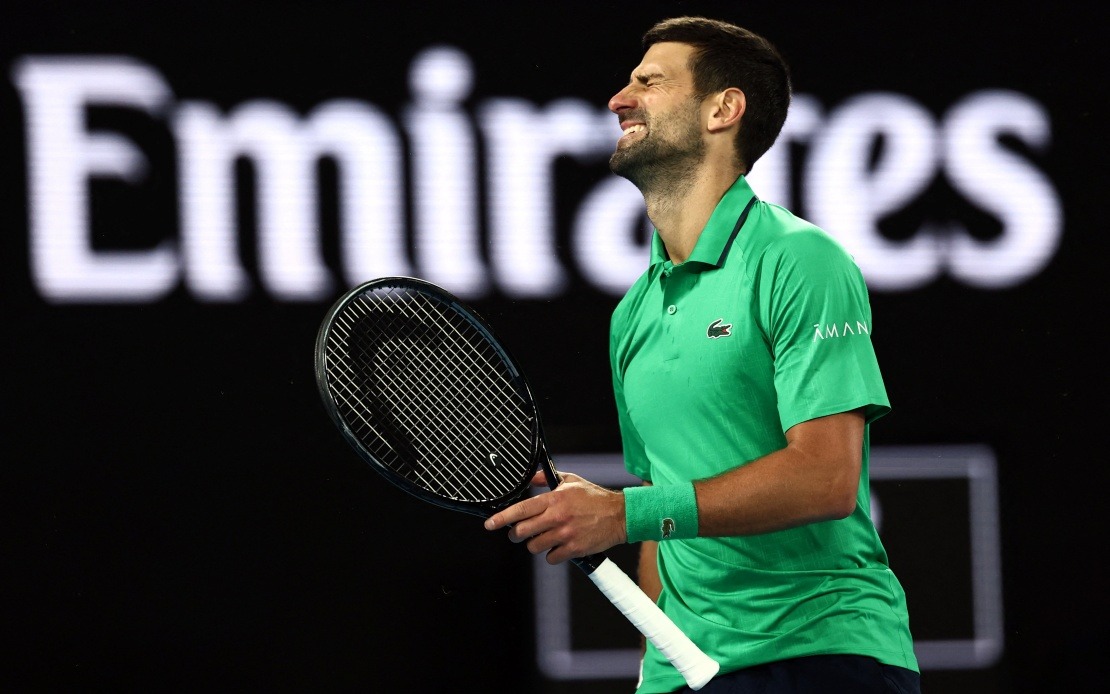
Novak Djokovic has cemented his place among tennis's all-time greats by matching Roger Federer's long-standing record of 105 singles match victories at Wimbledon. The Serbian champion's accomplishment came Friday at the All England Club after a gruelling three-hour battle against France's Arthur Rinderknech, whom he overcame 7-5, 6-4, 1-6, 7-6 (7-4) on Centre Court. The achievement underscores Djokovic's extraordinary consistency at one of sport's most prestigious tournaments and marks his 18th appearance in the fourth round at Wimbledon.
Now 39 years old, Djokovic has shown no signs of slowing down despite his advancing age, with this milestone placing him among an elite group of players who have shaped modern tennis. His seven previous Wimbledon titles and continued dominance in the sport's later stages demonstrate a level of physical conditioning and mental fortitude rarely seen in professional athletics. The record itself speaks to Djokovic's sustained excellence across nearly two decades of championship-level competition at the grass court venue.
When addressing the significance of his achievement in his on-court interview, Djokovic displayed characteristic humour and perspective. "I propose a match between me and Roger for 106," he quipped, suggesting a playful resolution to what may become a friendly competition for the record. Beyond the levity, however, Djokovic acknowledged the profound honour of achieving historic milestones in professional tennis. He emphasised that Wimbledon holds special significance in his career, having dreamed of competing at the tournament since childhood. His comments revealed that while aware of the statistical achievement, he remains focused on the present challenge rather than dwelling on records.
Djokovic's record at Wimbledon extends beyond mere match statistics. His 24 Grand Slam titles represent the most in men's professional history, a distinction that underscores his dominance across all major tournaments. The consistency required to accumulate 105 wins at a single venue—particularly one as demanding and unpredictable as grass courts—illustrates why Djokovic belongs in conversations about the greatest players ever to compete in the sport.
In the men's draw, defending champion Jannik Sinner maintained his strong form by dismissing American Jenson Brooksby with a commanding 6-4, 6-3, 6-4 victory. Sinner, the current world number one, extended an extraordinary record by recording his 20th consecutive win in third-round Grand Slam matches—a modern era men's record that highlights his emerging dominance. The Italian's straight-set progression through the tournament has been characterized by clinical efficiency, and he credited crowd support for providing crucial momentum during his matches.
Djokovic will now face Russian qualifier Roman Safiullin in the fourth round, seeking to reach the quarter-finals and maintain his championship aspirations. This encounter represents a significant test, as Safiullin's qualification run indicates he possesses the skill and determination to trouble top-seeded players. For Djokovic, advancing past this stage would place him one step closer to contending for his eighth Wimbledon title.
On the women's side, world number one Aryna Sabalenka made a decisive statement by eliminating former French Open champion Jelena Ostapenko 6-4, 6-4. Sabalenka's powerful baseline game proved too much for Ostapenko, securing her place in the round of 16 and her continued pursuit of a first Wimbledon crown. The Belarusian player has long been considered a threat on grass despite her success on harder courts, and her progress through the draw suggests she possesses the weaponry to compete for the title.
Sabalenka now faces four-time Grand Slam champion Naomi Osaka in a matchup that has generated considerable anticipation among tennis enthusiasts. Osaka reached the fourth round for the first time in her Wimbledon career, having dispatched Daria Kasatkina 6-1, 6-3 in a dominant display of aggressive tennis. The Japanese champion's return to form and accumulation of experience on grass courts could make her a formidable opponent despite Sabalenka's higher seeding and current ranking.
Acknowledging the challenging nature of her upcoming encounter, Sabalenka characterised the impending clash as another matchup between aggressive players whose power-based games would determine the outcome. "Another very powerful match," she noted, while expressing her readiness to fight with unwavering determination. This assessment reflects the respect both players have for each other's abilities and the intensity expected when such dominant competitors meet in the latter stages of a Grand Slam tournament.
The context of this matchup holds particular significance for South and Southeast Asian tennis followers. Osaka's success represents a landmark moment for Asian representation in tennis's upper echelon, demonstrating that players from the region can achieve and maintain status among the sport's elite. Her appearance in the fourth round of Wimbledon for the first time in her career suggests renewed momentum and confidence in her game, qualities that could translate into deeper tournament runs and potentially major title challenges in coming months.
For Malaysian and regional audiences, these developments offer compelling viewing. Djokovic's record-matching achievement provides a moment to reflect on the nature of sporting excellence and longevity—qualities that transcend national boundaries and inspire athletes worldwide. Simultaneously, Osaka's progress through Wimbledon and her matchup with Sabalenka offers Asian tennis fans a compelling storyline featuring one of the region's most celebrated athletes competing at the highest level against the sport's current world number one.
The outcomes of these matches will significantly influence the tournament's trajectory. Should Djokovic continue his run, he may yet challenge for another Wimbledon title, adding to his unprecedented Grand Slam legacy. Conversely, the Sabalenka-Osaka encounter carries implications for women's tennis dominance, with both players representing different approaches to aggressive, power-based play that has increasingly defined the modern women's game.

