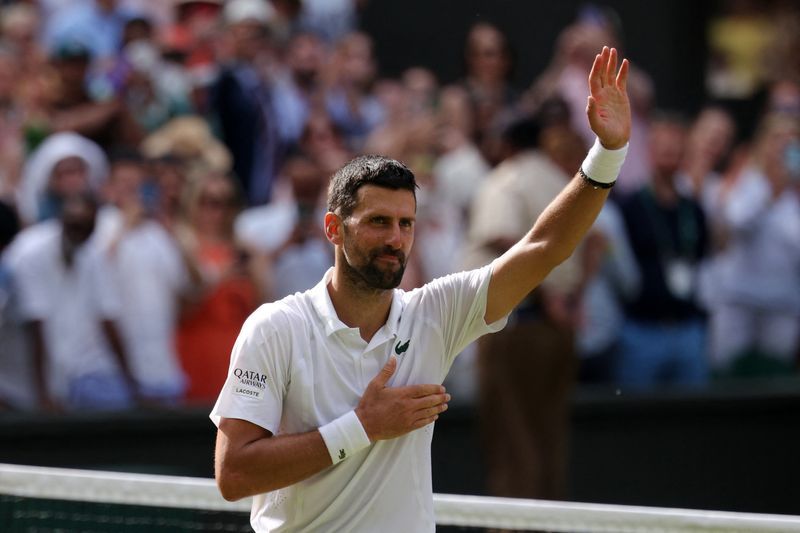
The Wimbledon quarter-finals commence on Tuesday with two compelling narratives driving the tournament's next phase. On one side, 39-year-old Novak Djokovic pursues what would be tennis history—a 25th Grand Slam title—as he confronts Canadian third seed Felix Auger-Aliassime. Simultaneously, 14th seed Naomi Osaka has captured widespread attention following her commanding defeat of world number one Aryna Sabalenka in the previous round, positioning herself among the tournament's most credible contenders for the crown.
Djokovic's path to the quarter-finals has been neither pristine nor commanding. His victory over qualifier Roman Safiullin in the round of 16, though labour-intensive, marked a milestone: the 39-year-old Serbian now holds the record for most wins at the All England Club with 106 victories across his Wimbledon appearances. Yet the toll of recent matches—two consecutive four-set encounters, including a gruelling 3½-hour battle against Safiullin—underscores the physical demands facing the veteran champion. The performance revealed a player who must grind through adversity rather than executing flawless tennis, a concern against a rising opponent like Auger-Aliassime.
Reflecting on his narrow escapes, Djokovic acknowledged the paradox of his situation. "I enjoy the battle. I enjoy the suffering in a sense, to some extent, even though I don't want it, I don't invite it," he explained after progression. His philosophy has become one of pragmatic persistence: when circumstances force extended contests, he concentrates on discovering paths to victory rather than playing the immaculate tennis of his prime. For Malaysian and Southeast Asian audiences familiar with Djokovic's dominance over two decades, his current vulnerabilities are noteworthy—they suggest even the greatest champions face inevitable constraints.
Auger-Aliassime, at 25, brings youthful energy and technical development to face a player who has largely defined the sport's elite tier. The two have met twice previously in 2022, each winning once, so Djokovic cannot assume familiarity equates to advantage. The Canadian's perspective carries the reverence of a younger generation confronting legendary competitors. "I hope that I can show that I've improved as a player," Auger-Aliassime stated, acknowledging the honour of testing himself against Djokovic. He further reflected on the weight of Djokovic's achievement: "the load of work he's done over the years, I mean, I'm not even near any of that. Just to think about it, it's crazy."
On the women's side, Osaka's resurgence has become one of Wimbledon's compelling subplots. The Japanese champion, who last captured a Grand Slam title in 2021, demonstrated on grass the aggressive tennis that once made her dominant in majors. Her demolition of Sabalenka—the tour's most dominant player across most of 2024—was emphatic, particularly with her serve and blistering forehand attacks neutralizing the world number one's typically overwhelming force. The achievement gains greater resonance given that Sabalenka had beaten Osaka three times already this year, suggesting a tactical breakthrough rather than mere chance.
Osaka's mental approach to high-stakes matches has evolved. Rather than treating her fourth-round clash as a career-defining moment, she reframed it with disarming humour: "I thought about it as a practice match. I was just telling myself, like, there's a really big crowd for this practice match, but we're going to get through it." This perspective—managing pressure by diminishing its psychological weight—contrasts with her earlier career difficulties with grand stage expectations. For Malaysian observers, this demonstrates how elite athletes learn to regulate mental state alongside physical skill.
Osaka now faces Czech 10th seed Karolina Muchova, a player who has reached Wimbledon's quarter-finals three times but never progressed beyond that stage. Their head-to-head record stands at three wins each from six meetings, with Muchova holding the advantage on grass following a victory at Bad Homburg last month. Muchova's preparation proved deliberate—she contested two tournaments leading into Wimbledon specifically to accumulate grasscourt matches and build confidence on the surface. "I think we did a great decision that I played two tournaments before Wimbledon so I get few more matches to feel better on the grass," she remarked after eliminating former Wimbledon champion Barbora Krejcikova. This strategic approach reveals how modern tennis requires meticulous planning around each event's unique demands.
In the men's draw, defending champion Jannik Sinner enters as commanding favourite against Jan-Lennard Struff, the 36-year-old German who has become the oldest male player in the Open Era to reach a Grand Slam quarter-final for the first time. Sinner has defeated Struff in all three previous encounters, yet the Italian acknowledged uncertainty. "Whatever happened in the past, it's gone already. Now we see if we found a solution. If not, we keep working for the next one," Sinner noted, demonstrating the philosophical approach of a champion who has already won four major titles at age 22. For regional audiences, Sinner's early career trajectory offers perspective on how new generations are reshaping tennis' power hierarchy.
Struff's achievement cannot be diminished by seeding or statistical disadvantage. The German earned his quarter-final berth when Hubert Hurkacz withdrew due to injury while trailing 4-2 in the fifth set, yet Struff's longevity to compete at this level into his late 30s represents an alternative career narrative. "I'm very happy because it's a huge achievement for me. I'm 36, my first quarters, it's amazing," he reflected, capturing the underdog's gratitude for an unexpected opportunity. Struff's presence among the last eight reminds observers that Wimbledon occasionally rewards persistence and determination as much as precocious talent.
The quarter-final draw balances the predictable dominance of seeded players against occasional disruptions that maintain tournament unpredictability. Sinner and Djokovic represent the tournament's elite tier, yet both face opponents capable of causing disruption. Similarly, Osaka's comeback carries psychological momentum that Muchova, despite her grasscourt comfort, must respect. These contests will shape not merely Wimbledon's eventual champion but also broader narratives about tennis in 2024—whether youthful players like Sinner are consolidating a new dominance, whether veteran champions like Djokovic retain competitive sharpness, and whether established professionals can orchestrate unlikely deep runs. For Malaysian tennis followers, these matches exemplify the sport's global stage where regional talent may eventually compete alongside established champions.

