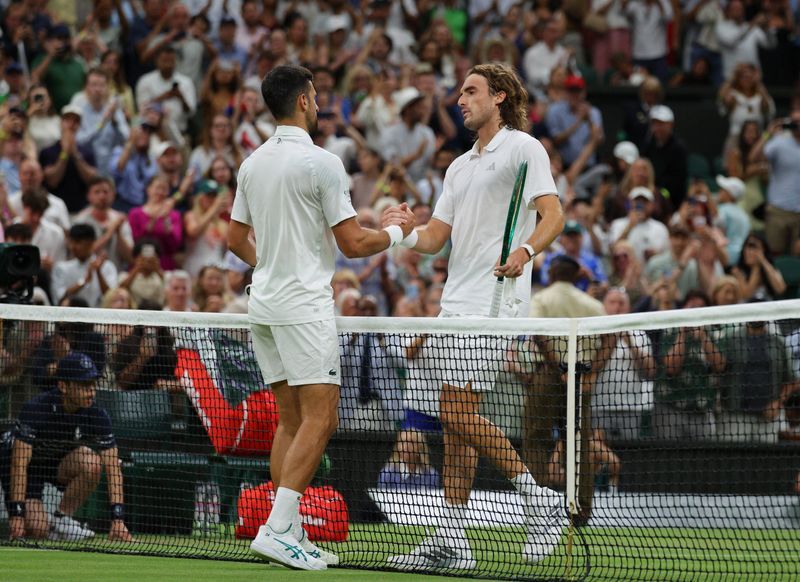
Novak Djokovic demonstrated the imperious form that has defined his three-decade career, dismantling Stefanos Tsitsipas with a comprehensive 6-3 6-4 6-2 victory on Centre Court at Wimbledon on Wednesday. The commanding performance propels the 39-year-old Serbian champion into the third round and keeps him firmly on course for a record 25th Grand Slam title and an eighth Wimbledon crown. The match, which had been positioned as a heavyweight clash between generations, unfolded into a masterclass in tennis that left little doubt about the vast gulf in class between the two competitors.
Djokovic's supremacy became most apparent during the second set at the 4-4 mark, when Tsitsipas squandered two critical opportunities to break his opponent's serve. With the match hanging in the balance and Djokovic facing a break point, the Greek player twice found himself in position to deliver a winning overhead smash—a shot that should have been straightforward at professional level. Instead, both overheads sailed wide, costly miscalculations that allowed Djokovic to surge ahead. This pivotal moment essentially decided the trajectory of the encounter, as Djokovic seized control and never relinquished it, winning eight of the final ten games to assert complete authority.
The victory extends Djokovic's remarkable head-to-head streak against Tsitsipas to 12 consecutive wins, a statistic that underscores the Australian Open champion's absolute mastery over his younger rival. This lopsided record becomes particularly significant when considering Tsitsipas's trajectory—he was once heralded as a potential future Grand Slam champion and has contested two Grand Slam finals against Djokovic, at Roland Garros in 2021 and the Australian Open in 2023, losing both encounters. The repeated failure to compete at the highest level against the Serbian maestro has increasingly defined Tsitsipas's career in the public consciousness.
Tsitsipas arrived at the All England Club facing considerable personal turmoil that could have severely impacted his psychological readiness. The 27-year-old's ranking has plummeted to 87th in the world, reflecting a dramatic decline in form and consistency. More immediately destabilizing, he had recently parted ways with his coaching team—a decision complicated by the fact that his primary coach was his father Apostolos. Such disruptions to the fundamental support structures of an athlete's career typically create uncertainty and doubt precisely when confidence is most vital during high-pressure matches.
Tsitsipas's journey to Wimbledon was also shaped by devastating health complications from the previous year. During the 2023 grass-court major, he was forced to retire midway through his opening round contest as chronic back pain proved too debilitating to overcome. That experience left genuine questions about whether the player would ever fully recover from an injury that threatened to curtail his competitive aspirations. His return to grass courts this year carried psychological weight beyond the typical tournament demands.
Despite these complicating factors, Tsitsipas attempted to mount a redemptive performance at the storied Wimbledon venue. However, Djokovic's combination of precision, movement, and tactical intelligence proved insurmountable. The Serbian veteran's consistency on grass surfaces remains extraordinary—he showed few signs of vulnerability and capitalized ruthlessly on the opportunities his opponent provided. The 6-3 6-4 6-2 scoreline, achieved in less than two hours, reflects the completeness of the dominant display.
Djokovic's progression brings him within one victory of Roger Federer's remarkable men's record of 105 match-wins at Wimbledon, a milestone that would further cement his legacy as arguably the greatest grass-court player of the modern era. For context, this record speaks to consistency across multiple editions of the tournament and the ability to win matches across different circumstances and opponents over an extended period.
Reflecting on his performance courtside, Djokovic expressed genuine contentment about his play and demeanor. He emphasized feeling privileged to compete at the All England Club at an age when most players have long since retired from professional tennis. His remarks about age being merely a number, while acknowledging they might sound like platitudes, carried genuine resonance given his documented approach to training, recovery, and nutrition. The 39-year-old's continued competitive excellence challenges conventional wisdom about athletic longevity in professional tennis.
Next opposing Djokovic is Arthur Rinderknech, the 25th-seeded Frenchman, a player capable of generating substantial pace but lacking the tactical sophistication to trouble an opponent as experienced and adaptable as Djokovic. The Serbian champion's path toward the latter rounds of the tournament appears considerably clearer following this resounding victory. Djokovic's dominance on Wednesday suggests that despite his advancing years, he remains the player to beat at Wimbledon, a tournament where his grass-court mastery continues to flourish.
For Southeast Asian fans following the tournament, Djokovic's persistence and excellence offer a compelling narrative about longevity and adaptability in elite sports. His ability to remain competitive and indeed dominant at an age when contemporaries have retired speaks to evolving understandings of athletic potential and the importance of meticulous preparation in professional tennis.

