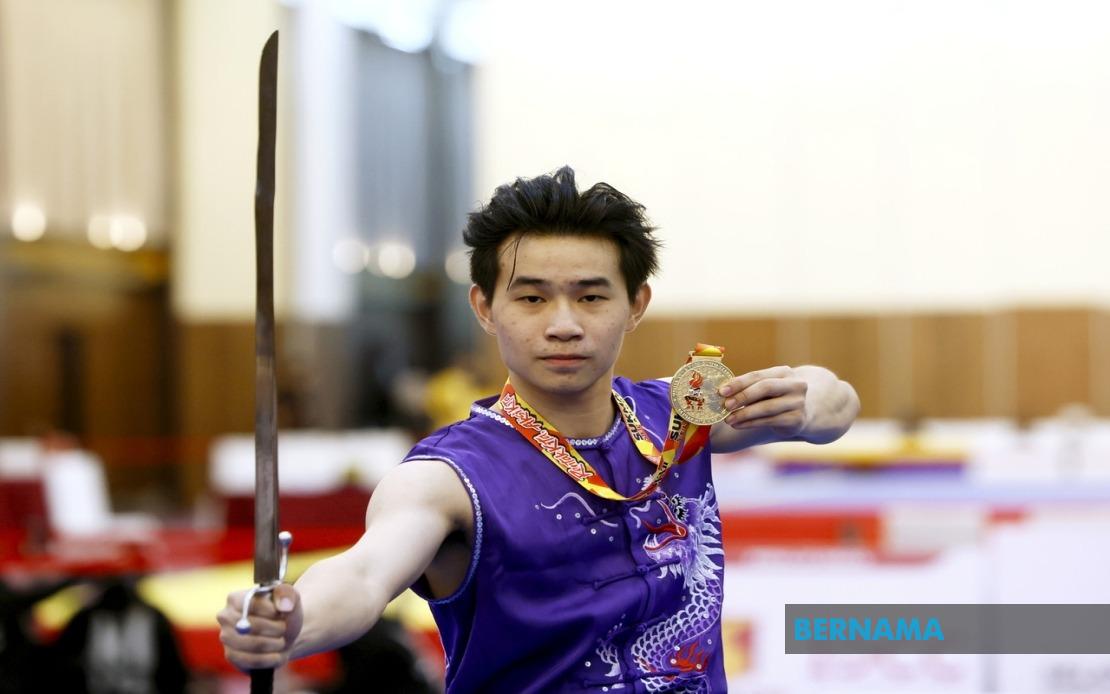
Wee Din Jun's final appearance at the Malaysia Games concluded on a triumphant note when the 21-year-old Penang wushu competitor captured the men's nandao nangun gold medal at the Shah Alam competition venue, demonstrating remarkable resilience after battling through a hip injury sustained just weeks before the national sporting spectacle. The competition, held at the Ideal Convention Centre (IDCC) Shah Alam, saw Din Jun deliver a commanding performance that resulted in a winning score of 9.600 points, sufficient to edge out Sarawak's John Phang, who secured silver with 9.563 points, while Selangor's Tan Yu Zhe completed the podium with a bronze-medal performance of 9.550 points.
This victory carries profound significance for the Bayan Lepas-born athlete, whose journey through successive SUKMA cycles has been characterised by substantial emotional fluctuations and the kind of adversity that tests an athlete's mental fortitude. At SUKMA 2022 in Kuala Lumpur, Din Jun managed to secure a bronze medal, establishing himself as a medal prospect for future Games appearances. However, his subsequent participation at SUKMA 2024 in Sarawak proved deeply disappointing, as technical errors and inconsistent execution across three separate events resulted in his departure without any medal recognition—a setback that would have weighed heavily on any young competitor.
The path to redemption at the 2026 Games required Din Jun to overcome not merely the psychological burden of his previous shortcomings, but also a significant physical obstacle in the form of a hip injury incurred approximately one month before the Games commenced. Such injuries carry particular consequences for wushu competitors, whose discipline demands precise body mechanics, explosive movements, and sustained balance throughout demanding routines. The fact that Din Jun competed through this limitation and emerged victorious speaks to both his physical conditioning and his mental resolve.
In reflecting on his achievement, Din Jun articulated the psychological shift that enabled his turnaround. He explained that following his disappointment at SUKMA 2024, his coaching staff counselled him to adopt a fundamentally different mindset approaching the 2026 Games. Rather than fixating on medal outcomes or burdened by the weight of previous failures, his coach encouraged him to remain mentally composed and genuinely relish the performance experience itself. This represents a sophisticated understanding of sports psychology, where excessive pressure and outcome-focused thinking frequently undermine athletic execution.
Din Jun revealed that he deliberately suppressed preoccupation with external concerns and instead channelled his energy exclusively into delivering his optimal technical and artistic performance. This mental discipline—the ability to compartmentalise worry and concentrate entirely on execution—represents a maturation in his approach to competitive sport that may well have been catalytic to his success. Young athletes frequently struggle with this transition from result-obsessed thinking to process-focused concentration, making his demonstrated capacity to embrace this shift noteworthy.
Beyond the personal satisfaction of finally achieving a gold medal at Malaysia's premier domestic sporting competition, Din Jun emphasised that this victory held special meaning because it represented the fulfilment of a long-held ambition to prove his capacity for gold-medal performance at SUKMA. The distinction between bronze and gold, while seemingly modest numerically, carries considerable psychological weight in an athlete's narrative and personal sense of achievement. For Din Jun, this medal embodied validation that he belonged among the sport's elite performers at the national level.
The wushu competitor also dedicated his achievement to a former coach who has since relocated to China, acknowledging that this coach had unfortunately departed before witnessing Din Jun claim medal success at SUKMA. This gesture reflects the mentoring relationships that shape athlete development and the recognition that individual achievements often represent collaborative efforts involving coaches, training partners, and support personnel. In the Malaysian sporting context, where many international coaching engagements remain temporary, such dedications underscore the transient nature of professional relationships in developing talent.
Looking ahead, Din Jun's competitive journey at SUKMA 2026 extends beyond today's triumph. The athlete remains scheduled to compete in the nanquan event the following day, providing him with an additional opportunity to augment his medal haul and craft an even more distinguished final SUKMA memory. This sequencing of events—concluding his Games participation across multiple disciplines over consecutive days—represents both an opportunity and a challenge, as back-to-back competitions demand sustained physical and mental energy.
The significance of Din Jun's achievement extends beyond individual success to reflect broader patterns in Malaysian wushu development. As a relatively younger athlete within his discipline, his progression from bronze to gold across successive Games cycles demonstrates the sport's capacity to cultivate increasingly competitive performers. Wushu remains somewhat less prominent in Malaysian sporting consciousness compared to conventional Olympic disciplines, yet performances at SUKMA provide crucial platforms for developing and showcasing talent within the country.
Furthermore, Din Jun's story encapsulates the resilience narrative that defines elite athletic careers. The combination of physical adversity through injury, psychological setback from previous disappointing results, and the ultimate triumph through persistence and mental reorientation offers a template applicable across diverse sporting contexts. For younger Malaysian athletes navigating their own competitive journeys, Din Jun's redemption arc provides both inspiration and practical demonstration that setbacks need not define ultimate trajectory.
The timing of his success also occurs within SUKMA 2026, a Games edition that continues serving as a significant platform for identifying emerging national talent and consolidating the positions of established competitors. As Malaysia continues to develop its sporting infrastructure and international competitiveness across diverse disciplines, performances in events like wushu contribute to the broader national sporting ecosystem and the pathways through which young talent progresses toward potential international representation.

