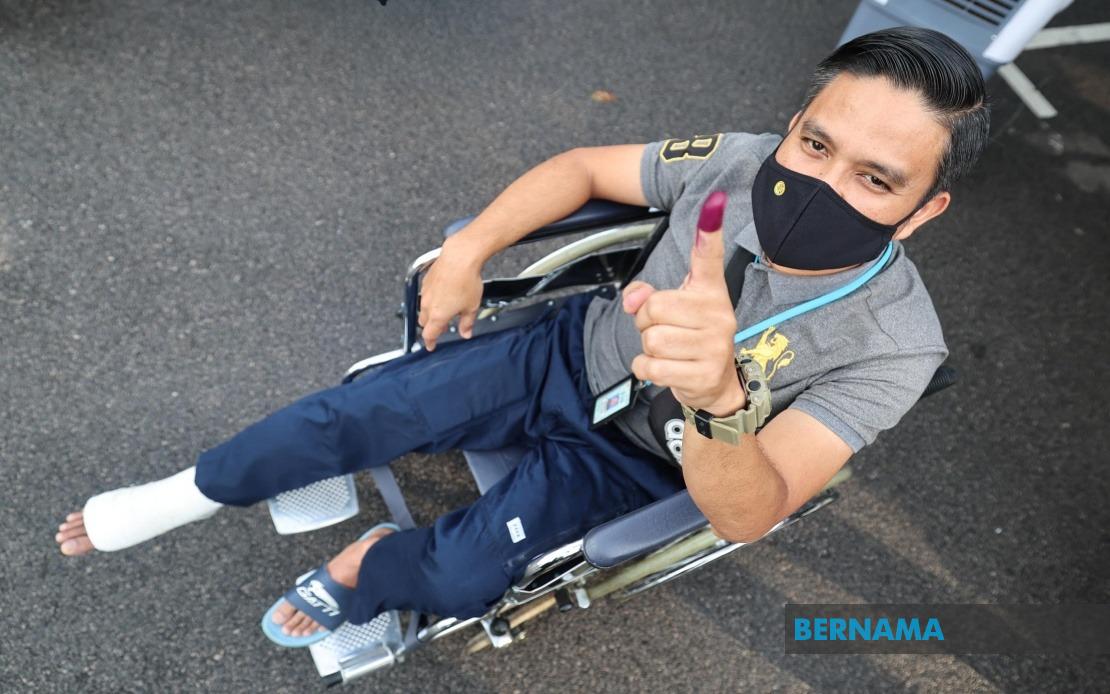
An Achilles tendon injury failed to deter a determined Malaysian police officer from participating in the 16th Johor state election. Sergeant Syahrizal Musa, 40, arrived at the early voting centre at Johor Police Contingent Headquarters on crutches and in a wheelchair despite being granted medical leave extending to July 16 following a sepak takraw injury sustained the previous week.
Syahrizal's decision to vote while incapacitated underscores a broader narrative about civic engagement in Malaysia's electoral processes. The officer, attached to the Internal Security and Public Order Department at the Johor IPK, travelled from police quarters in Tampoi with assistance from a colleague to reach the polling station. His journey, though physically demanding given his mobility restrictions, reflects a conviction that voting represents a fundamental responsibility that transcends personal circumstances.
The injury itself came during recreational sport rather than duty-related activities. As an active sepak takraw enthusiast since youth and a former representative for the police contingent in several tournaments, Syahrizal sustained the minor tear while playing the traditional Southeast Asian sport. Medical professionals confirmed the diagnosis, yet the prognosis did not sway his determination to participate in the election process on the first day of early voting.
In a statement to reporters, Syahrizal articulated his reasoning with clarity. He emphasised that his physical condition presented no legitimate barrier to exercising his constitutional right, framing voting as an obligation rather than a mere privilege. Having served in the police force for over two decades—more than 22 years in total—he maintained a perfect record of voting participation across multiple electoral cycles, a consistency he was unwilling to compromise despite unprecedented circumstances.
Syahrizal's origins in Seri Iskandar, Perak, highlight the geographic diversity within Malaysia's security forces, with officers deployed across states far from their home states. His relocation to Johor IPK in 2014 followed nine years stationed at Muar IPD, demonstrating the mobility characteristic of police service and the various polling jurisdictions within which officers may find themselves during elections.
The early voting mechanism itself plays a crucial role in enabling security personnel to participate, given their operational demands and potential unavailability on regular polling day. On July 7, a total of 64 polling centres opened across Johor specifically to accommodate early voters from military and police establishments. The scale of this alternative voting arrangement reflects the significant bloc represented by uniformed services: 24,751 early voters cast ballots, comprising 12,041 Malaysian Armed Forces personnel and their spouses alongside 12,710 Royal Malaysia Police and General Operations Force personnel with their spouses.
This institutional infrastructure demonstrates Malaysia's recognition that maintaining electoral participation among security forces requires logistical accommodation. The separation of early voting from ordinary polling day protects operational readiness while preserving democratic rights—a balance particularly important for a nation with substantial security sector personnel. Sergeant Syahrizal's participation, therefore, operates within a well-established framework designed precisely to facilitate such civic engagement.
The 16th Johor state election itself represented a substantial democratic exercise. Across 56 seats, 172 candidates competed for representation, with general voting scheduled for the following Saturday. The electorate numbered approximately 2.7 million ordinary voters, making Johor's electoral process a significant undertaking within Malaysia's electoral calendar and reflecting the state's demographic importance within the federation.
Syahrizal's public articulation of his voting experience carries implications beyond the individual narrative. His assertion that voting constitutes a responsibility rather than an optional activity represents a counterpoint to concerning trends of declining electoral participation observed in some Malaysian demographics. His emphasis on maintaining voting consistency throughout a 22-year career, combined with his willingness to overcome physical obstacles to participate, implicitly critiques complacency among eligible voters who face fewer barriers.
Moreover, his determination resonates particularly within the context of Malaysian civic culture, where narratives of duty and service command respect. Police and military personnel occupy a distinct position within society's perception of obligation and commitment. When such figures publicly demonstrate prioritisation of democratic participation despite hardship, they model civic values for broader society.
The officer's hope that his example might inspire broader Malaysian participation in electoral processes reflects an understanding that voting behaviour is partly culturally reinforced. By highlighting his own commitment despite significant physical impediment, Syahrizal implicitly challenges others to examine their own participation patterns and to reconsider barriers they may have previously accepted as insurmountable.
From a practical standpoint, Syahrizal's ability to vote early while on medical leave and mobility-restricted underscores the accessibility features embedded within Malaysia's electoral infrastructure for security personnel. The provision of early voting specifically accommodates circumstances precisely like his—situations where standard polling day participation might be genuinely impossible.
The intersection of personal narrative and systemic design visible in Syahrizal's experience illuminates how Malaysia's electoral framework attempts to balance inclusivity with administrative necessity. His participation, though individually voluntary and personally motivated, exists within deliberately constructed institutional mechanisms that recognise the unique circumstances of uniformed service while maintaining democratic principles. His journey from Tampoi police quarters to the voting centre, though accomplished in pain and from a wheelchair, ultimately demonstrates both individual determination and a system designed to enable it.

