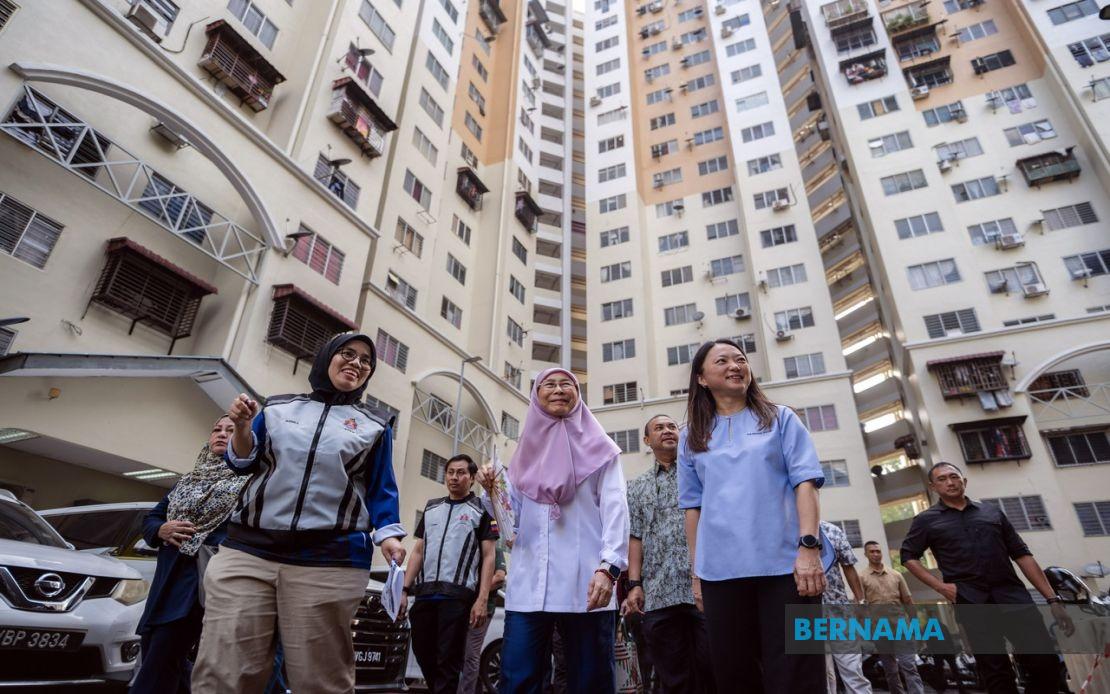
The Desa Tun Razak People's Housing Project (PPR) in Kuala Lumpur has successfully concluded its comprehensive upgrading programme, marking a significant milestone in the federal government's push to systematically improve public housing facilities across the capital. The RM9.6 million investment represents part of a broader RM300 million commitment announced this year, reflecting a strategic shift away from fragmented maintenance towards planned, coordinated improvements across all 61 PPR complexes in the city.
Minister in the Prime Minister's Department (Federal Territories) Hannah Yeoh underscored the importance of this structured approach during an inspection of the completed works. The initiative, which has already seen 22 projects completed with all Kuala Lumpur Members of Parliament aligned on priorities, addresses a longstanding challenge in public housing management. Rather than responding reactively to individual facility problems, the government now has a dedicated maintenance framework designed to sustain living conditions across the more than 8,000 residents who call Desa Tun Razak home, a complex that has served the community for over two decades since opening in 1998.
The breakdown of the RM9.6 million expenditure reveals the administration's focus areas. Kuala Lumpur Mayor Datuk Fadhlun Mak Ujud detailed that repainting and cosmetic enhancements absorbed RM7 million, addressing the visible deterioration that characterises aging public housing stock. Critical safety upgrades accounted for RM1.68 million, targeting fire prevention systems and electrical infrastructure overhaul—improvements rendered urgent following a series of fire incidents at the facility during 2023. Road resurfacing claimed nearly RM1 million, while complementary work to the fire riser system and drainage infrastructure rounded out the package.
The emphasis on fire safety reflects a painful learning curve for Malaysia's public housing sector. Previous incidents highlighted dangerous conditions in ageing complexes, where outdated electrical systems and inadequate fire suppression capabilities placed residents at risk. By systematically upgrading these critical systems, the authorities acknowledge that public housing residents deserve the same safety standards as residents elsewhere. The investment signals recognition that deferred maintenance exacts a human cost, particularly in densely occupied residential settings where fire can spread rapidly through multiple units.
The parking challenge at Desa Tun Razak illustrates ongoing tensions between infrastructure capacity and population density in urban public housing. Rather than permanent solutions, Kuala Lumpur City Hall is identifying temporary parking zones on vacant land—a pragmatic but limited response to space constraints. This suggests that while upgrading ageing facilities represents progress, fundamental issues of overcrowding and inadequate amenities in some PPR complexes remain partly unresolved. For residents, the availability of parking significantly impacts daily quality of life, and temporary measures may satisfy immediate needs without addressing longer-term planning deficiencies.
The completion timeline carries political and practical weight. Fadhlun's statement that all RM300 million worth of projects should conclude by year-end represents an ambitious but achievable target given the current pace—22 completed from a total of 61 suggests momentum. This schedule matters for residents awaiting improvements and for government credibility. Delays would feed narratives about inefficient public administration, while completion bolsters confidence in the authorities' capacity to deliver welfare improvements. For other states and municipalities observing Kuala Lumpur's experience, the timeline offers a benchmark for similar upgrading programmes.
Bandar Tun Razak Member of Parliament Datuk Seri Dr Wan Azizah Wan Ismail injected a civic dimension to the completion ceremony, appealing to residents to maintain and respect the improved facilities. This emphasis on resident responsibility reflects a common pattern: government invests in infrastructure, then depends on community stewardship for longevity. While reasonable, this places significant burden on residents who may lack resources, education, or motivation for proactive maintenance. Historical patterns suggest that without formal maintenance budgets and professional oversight, even recently upgraded facilities can deteriorate rapidly if left primarily to resident goodwill.
The RM300 million allocation this year represents a notable investment in federal territories public housing, though observers may question whether it suffices for all 61 PPR complexes across Kuala Lumpur. If distributed evenly, each complex would receive approximately RM4.9 million—roughly in line with Desa Tun Razak's expenditure. However, complexes vary significantly in age, size, and condition, suggesting that equal distribution may not optimally address the most urgent needs. Targeted prioritisation of the most deteriorated facilities could yield better overall outcomes than a formulaic approach.
The multi-stakeholder coordination evident in the Desa Tun Razak upgrade—involving federal ministers, city authorities, and elected representatives—reflects improved governance compared to previous fragmented approaches. Yet the initiative's success depends on sustained funding beyond 2024. If RM300 million represents a one-off injection rather than recurring maintenance budgets, PPR complexes face renewed deterioration within years. For Malaysian policymakers and residents, the question becomes whether this represents structural reform of public housing management or merely a catch-up campaign addressing years of deferred investment.
Looking ahead, the Desa Tun Razak completion offers a proof-of-concept for comprehensive PPR upgrading. Whether the momentum continues across all 61 complexes depends on political will, budgetary discipline, and effective project management. For the estimated hundreds of thousands of Malaysians living in PPR housing nationwide, the Kuala Lumpur initiative sends a signal that their living conditions matter sufficiently to warrant government investment. Sustaining and extending that commitment remains the central challenge as Malaysia continues grappling with affordable housing provision in increasingly expensive urban centres.

