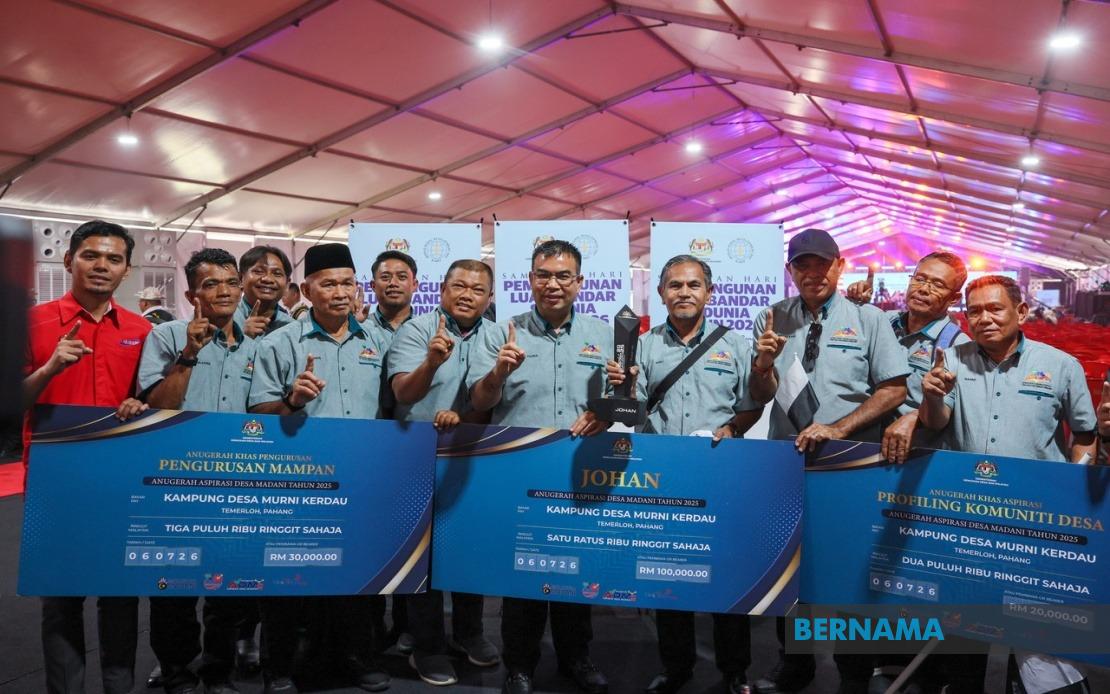
Desa Murni Kerdau, a traditional settlement in Temerloh, Pahang, has distinguished itself as a model rural community by capturing three major awards at the World Rural Development Day 2026 event held at Tun Abdul Razak Stadium in Jengka Sentral. The village's triple recognition—comprising the 2025 MADANI Rural Aspiration Award Champion designation, the Rural Community Profiling Aspiration Special Award, and the Sustainable Management Special Award—underscores emerging best practices in village governance and socioeconomic development across Malaysia's heartland.
The accolades were bestowed during a ceremony that highlighted the government's commitment to elevating rural living standards. Deputy Prime Minister Datuk Seri Dr Ahmad Zahid Hamidi presented the primary MADANI Rural Aspiration Award, while Deputy Minister of Rural and Regional Development Datuk Rubiah Wang conferred the two additional special awards. This dual ministerial involvement reflects the significance placed on rural development within the current administration's policy framework, particularly as Malaysia seeks to narrow the development gap between urban and non-urban areas.
Modamad Fazrul Ahmad, who chairs the Village Development and Security Committee overseeing Desa Murni Kerdau, characterised the awards as validation of the village's systematic approach to leadership, administrative efficiency, and grassroots community engagement. Speaking to reporters immediately after the ceremony, he emphasised that the recognition transcended symbolic value, instead affirming the tangible outcomes the village has achieved through coordinated effort and strategic planning. His remarks suggested that award ceremonies such as this serve not merely to celebrate past accomplishments but to incentivise other rural communities to adopt similar developmental frameworks.
The village's economic diversification strategy has proven particularly robust. With approximately twenty entrepreneurs now operating across multiple sectors—including small and medium enterprises, agricultural ventures, and automotive businesses—Desa Murni Kerdau demonstrates how rural communities can generate sustainable income without depending exclusively on traditional livelihoods. This entrepreneurial ecosystem appears especially relevant for Southeast Asian policymakers examining how to stem rural-to-urban migration and retain talent in provincial areas.
Beyond enterprise development, the settlement has successfully branded itself as a rural tourism destination through its "Kampung Stay" product offering. This initiative has generated measurable attention and visitor traffic, positioning the village as one of Malaysia's increasingly popular rural tourism experiences. Such ventures highlight how cultural authenticity and village hospitality can be monetised responsibly, creating employment opportunities while preserving community character—a balance that many developing regions struggle to achieve.
The demographic profile of Desa Murni Kerdau—approximately 200 households accommodating more than 600 residents—classifies it as a mid-sized village rather than a scattered hamlet. This scale permits effective collective action and resource pooling while maintaining the intimate social cohesion typically associated with traditional villages. The size also allows governance structures like the Village Development and Security Committee to remain accessible and responsive to resident concerns, a feature often lost in larger urbanising settlements.
Fazrul Ahmad confirmed that the monetary prize accompanying the awards would be redistributed directly to residents and channelled into localised improvement projects. This approach to prize allocation—prioritising community benefit over institutional accumulation—reflects a philosophy of inclusive development wherein recognition ultimately translates into tangible quality-of-life improvements. It also suggests that village leadership maintains strong accountability relationships with the constituency they serve.
The awarding of Sustainable Management as a distinct category underscores growing official emphasis on environmental stewardship and resource conservation within rural development frameworks. For communities in Pahang and similar states where forestry, agriculture, and water resources remain economically significant, embedding sustainability principles into village-level decision-making carries obvious practical importance. Desa Murni Kerdau's recognition in this domain may serve as a template for other communities navigating the tension between economic advancement and ecological preservation.
The World Rural Development Day 2026 celebration itself represents a coordinated effort by Malaysia's Ministry of Rural and Regional Development to showcase successful rural initiatives and disseminate best practices across the countryside. By hosting the event in Jengka Sentral and awarding villages from different regions, the ministry simultaneously celebrates existing achievements while encouraging competitive improvement among communities nationwide. This benchmarking approach can accelerate adoption of effective governance models and entrepreneurial strategies.
For Malaysian readers and regional observers, Desa Murni Kerdau exemplifies how intentional planning, diversified economic activity, and transparent community governance can transform a traditional village into a thriving, sustainable settlement. The village's success in simultaneous entrepreneurship, tourism development, and administrative excellence suggests that rural advancement need not require wholesale modernisation or abandonment of cultural identity. Instead, it demonstrates that traditional communities can selectively adopt contemporary practices—in marketing, business development, and governance—whilst preserving their distinctive character and social fabric.

