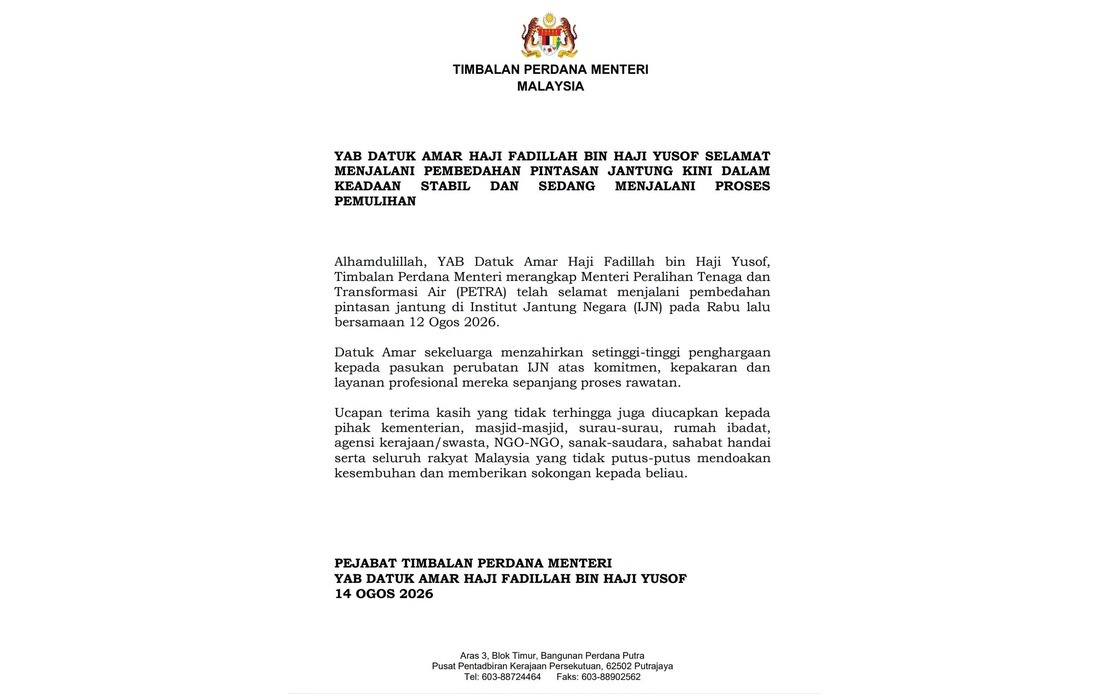
Deputy Prime Minister Datuk Seri Fadillah Yusof, who also serves as Energy Transition and Water Transformation Minister, is progressing positively following a successful double coronary artery bypass procedure conducted at the National Heart Institute (IJN) this week. The surgical intervention, performed on August 12, has proceeded according to medical expectations, with the patient now in the early stages of cardiac rehabilitation at the Kuala Lumpur facility.
Fadillah's medical journey began when he sought treatment on July 28, during which physicians conducted a diagnostic coronary angiogram the following day to assess the extent of arterial blockage. Based on the findings and following consultation among multiple specialist disciplines, the medical team concluded that surgical bypass grafting represented the optimal therapeutic approach for his condition. The procedure itself involved two separate bypass grafts, a common intervention when multiple coronary vessels require revascularisation to restore adequate blood flow to the heart muscle.
The surgical team comprised senior cardiothoracic specialists at IJN, with Prof Datuk Seri Dr Mohamed Ezani Md Taib and Prof Datuk Seri Dr Mond Azhan Yakub performing the operation alongside Clinical Fellow Cardiothoracic and Vascular Surgery Dr Ahmad Mahir Shamsuddin. Their expertise in coronary revascularisation reflects IJN's standing as the nation's foremost cardiac care centre, drawing complex cases requiring specialist intervention from across the country.
The surgery employed IJN's Enhanced Recovery After Surgery (ERAS) protocol, a comprehensive framework combining coordinated medical, nursing, and allied health involvement to facilitate faster recuperation while reducing post-operative complications. This methodology prioritises early mobilisation and structured rehabilitation, representing a significant advancement from traditional post-surgical recovery practices that often involved prolonged bed rest. For cardiac patients undergoing bypass grafting, such protocols have demonstrated measurable improvements in outcomes and length of hospitalisation.
Rapid progress during the critical first post-operative days has been particularly encouraging. By August 13, merely one day after the extensive surgical procedure, Fadillah had already commenced structured physical rehabilitation exercises. Remarkably, he completed 2.8 kilometres of cycling activity under clinical supervision, a considerable achievement that underscores his physical resilience and the effectiveness of the early mobilisation approach. This early activity helps prevent complications such as blood clots and respiratory deterioration while promoting cardiovascular reconditioning.
Following his successful exercise session, medical staff transferred the Deputy Prime Minister from the intensive care setting to a standard cardiac ward, indicating that his condition had stabilised sufficiently to permit transfer from continuous close monitoring. This transition represents a standard progression in cardiac recovery and reflects confidence among the clinical team in his trajectory. Within the general ward environment, he continues his prescribed cardiac rehabilitation programme, which typically includes supervised exercises, patient education, and medication management.
Prof Datuk Seri Dr Mohamed Ezani Md Taib, serving as IJN Group Chief Executive Officer, publicly affirmed satisfaction with the patient's advancement, noting that recovery has proceeded in alignment with anticipated timelines and that clinical indicators continue improving as expected. Such reassurances from senior institutional leadership carry particular weight, as they reflect not merely routine medical optimism but informed assessment from a physician directly involved in the case and responsible for IJN's overall cardiac programme.
The Deputy Prime Minister's office and family have expressed profound gratitude toward the IJN medical team for their technical competence, attentiveness, and personalised care throughout both the acute treatment phase and early recovery period. Beyond the hospital environment, they have acknowledged the widespread prayer, supplication, and encouragement extended by religious institutions, government ministries, civil society organisations, and the Malaysian public. Such collective expressions of support reflect the nation's regard for a senior government figure and the broader cultural values surrounding recovery from significant health challenges.
From a broader policy perspective, Fadillah's procedure and recovery illustrate the critical importance of maintaining world-class cardiovascular services within the Malaysian healthcare system. Coronary artery disease remains among the leading causes of mortality nationally, and access to advanced interventional procedures such as bypass grafting at institutions like IJN ensures that senior government officials and, more significantly, ordinary Malaysians can receive life-saving treatment domestically. The successful outcome also underscores the value of Malaysia's investment in medical infrastructure and specialist training programmes that have positioned local institutions competitively within the regional healthcare landscape.
The timing of Fadillah's recovery merits consideration within the context of Malaysia's political and administrative operations. As Deputy Prime Minister, his role encompasses significant responsibilities within government machinery, though the immediate focus remains entirely upon his health restoration rather than resumption of official duties. Senior officials typically maintain extended recovery periods following major cardiac surgery, typically measured in weeks rather than days, reflecting the substantial physiological demand of coronary bypass procedures on the body's organ systems.
From a medical standpoint, the successful navigation of the surgical phase and positive early recovery trajectory establish a favourable foundation for long-term outcomes. Patients undergoing coronary artery bypass grafting typically experience substantial improvements in symptoms, exercise capacity, and quality of life compared to their pre-surgical status, provided they adhere to prescribed medications, maintain lifestyle modifications, and engage in sustained cardiac rehabilitation. The degree of Fadillah's early mobilisation success suggests optimism regarding his eventual return to productive function, though complete recovery typically requires several months of progressive rehabilitation.

