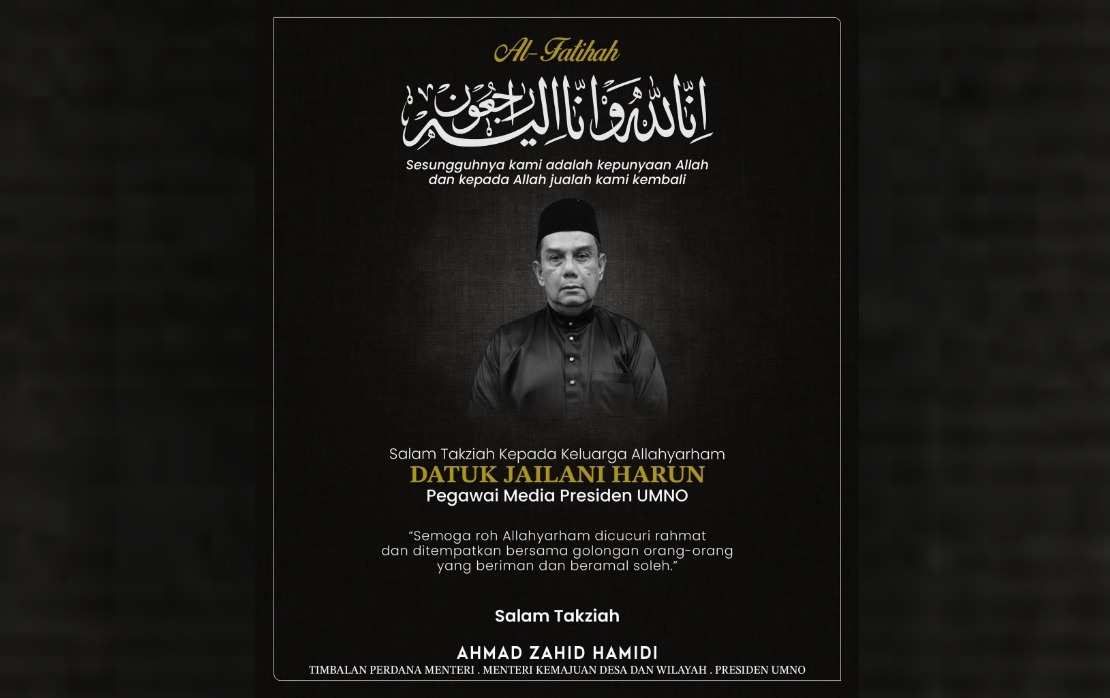
Deputy Prime Minister Datuk Seri Dr Ahmad Zahid Hamidi has extended his condolences to the family of Datuk Jailani Harun, a longtime media professional who served at the UMNO President's Office and passed away on July 7. The 66-year-old veteran journalist died at Serdang Hospital and will be laid to rest at Alam Damai Muslim cemetery in Cheras following afternoon prayers.
Ahmad Zahid, who also holds the position of UMNO president, shared his tributes through a social media post, recounting a visit he made to Jailani earlier that morning at the hospital. The Deputy PM's remarks reflected deep personal regard for the deceased, describing him as an individual whose character was marked by kindness, humility, and widespread respect within professional and party circles. The emotional tone of Ahmad Zahid's statement underscored the close working relationship that existed between the two figures within UMNO's upper echelon.
In his tribute, Ahmad Zahid revealed that he had hoped for a positive turn in Jailani's condition during his hospital visit, though circumstances ultimately proved otherwise. The Deputy PM's words acknowledged the inevitability of fate, expressing his acceptance of what he described as Allah's greater love for Jailani. This language reflects the Islamic perspective commonly invoked in Malaysian political and social discourse when marking the passing of prominent figures.
The formal condolence message conveyed Ahmad Zahid's prayers for Jailani's family, calling upon divine strength and resilience to sustain them through their bereavement. Such expressions of sympathy are customary within Malaysian political culture, particularly when senior government and party officials acknowledge the loss of colleagues or associates who have contributed significantly to their respective organizations over extended periods.
Jailani's career in journalism and subsequent role within UMNO's administrative apparatus positioned him as a bridge between media operations and party machinery during a significant period in Malaysian politics. His decades-long involvement in communications work would have exposed him to pivotal moments in the nation's political landscape, providing him with institutional knowledge and professional experience that extended beyond typical media roles.
The timing of Jailani's death marks another moment of reflection within UMNO, an organization that has experienced considerable internal dynamics and restructuring in recent years. His passing represents the loss of institutional memory and professional expertise accumulated over a lifetime of service in roles that demanded discretion, strategic communication, and deep understanding of political messaging.
The burial arrangements at Alam Damai Muslim cemetery, following afternoon prayers, align with Islamic burial traditions observed throughout Malaysia. The specific timing and location of funeral rites typically reflect family preferences and religious observance, with many prominent figures receiving substantial attendance from colleagues, political associates, and professional contacts.
Jailani's identity as someone who maintained working relationships across UMNO's hierarchy suggests he was regarded as a capable and trusted professional within party structures. The careful description of his character by Ahmad Zahid—emphasizing humility alongside professional competence—indicates that Jailani managed to maintain respect without becoming a controversial or polarizing figure, a notable achievement within Malaysian politics where communications roles often place individuals at the center of sensitive strategic decisions.
The passing of individuals with longstanding connections to Malaysia's major political organizations often prompts broader reflections on institutional continuity and the value of experienced practitioners in maintaining organizational coherence. Jailani's transition from journalism to party media work exemplifies a career trajectory common among Malaysian professionals who move between independent media operations and aligned institutional roles, each phase building on previous experience and networks.
For readers following Malaysian political developments, Jailani's death represents the departure of a generational figure who witnessed and participated in UMNO's evolution across multiple political cycles. His contributions to party communications, though often operating behind public view, would have shaped how UMNO's messaging reached both internal stakeholders and broader constituencies during periods of significant political change and challenge.
The Deputy PM's personal visit to the hospital and subsequent public acknowledgment of Jailani's passing through formal condolence statements demonstrates the protocols that govern Malaysian political life, where recognition of colleagues' contributions extends beyond workplace interaction to encompass public expressions of respect and remembrance. These gestures carry weight within professional and political circles, signaling the departed individual's standing and significance within organizational hierarchies.

