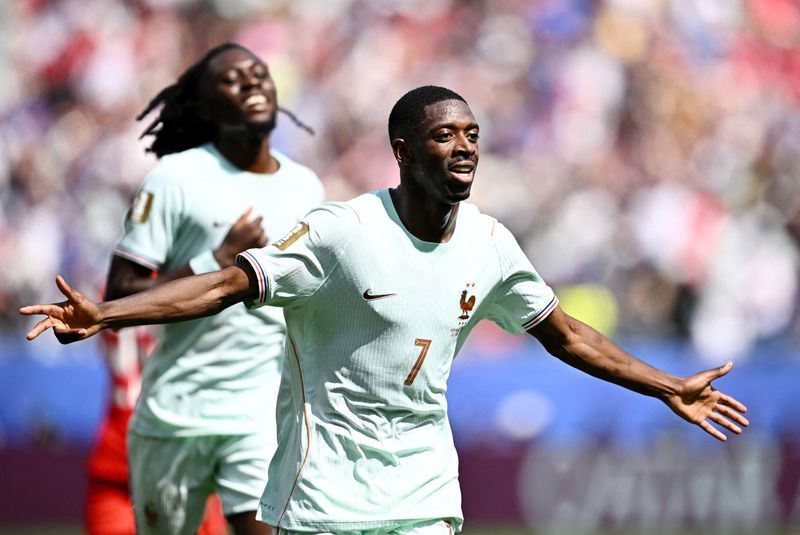
In a dominant display at Foxborough, Massachusetts, on Friday, France delivered a resounding 4-1 victory over a second-string Norway outfit to claim first place in World Cup Group I and momentum heading into the knockout stages. Ousmane Dembele was the architect of this emphatic performance, scripting an extraordinary hat-trick in the opening half-hour that saw the Paris St-Germain forward strike three times within just 25 minutes—a devastating spell that underlined France's credentials as serious contenders for global honours.
The comprehensive nature of France's triumph was shaped significantly by Norway's approach to the fixture. Coach Stale Solbakken elected to field a largely second-choice XI, resting most of his regular starters who had featured in the previous match against Senegal. This meant that talismanic striker Erling Haaland, widely regarded as one of the tournament's most potent attacking threats, remained on the bench alongside captain Martin Odegaard. Such wholesale changes reflected Norway's pragmatic stance, having already secured their passage to the Round of 32 before Friday's encounter, making the specific outcome of this group match less consequential for their tournament trajectory than the standings they could achieve.
Yet France's hunger to finish atop Group I was driven by factors beyond the usual competitive instinct. The French players had explicitly pledged to pursue victory as a tribute to their coach Didier Deschamps, who had departed the United States to return home and attend his mother's funeral. This personal motivation transformed the match into something beyond a routine group-stage fixture, infusing the squad with added determination to deliver a performance worthy of their absent leader. Both nations had mathematically qualified before the match began, but only one could claim the prestige and strategic advantage of topping the group.
France's dominance became apparent from the very first moment, with Kylian Mbappé nearly opening the scoring within 20 seconds when his angled attempt cannoned off the crossbar. The Paris St-Germain forward, competing for the tournament's Golden Boot award alongside the rested Haaland, orchestrated much of France's early rhythm with his customary blend of pace and precision. In the sixth minute, Mbappé demonstrated his creative prowess by delivering a sublime cross-field pass to Dembele, who cut inside past his marker before unleashing a well-struck angled finish that left goalkeeper Egil Selvik stranded.
Dembele's second goal arrived fourteen minutes later, arriving in the 20th minute when Mbappé again supplied the ammunition with another incisive delivery. The winger gained crucial separation from his defender to slot home a dipping shot that extended France's advantage. Norway briefly stemmed the tide through Thelo Aasgaard's immediate response, but the respite proved temporary as Dembele completed his hat-trick in the 32nd minute with a beautifully executed curling effort into the bottom corner. This achievement made Dembele only the third French player ever to score a World Cup hat-trick, joining the illustrious company of Just Fontaine and Kylian Mbappé himself—a remarkable statistic that underscored both the rarity of such performances and Dembele's exceptional quality on the day.
Historically, Dembele's treble ranks among the quickest ever recorded at a World Cup, arriving after just 25 minutes of play. Only Erich Probst's hat-trick for Austria against Czechoslovakia in 1954, which came after 24 minutes, surpassed this timing. The comparison highlights how exceptional such explosive performances have been across seven decades of World Cup football, and Dembele's joining that rarefied air speaks to both his individual brilliance and France's tactical superiority during this opening period.
Norway mounted some semblance of a response in the second half, with goalkeeper Mike Maignan called upon twice to preserve France's commanding position. Jørgen Strand Larsen's soft penalty in the early stages of the second period was comfortably saved by the AC Milan custodian, while winger Oscar Bobb forced another save as the Scandinavians exploited pockets of space in the French defence. These chances, however, never developed into genuine momentum shifts, and France's attacking potency ultimately proved insurmountable for their opponents.
The fourth goal duly arrived as the match dwindled toward conclusion, with substitute Bradley Barcola crossing for Désiré Doué to head past Selvik. This final flourish provided an appropriate full stop to France's statement performance and cemented their status as Group I winners. The final standings meant that as group champions, France would face Sweden in the Round of 16, securing a route through the knockout draw that appeared marginally more favourable than other available options given the tournament's complex scheduling logistics across North America.
Norway's consolation as group runners-up saw them draw Ivory Coast in the next phase, a fixture that will test their regenerated squad against opposition that has presented considerable challenges for European teams historically. For France, however, the emphasis now shifts toward preparation for a Swedish side that has proven capable of frustrating established powerhouses. Dembele's scintillating performance will have served notice that Les Bleus possess the cutting edge required to progress far in this tournament, while Mbappé's creative contributions suggest the supporting cast around him remains world-class. With Deschamps' expected return to the touchline after honouring his personal obligations, France enter the knockout phase as genuine contenders.

