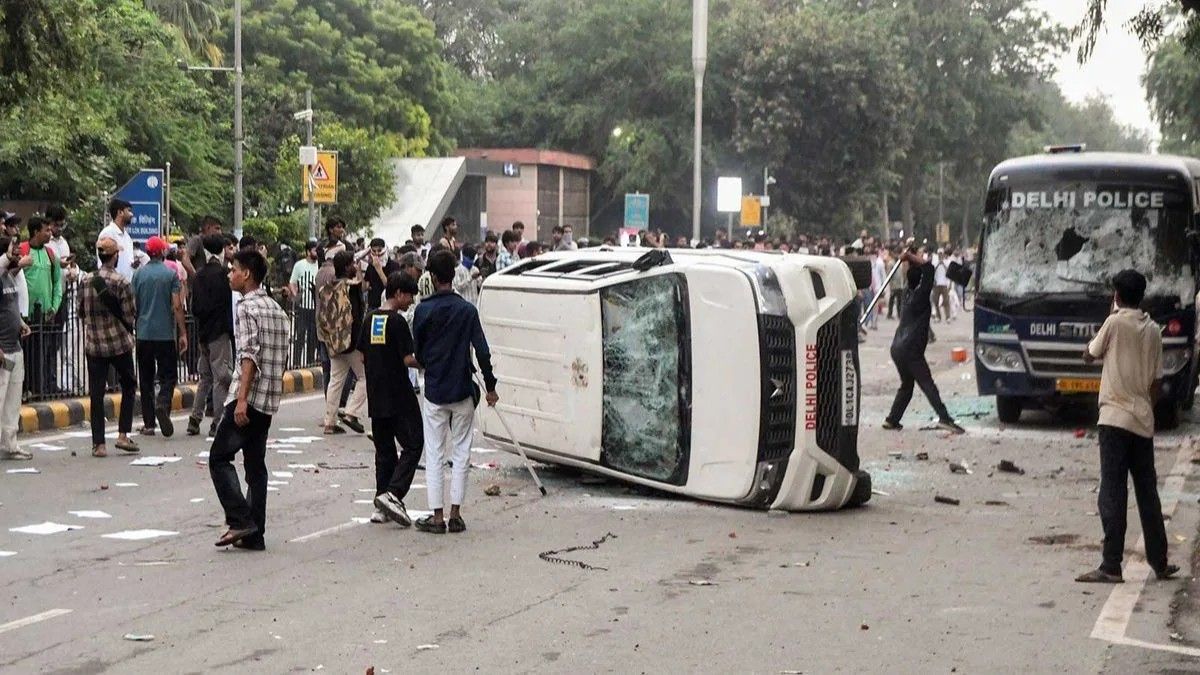
Delhi Police have initiated a substantial criminal investigation into violence surrounding the Cockroach Janta Party's "Sansad Chalo" march, filing 10 First Information Reports across multiple police stations in the New Delhi district. The protest, which culminated in clashes on Monday as demonstrators attempted to march towards Parliament, has triggered a comprehensive law enforcement response involving video analysis, forensic examination, and charges spanning multiple statutory provisions. The situation underscores growing tensions between protest movements and state security apparatus in India's capital, with implications for how authorities manage dissent in South Asia's largest democracy.
Authorities moved quickly to counter narrative claims circulating via social media platforms, with the Deputy Commissioner of Police (New Delhi) explicitly stating that videos allegedly showing fresh stone-pelting and police action at Jantar Mantar on Tuesday were fabricated or misleading. Through an official post on X, Delhi Police declared that no such incidents occurred on the second day of the sit-in, emphasizing the importance of relying on authorised sources rather than unverified digital content. This assertion came as demonstrators maintained their presence at the protest venue following removal of tents and staging infrastructure by security personnel, raising questions about the persistence of the movement despite police containment efforts.
The underlying catalyst for the demonstration centres on demands that Union Education Minister Dharmendra Pradhan resign over alleged examination irregularities—a matter that has gained traction among student activists and civil society organisations concerned with educational governance. The Cockroach Janta Party framed its parliamentary march as a pressure tactic to compel governmental response to these grievances, positioning the action within a broader discourse about accountability in higher education administration. For Malaysian observers, this reflects regional patterns where education policy debates frequently intersect with street-level activism and institutional accountability demands.
Police have distributed the 10 FIRs across distinct venues: four at Parliament Street police station, three at Connaught Place police station, and single cases filed at Mandir Marg, Barakhamba Road, and Kartavya Path police stations. This geographic distribution indicates that incidents classified as criminal occurred across multiple locations during the march route, suggesting either spontaneous confrontations at different points or coordinated activity spanning substantial territory. The dispersed filing pattern also reflects administrative mechanisms for managing complex multi-location incidents within Delhi's jurisdictional framework.
Among the most serious allegations is an alleged life-threatening attack on a Rapid Action Force personnel during Monday's demonstration, suggesting that confrontations involved weaponry or instruments capable of causing severe injury. Additionally, police have charged individuals with unauthorised drone operation during parliamentary sessions—a regulatory concern that intersects security protocols governing sensitive government spaces. These charges employ provisions from the Bharatiya Nyaya Sanhita, the Arms Act, and the Prevention of Damage to Public Property Act, establishing a comprehensive legal framework for prosecuting varied categories of alleged misconduct.
Further criminal allegations encompass conspiracy charges, obstruction of government functions, assault on police personnel, and property damage—categories that collectively suggest organised activity extending beyond spontaneous crowd behaviour. The conspiracy allegations particularly warrant scrutiny, as they indicate police assessment that violence resulted from pre-planned coordination rather than uncontrolled escalation. Investigators are examining more than 250 videos to identify participants and establish whether alleged violence represented coordinated strategy, a process that will likely extend investigation timelines considerably.
CJP spokesperson Ashutosh Ranka has countered official narratives by alleging that numerous demonstrators sustained injuries during Monday's confrontation, including students and volunteers. Notably, he highlighted the mistreatment of female protesters, specifically naming Geetanjali J. Angmo, wife of environmental activist Sonam Wangchuk, whose involvement signals that the protest attracted prominent civil society figures and their family members. This gendered dimension of alleged police conduct raises questions about differential treatment of women protesters and potential concerns regarding excessive force application.
The party's insistence on continuing the agitation until Dharmendra Pradhan resigns indicates determination to sustain pressure despite law enforcement responses. Demonstrators have reconvened at Jantar Mantar following the removal of infrastructure, adapting their protest format to circumvent police restrictions while maintaining physical occupation of the symbolic space. This adaptability reflects evolving protest tactics in response to state counter-measures, demonstrating demonstrators' capacity to sustain movements despite official impediments.
Delhi Police have maintained substantial security deployments at Jantar Mantar, with heavy presence of regular police and Rapid Action Force personnel indicating sustained operational commitment to containing the demonstration. Officials characterised Monday's protests as displaying "unruly, aggressive and violent behaviour" despite prior warnings and prohibitory orders, establishing an official narrative that attributes violence to protester misconduct rather than police provocation. This framing disputes counter-claims regarding excessive force application, setting up contested factual narratives typical of such confrontations.
The divergence between police assertions regarding Tuesday's relative calm and activist claims regarding ongoing mistreatment reflects fundamental disagreement about protest dynamics and state conduct. Social media circulation of contested videos exemplifies modern protest communication strategies, whereby digital platforms enable rapid dissemination of alternative narratives challenging official accounts. For regional observers, this case illustrates broader challenges governments face managing information environments during contentious demonstrations.
The investigation's scope—examining 250-plus videos and filing charges across multiple categories—signals that Delhi Police view the incident as significant enough to warrant comprehensive prosecutorial investment. The outcome of these investigations will establish important precedents regarding police authority to manage parliamentary vicinity protests and the legal consequences for demonstrators engaging in alleged violence. For Malaysian readers following South Asian governance trends, this case illuminates how major democracies navigate tensions between protest rights and public order maintenance, with potential implications for how Southeast Asian governments develop their own crowd management protocols.

