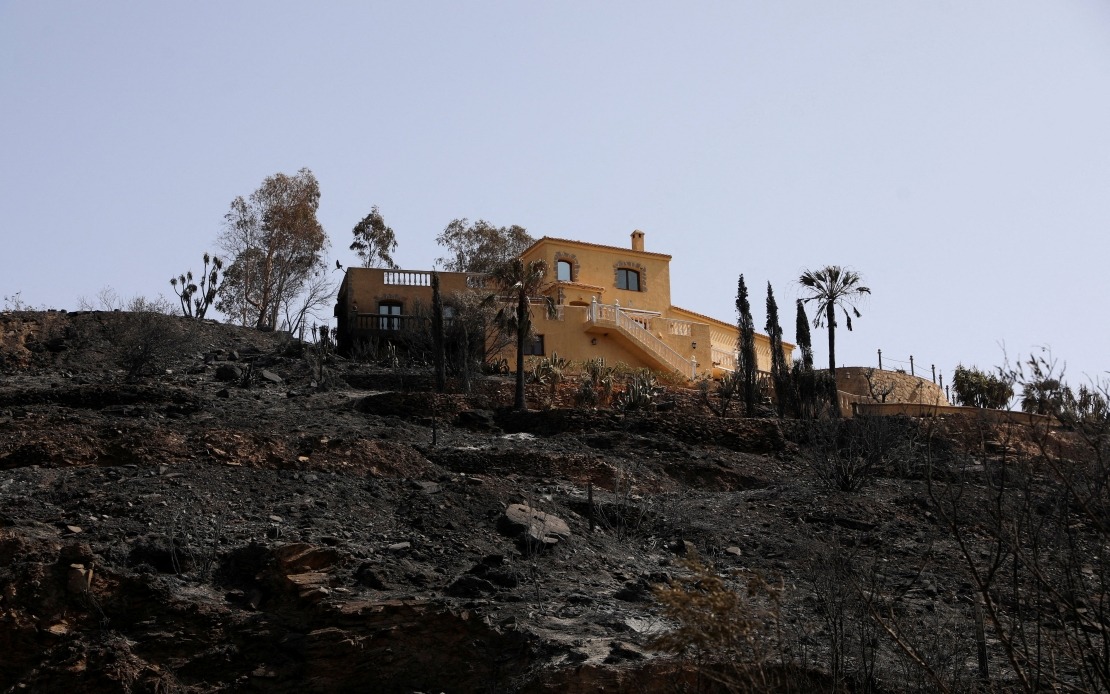
A severe wildfire ravaging Spain's southeastern Almeria province has left 13 people dead and forced thousands to flee their homes, though regional officials announced Sunday that the destructive flames have been stabilised after burning through vast stretches of farmland and countryside. The blaze, which ignited on Thursday near Los Gallardos in the Andalusian region, represents a catastrophic natural disaster that has drawn international attention and sparked fresh concerns about climate-driven environmental catastrophes in Europe.
The humanitarian toll continues to weigh heavily on emergency responders and local communities. Seven people remain hospitalised, with three classified as critically injured and requiring intensive medical care. Additionally, ten individuals remain officially registered as missing, prompting ongoing search and rescue operations across the fire-ravaged terrain. Notably, many of those impacted by the disaster are foreign nationals, underscoring the international dimension of the crisis and complicating coordination efforts for authorities seeking to reunite survivors with families and provide necessary support.
The containment of the fire has yielded some relief for affected residents. Approximately 600 evacuees were permitted to return to their homes on Saturday, and regional authorities subsequently authorised the remaining roughly 1,000 people to leave evacuation shelters and emergency centres. This gradual reopening of affected areas reflects a cautious optimism among officials that the immediate threat has passed, though extensive rebuilding and recovery efforts will occupy local communities for months to come.
Investigators are actively pursuing multiple leads regarding the fire's origins. While the precise cause remains officially undetermined, preliminary findings strongly suggest that structural failure of electrical infrastructure may have ignited the blaze. The hypothesis centres on the potential collapse of an electricity pole or associated cable, which would have created sparks capable of igniting the dry vegetation characteristic of Almeria's landscape during summer months. This possibility carries significant implications for utilities operators across Spain and raises questions about maintenance standards for critical infrastructure in high-risk fire zones.
Juanma Moreno, the head of Andalusia's regional government, provided a measured assessment of the containment efforts while emphasising that complete suppression remains a pending objective. Speaking Sunday, Moreno confirmed that the wildfire had ceased advancing and been confined within its perimeter, preventing further territorial expansion. However, he cautioned that intensive labour would be necessary before officials could declare the emergency fully resolved and the flames completely extinguished. This distinction between containment and extinction reflects the complex, prolonged nature of large-scale wildfire management.
The sheer scale of the disaster underscores its historical significance for the region. Moreno characterised the fire as the most serious incident in Andalusia's recent history, a sobering designation that highlights how the incident transcends typical seasonal fire events. The 7,000 hectares consumed represent an enormous expanse of territory, encompassing agricultural zones, natural habitats, and residential areas. This magnitude has prompted serious reflection among both policymakers and citizens regarding preparedness and prevention strategies.
Moreno seized the moment to deliver a pointed message about planetary environmental change, urging citizens and government agencies alike to treat climate change with appropriate seriousness. His remarks positioned the wildfire as a manifestation of broader climatic shifts rather than an isolated anomaly, framing the disaster within the context of escalating global temperatures and shifting weather patterns. This framing resonates with international scientific consensus regarding the intensification of extreme weather phenomena linked to anthropogenic climate change.
The governor highlighted a troubling progression in wildfire dynamics that specialists have documented across Europe and globally. Climate change is generating increasingly complicated conditions that challenge conventional fire-fighting approaches and tactics, he noted. Simultaneously, fires themselves are expanding to unprecedented proportions, achieving scales and intensities that stretch the capacity of traditional emergency response systems. The combination of larger fires and more complex atmospheric conditions creates a compounding crisis for authorities, who must deploy ever-greater resources to combat these evolving threats.
For Malaysia and Southeast Asian observers, the Almeria disaster carries instructive lessons regarding climate vulnerability and environmental risk. Southeast Asia faces analogous threats from intensifying wildfires, as documented by recurrent transboundary haze episodes originating from regional agricultural burning and land-clearing operations. The Spanish experience demonstrates how even wealthy, industrialised nations struggle to manage large-scale fire events in an era of climatic instability. The region's experiences with seasonal fire crises in Indonesia and Malaysia suggest that comparable disasters may increase in frequency and severity without robust prevention and early-warning systems. Spanish authorities' emphasis on climate change adaptation therefore offers relevant takeaways for policymakers across Asia.
The incident also raises questions about infrastructure resilience and preventative maintenance in fire-prone regions. If electrical system failure indeed triggered the Almeria blaze, the implication extends beyond Spain alone. Utility companies throughout Europe and globally may need to reassess maintenance protocols and upgrade aging infrastructure to withstand heat stress and reduce ignition risks. This infrastructure dimension connects the immediate disaster to longer-term investment decisions that policymakers must confront.
Emergency coordination efforts revealed both successes and ongoing challenges in modern disaster response. The relatively swift evacuation of thousands of residents, coupled with the gradual authorisation of returns, demonstrates functional emergency management systems. However, the persistence of missing persons and the complexity of coordinating international victim assistance underscores the complications that large-scale disasters generate. As Spain undertakes recovery operations and investigations proceed, the incident will likely generate policy recommendations affecting fire prevention, emergency preparedness, and climate adaptation strategies across the European Union and beyond.

