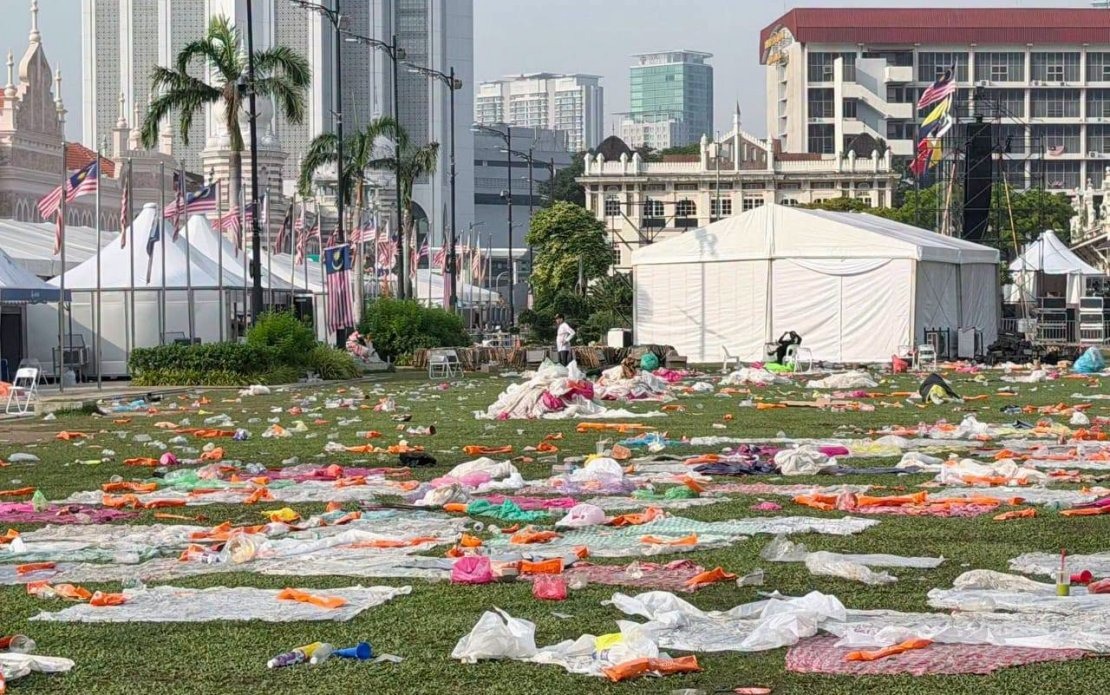
Kuala Lumpur City Hall (DBKL) is mobilising cleaning crews to tackle substantial litter left behind at Dataran Merdeka following a massive public gathering to witness the live broadcast of the 2026 FIFA World Cup final early this morning, in which Spain defeated Argentina 1-0. The cleaning operation marks a significant challenge for the capital's municipal authorities, who have issued a broader statement about public responsibility and civic consciousness among Kuala Lumpur residents.
The iconic national landmark transformed into an open-air stadium overnight as more than 25,000 football enthusiasts flooded the space to experience the World Cup final broadcast together. The spontaneous congregation reflected widespread passion for the tournament, yet the aftermath revealed the environmental toll of such large-scale public gatherings. Images and reports suggest that the ground was extensively covered with discarded food packaging, beverage containers, and general refuse once the match concluded and crowds dispersed.
In an official Facebook statement, DBKL acknowledged the cleanup responsibility while deliberately shifting the narrative toward public consciousness and personal accountability. The municipal authority emphasized that maintaining Kuala Lumpur's cleanliness should not rest solely on the shoulders of municipal staff responding to situations created by the public. This messaging appears designed to prompt reflection among citizens about the relationship between individual freedom and collective responsibility within shared urban spaces.
The authority's statement carried notable symbolic weight, characterizing Dataran Merdeka as far more than a recreational gathering point. The space holds profound historical significance as a symbol of national independence and dignity, making the condition in which it is left a matter of cultural importance. DBKL framed the post-event littering as a reflection of how Malaysian society values this heritage site and what message the state of the grounds communicates to both local and international observers.
Central to DBKL's message was a distinction between celebration and cleanliness. The statement acknowledged that public joy, enthusiasm, and the freedom to cheer unreservedly are legitimate and valued aspects of urban life. However, authorities contended that such freedoms exist within boundaries and cannot justify the fouling of communal spaces. This framing presents a philosophical challenge to visitors and residents: that collective happiness does not automatically grant permission to compromise shared environmental and civic standards.
The timing of this incident carries broader implications for Malaysia's reputation as a host nation and urban management capacity. As the country continues developing its infrastructure and international profile, episodes like this generate scrutiny regarding civic culture and the alignment between public behaviour and national aspirations. Large-scale World Cup broadcasts represent opportunities to showcase community spirit, yet simultaneous cleanliness failures risk undermining positive narratives about Malaysian society.
DBKL's appeal to residents to treat Kuala Lumpur as their own home requiring collective care reflects growing municipal emphasis on shared ownership of public spaces. Rather than framing cleanup as purely a government responsibility, the authority positioned proper maintenance as a direct reflection of residents' and visitors' personal values and commitment to their community. This approach aligns with global best practices in civic management, wherein public engagement proves more sustainable than top-down enforcement alone.
The incident also highlights challenges inherent in managing spontaneous large gatherings at heritage sites. Unlike ticketed, organized events where crowd management and waste infrastructure can be planned comprehensively, open-air public broadcasts at Dataran Merdeka occur with minimal advance preparation. Future World Cup matches and similar international sporting broadcasts will likely attract comparable crowds, suggesting that DBKL and other municipal bodies require frameworks for managing such situations more proactively.
For Malaysian readers and Southeast Asian observers, this episode encapsulates broader urbanization tensions across the region. Rapid city development, growing middle-class participation in global entertainment, and expanding public spaces create unprecedented opportunities for collective experience. Simultaneously, these same dynamics generate management challenges that require coordinated responses involving government, citizen participation, and cultural shifts regarding environmental consciousness in public areas.
The situation also reflects differing standards for event management between formal stadium environments and spontaneous public gatherings. Professional sporting venues maintain comprehensive waste management systems, trained staff, and infrastructure designed for large crowds. Dataran Merdeka, while iconic and spacious, fundamentally operates as an open public plaza rather than a specialized venue, creating inherent disparities in preparation and cleanup capacity.
Moving forward, DBKL's statement appears positioned to catalyse behavioral change through moral persuasion rather than punitive measures. The authority's emphasis on dignity, shared values, and collective responsibility suggests an assumption that many participants genuinely did not consider the environmental impact of their presence. This optimistic framing assumes education and awareness can modify future conduct more effectively than fines or restrictions on gathering access.
The cleanup operation itself, while necessary and significant, represents a reactive rather than preventive approach. Sustainable solutions likely require collaboration between DBKL, event organizers, and community groups to install temporary waste infrastructure, deploy volunteer cleanup stations, and establish clear expectations before large gatherings occur. The 2026 World Cup final broadcast's aftermath offers valuable lessons for managing the city's ongoing evolution into a global metropolis where spontaneous public congregation is increasingly common.

