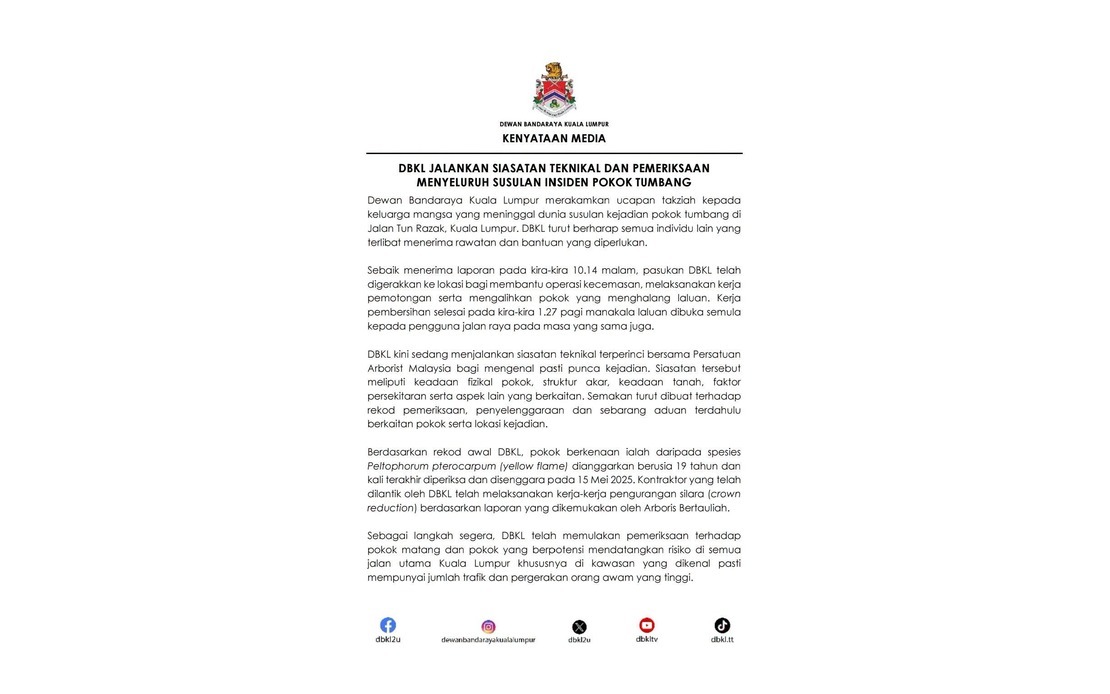
A 19-year-old Yellow Flame tree that fell on Jalan Tun Razak claimed one life last night, prompting Kuala Lumpur City Hall (DBKL) to launch an urgent technical investigation into what caused the sudden collapse. The fallen Peltophorum pterocarpum has triggered a comprehensive examination of the tree's condition and its surroundings, conducted jointly with the Malaysian Society of Arborist, as authorities work to understand how such a mature specimen could pose such a deadly hazard to commuters passing below.
The investigation being conducted by DBKL and the arborists represents a multi-layered approach to understanding tree failures in urban environments. Rather than accepting the incident as a random event, the authorities are examining the tree's structural integrity, its root system, and the soil composition where it was planted. Environmental factors including weather patterns and ground stability are also under scrutiny, while officials will review all historical records of inspections, maintenance work, and any complaints filed about this specific tree or the Jalan Tun Razak location more broadly. This thoroughness reflects growing recognition that urban tree failures are typically preventable through proper assessment and care.
Records show that this particular Yellow Flame tree had undergone crown reduction work based on recommendations from a certified arborist. The tree was last inspected and maintained on May 15, suggesting that DBKL had conducted relatively recent upkeep. However, the two-month gap between the last maintenance and the fatal collapse has raised questions about the adequacy of inspection intervals and whether certain warning signs might have been missed or misinterpreted. The involvement of the Malaysian Society of Arborist elevates the investigation beyond standard municipal procedures, bringing specialized expertise to bear on what may have been underlying weaknesses in the tree's structure or health.
Emergency response to the incident was swift, with a DBKL team deployed immediately upon receiving reports at 10.14 pm. The team cut down the tree and cleared obstructions, with Jalan Tun Razak reopened by 1.27 am. This rapid response minimized disruption to traffic flow, but the incident itself has sparked broader concerns about the safety of thousands of mature trees lining Kuala Lumpur's major thoroughfares. As a densely urban area with heavy vehicular and pedestrian traffic, the capital faces particular vulnerability to tree failures that can injure or kill people below.
In response to the fatality, DBKL has initiated expedited inspections of mature and potentially hazardous trees across all major roads in Kuala Lumpur, with particular focus on corridors experiencing high traffic volumes and significant public foot traffic. The initial phase targets several key arterial roads including Jalan Ampang, Jalan Sultan Ismail, Jalan Raja Laut, Jalan Datuk Keramat, and additional stretches of Jalan Tun Razak itself. Eight inspection teams, comprising five certified arborists and supporting personnel, have been deployed to complete these assessments within a ten-week timeframe. This intensive effort underscores the seriousness with which DBKL is treating the incident and the scale of the urban tree stock requiring evaluation.
Looking beyond immediate response measures, DBKL is pursuing longer-term preventive strategies that leverage technology to monitor tree health continuously. The city authority has applied for SIRIM approval to deploy 400 specialized tree sensors at high-risk locations throughout Kuala Lumpur. These devices would function as early-warning systems, tracking critical indicators of tree stability including soil moisture content, structural movement, and root stress. By monitoring how trees respond to environmental stressors such as heavy rainfall and flooding, the sensors could theoretically identify trees at risk of failure before they collapse, allowing for preventive intervention such as reinforcement, pruning, or removal.
The first phase of sensor installation is expected to concentrate on four strategically important locations: Jalan Bangsar, Dataran Merdeka, Jalan Ampang, and Jalan Raja Chulan. These areas likely represent a combination of high foot traffic, prominent mature tree populations, and vulnerability to environmental stressors. The technology represents a significant shift toward data-driven urban forestry management, moving beyond reactive maintenance triggered by visual inspection toward predictive systems that anticipate failures. For Malaysian readers, this development signals DBKL's willingness to invest in innovative solutions to enhance public safety in one of Southeast Asia's major metropolitan areas.
The incident on Jalan Tun Razak raises uncomfortable questions about how well-maintained urban tree populations are across Malaysia's major cities. While DBKL maintains comprehensive records and engages certified arborists, the fact that a tree last inspected two months prior could still fail fatally suggests that inspection intervals may require shortening or that assessment methodologies may need refinement. Other Malaysian municipalities may scrutinize their own tree maintenance protocols in light of this tragedy, particularly in cities like George Town, Ipoh, and Selangor where mature trees are prevalent along major roads and in parks frequented by large numbers of people.
The tragic loss of life in this incident cannot be understated, and DBKL's expression of condolences to the victim's family reflects the gravity of the situation. However, from a systemic perspective, the comprehensive investigation and subsequent expansion of monitoring and inspection activities offer pathways toward preventing similar incidents. The commitment to cooperate fully with police and relevant agencies, combined with the immediate deployment of additional resources, demonstrates institutional responsiveness to public safety concerns. For residents and commuters in Kuala Lumpur, these measures may provide some reassurance that authorities are taking the risk of tree failure seriously.
The implementation of 400 tree sensors, pending SIRIM approval, represents a forward-thinking approach that could position Kuala Lumpur as a leader in urban tree safety management within the region. However, the effectiveness of such technology will ultimately depend on whether DBKL has the financial resources, personnel, and technical capacity to maintain the system over the long term and to act decisively on data indicating tree instability. The human cost of tree failure—one life lost to a collapsing tree—underscores why such investments in prevention and monitoring are not merely desirable but essential for maintaining safe urban public spaces.
For Malaysian households affected by this tragedy and for the broader public using Kuala Lumpur's roads and spaces, the investigation and remedial actions now underway represent both accountability and protection. The involvement of specialist arborists, the systematic inspection of high-risk trees, and the deployment of monitoring technology collectively signal that urban tree management is receiving elevated attention. Whether this represents a temporary response to a crisis or a sustained commitment to improving the safety of Malaysia's urban forests will become apparent over the coming months as DBKL implements these expanded protocols across the capital.

