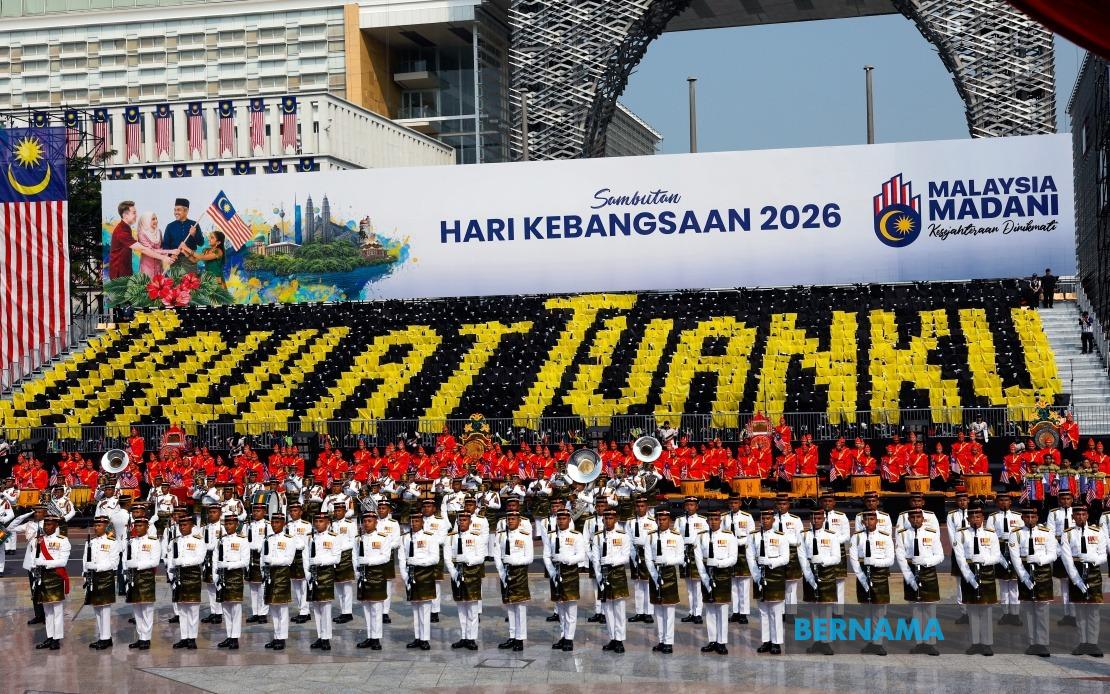
Tomorrow's National Day celebration at Dataran Putrajaya will transform the nation's administrative hub into a focal point of patriotic expression, with elaborate preparations underway to accommodate thousands of participants and showcase Malaysia's national pride. His Majesty Sultan Ibrahim, King of Malaysia, and Her Majesty Raja Zarith Sofiah, Queen of Malaysia, will grace the occasion, alongside Prime Minister Datuk Seri Anwar Ibrahim and his Cabinet, lending the event the highest ceremonial significance. The celebration carries the thematic banner "Malaysia MADANI: Kesejahteraan Dinikmati," emphasizing the government's commitment to distributing prosperity across society while reinforcing the nation's independence heritage and collective identity.
The scale of tomorrow's event reflects an ambitious vision spanning multiple dimensions of national life and governance. The parade will mobilize 10,819 participants distributed across 76 contingents supported by 22 marching bands, while 328 military assets from land, naval, and air components will be on display. This formidable assembly includes 112 working animals and 22 electric vehicles, representing the country's evolving defence infrastructure and environmental consciousness. Eleven float vehicles will weave through the proceedings, each serving as a mobile canvas for themes ranging from state tourism promotion to corporate participation, collectively painting a portrait of Malaysia's economic and cultural landscape.
The opening ceremonial performance, "Gema Inovasi MADANI," coordinated by the National Department for Culture and Arts, will establish the event's cultural tenor through an innovative fusion of tradition and contemporaneity. Utilising 150 musical instruments and notably 700 traditional kompang frame drums, the performance will celebrate Malaysia's ethnic plurality through percussion idioms representing the nation's primary communities. This symbolic approach—rooting national identity in shared musical heritage while acknowledging community distinctiveness—embodies the MADANI framework's emphasis on unity without uniformity. The kompang, deeply embedded in Malaysian folk traditions, becomes the vehicle for articulating messages of harmony, goodwill, and collective well-being to assembled crowds.
The parade structure itself has been organized thematically to narrate multiple facets of national endeavour and governance. The statehood component will prominently feature a large contingent bearing the Jalur Gemilang, accompanied by cadet officers from institutions including the National Defence University of Malaysia and representatives from the National Service Training Programme, visually cementing the link between youth development and national continuity. Simultaneously, the sports well-being component will bring together national athletes and medallists from the Glasgow 2026 Commonwealth Games, positioning Malaysian sporting achievement as an extension of patriotic service and an emblem of competitive excellence on the global stage.
The public economy dimension underscores how the celebration extends beyond ceremonial nationalism to encompass commercial and entrepreneurial participation. A diverse coalition of service providers—including Munchy's Malaysia, ZUS Coffee, Carsome, and the Malaysian Security Industry Association—will march as representatives of the private sector's role in national development. This inclusion signals the government's framework of inclusive patriotism, wherein businesses contribute to national identity-building while advancing economic objectives. The representation of cooperative movements and retail enterprises alongside airline partners Malaysia Airlines, AirAsia, Batik Air, and Air Borneo transforms the parade into a demonstration of economic interdependence and sectoral cooperation.
Public order and safety agencies assume prominent roles in the procession, with the Malaysia Civil Defence Force, Road Transport Department, and Malaysian Fire and Rescue Department participating to highlight governance's protective functions. These organizations, typically positioned behind the scenes, take centre stage to reinforce public consciousness of state structures dedicated to security and welfare. The Johor Military Force, noted as Malaysia's oldest military unit, will contribute its distinctive heritage to the display, while the parade's inclusion of naval and air force assets directly showcases the nation's defence capabilities before civilian spectators. This measured militarization of public space—displaying capabilities without militaristic aggression—calibrates national security messaging for contemporary audiences.
Cultural and entertainment dimensions have been carefully curated to broaden the celebration's intergenerational appeal. The Visit Malaysia Year 2026-2027 floats will traverse Dataran Putrajaya displaying state tourism icons, indigenous flora and fauna, and traditional attire representing Malaysia's regional diversity. Notably, national animation studio Les' Copaque will feature characters Upin and Ipin, popular figures among younger audiences whose inclusion acknowledges that National Day pedagogy must engage children through familiar cultural touchstones. The human graphics performance, marshalling 1,500 students from 36 Selangor schools into synchronized formations with music and visual choreography, transforms youth participation from passive spectatorship into active performative contribution, embodying notions of shared national responsibility.
The musical soundscape has been entrusted to Faizal Tahir, whose composition "Aku Berjanji" (I Promise) will frame the celebration's conclusion with lyrical reinforcement of patriotic commitment. This strategic selection of an established Malaysian performer ensures cultural authenticity while providing recognizable artistic continuity for audiences accustomed to Tahir's previous work. The song's title—framing patriotism as a volitional promise rather than inherited obligation—suggests subtle philosophical positioning regarding how younger Malaysians should conceptualize national belonging in the contemporary context.
The celebration's climactic moment will feature Royal Malaysian Air Force fighter jets executing aerial maneuvers above Dataran Putrajaya, translating abstract notions of national defence into concrete visual spectacle. This airshow represents the practical apex of the parade's security messaging, converting demonstration of defence assets into an experiential encounter with national power projection. The timing of this display—positioned as the event's crescendo before the approximately 10:00 am conclusion—ensures it functions as the dominant sensory memory for attending crowds, encoding military capability as the final and most visceral image of national identity.
Logistical coordination on an unprecedented scale accompanies tomorrow's proceedings. Communications Minister Datuk Seri Fahmi Fadzil, who chairs the Main Committee for the National Day and Malaysia Day celebrations, has advised participants and visitors to wear N95 face masks given the current haze affecting air quality—a pragmatic acknowledgment that patriotic celebration must accommodate environmental realities. The organizers have proactively distributed over 10,000 face masks to parade participants, demonstrating that public health considerations are integrated into celebration planning rather than treated as external constraints. This health-conscious approach reflects regional concerns about air quality that have periodically disrupted activities across Southeast Asia.
The Ministry of Home Affairs has coordinated extensive road closures affecting Putrajaya's Core Island, with five major bridges—Seri Wawasan, Seri Saujana, Seri Gemilang, Putra, and Seri Ehsan—sealed from 5:00 am on August 30 through 6:00 pm on August 31. These traffic restrictions, while necessary for logistical management, require public cooperation and advanced journey planning. The emphasis on public transport utilization reflects broader urban mobility principles aligned with reducing congestion and environmental impact, positioning the National Day celebration within contemporary sustainability frameworks. For Selangor residents and Putrajaya commuters, these closures represent temporal disruption offset by participation in what organizers frame as a once-yearly assertion of national cohesion.

