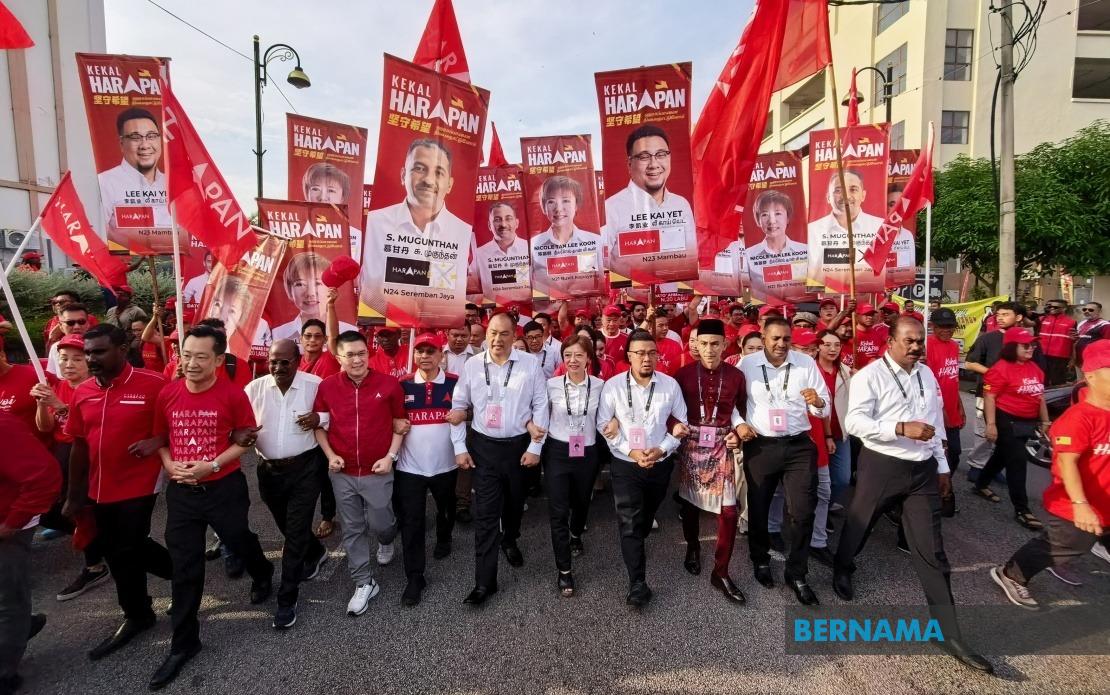
The battle for Negeri Sembilan's state assembly seats is shaping up as a fragmented contest across multiple constituencies, with the Rahang seat emerging as a particularly crowded battleground. Siaw Meow Keong, the Negeri Sembilan DAP treasurer who won the seat in 2023, must now defend his position against three challengers representing competing political coalitions. His nomination was confirmed during proceedings at the Seremban City Council Hall, where the returning officer Mohamad Najib Mustafa oversaw the candidate registration process that concluded at 10 am.
The four-way race in Rahang reflects the increasingly complex political landscape across Malaysia's smaller states, where single coalitions no longer dominate races unchallenged. Siaw's opponents include Yap Siok Moy, a prominent figure in the Barisan Nasional-aligned MCA's women's wing and a resident of Rasah, representing the traditional establishment coalition. This pairing highlights the persistent tension between Pakatan Harapan and Barisan Nasional, a rivalry that continues to structure electoral competition even as newer political forces gain traction. The inclusion of two additional candidates—S. Thinagaran representing Parti Sosialis Malaysia and Tang Jay San standing for Bersatu—demonstrates how third and fourth parties now command sufficient organisational capacity to mount serious campaigns in state-level races.
The candidacy filing sequence offers subtle insights into campaign readiness and strategic positioning. Thinagaran submitted his nomination papers first at 9.06 am, followed by Tang at 9.10 am and Siaw at 9.12 am, with Yap completing the quartet at 9.13 am. This rapid succession suggests all four candidates had completed their groundwork and were prepared to proceed immediately once nominations opened. The timing reflects a maturing electoral infrastructure where parties now routinely execute their filing procedures with clockwork precision, minimising delays or administrative complications that might affect candidate eligibility or campaign momentum.
Beyond Rahang, the broader contest reveals significant variation in competitive intensity across Negeri Sembilan's constituencies. In Bukit Kepayang, DAP's Nicole Tan Lee Koon, who chairs the party's women's wing in the state, faces a two-horse race against Perikatan Nasional candidate Lee Boon Shian. This straight fight contrasts sharply with the crowded Rahang race, suggesting that in some areas one or more parties have decided against fielding candidates, either through explicit coordination or strategic withdrawal. The Bukit Kepayang scenario favours Tan, as candidates in one-on-one contests typically enjoy enhanced visibility and concentrated campaign resources compared to those battling multiple opponents.
Three additional constituencies will feature three-way contests, further fragmenting the electoral map. In Labu, PH's Datuk Ahmad Faez Abdul Razak must contend with both Bersatu and Barisan Nasional challengers, while Lee Kai Yet faces similar opposition in Mambau. Seremban Jaya presents another three-cornered contest between PH's S. Mugunthan, BN's Datuk T. R. Thinalan and Bersatu's R. Mahendran. This proliferation of multi-candidate races suggests voters across numerous constituencies will lack a clear choice between two frontrunners, instead navigating a genuinely competitive field where second-place finishes remain plausible outcomes.
The fragmentation of Negeri Sembilan's political space reflects broader dynamics unfolding across Malaysian state politics. Bersatu's consistent participation across multiple constituencies demonstrates the party's efforts to establish itself as a serious force beyond its Perikatan Nasional collaboration, while PSM's candidacies indicate continued ambitions by smaller left-wing parties to contest spaces where they perceive openings. These dynamics complicate the national political narrative, which often simplifies contests to binary PH-versus-BN frameworks. On the ground in states like Negeri Sembilan, however, the reality involves juggling multiple political brands, each attempting to capture distinct voter constituencies and demonstrate relevance in competitive races.
The electoral calendar compressed into a fortnight concentrates campaign activities and media attention. Early voting is scheduled for July 28, with the main polling day set for August 1. This tight timeframe means candidates have minimal opportunity for extended grassroots mobilisation or incremental message refinement. Campaigns must achieve maximum impact rapidly, relying on existing party machinery, candidate recognition and concentrated media outreach. For established politicians like Siaw, incumbency advantages may prove decisive in cut-through environments where first-name recognition translates directly into votes. Newer candidates or those representing smaller parties must overcome structural disadvantages in reaching voters within such compressed timelines.
For Malaysian voters tracking electoral outcomes, the Negeri Sembilan poll offers a preliminary indication of how political realignments manifest in state-level contests. The performance of established coalitions against newer entrants, the extent to which Bersatu makes inroads outside its Perikatan base, and whether DAP retains its foothold in constituencies where it recently made gains will all provide signals relevant to national political calculations. Perikatan Nasional's decision to contest multiple constituencies despite relatively recent formation demonstrates the coalition's organisational progress since its inception. Similarly, voters' receptiveness to PSM and other marginal parties will indicate whether electorates value ideological diversity or remain concentrated on major political brands.
The Negeri Sembilan state election, though centred on state-level governance, carries implications extending beyond the state's borders. Smaller states like Negeri Sembilan often serve as testing grounds where national parties experiment with messaging, candidate selection and coalition arrangements before scaling successful models to larger states. A strong performance by Bersatu in Negeri Sembilan might encourage the party to contest more aggressively in larger state elections scheduled subsequently. Conversely, poor showings might prompt strategic recalibration or renewed focus on federal-level politics. For DAP, defending seats won in 2023 represents an early test of whether the party can consolidate gains made during that election or whether anti-establishment backlash or shift in voter preferences will erode its representation.
The state election also reflects Negeri Sembilan's particular demographic and geographic position as a relatively small state occupying central Peninsular Malaysia. The contests across Rahang, Bukit Kepayang, Labu, Mambau and Seremban Jaya involve constituencies with distinct voter compositions ranging from urban workers to suburban residents to semi-rural populations. Candidates must tailor messaging accordingly rather than deploying uniform national scripts. Siaw Meow Keong's campaign in Rahang necessarily reflects that constituency's specific concerns and demographics, placing his four-way race within micro-level electoral logic even as broader partisan patterns structure competition. This interplay between national political brands and local constituency dynamics ultimately determines how votes distribute across the state.
The nomination of candidates across Negeri Sembilan's constituencies concludes the formal electoral machinery's preparatory phase. From the returning officer's declaration until August 1, campaigns will intensify, manifestos will be distributed, and candidates will maximise whatever opportunities remain to persuade voters. The state election's outcome will then provide voters and observers across the region with crucial data points about how Malaysian political competition continues evolving. Whether traditional coalitions retain dominance, whether newer entrants successfully establish themselves, and how incumbents perform under challenge will collectively shape interpretations of Malaysian politics' trajectory heading into subsequent elections.

